

ADVERTISEMENT:
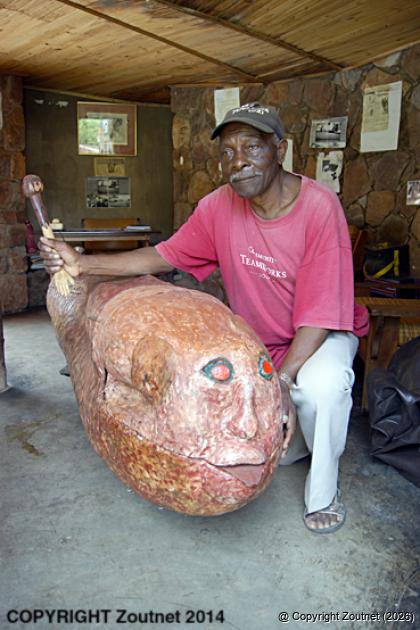
Samson Mudzunga is known internationally for his large-scale fish drums.
Legendary sculptor is still blowing his own khwatha
Entertainment Date: 07 March 2014
It is around 06:00 in the mountainous village. A middle-height, dark-skinned man climbs onto the wall and blows his khwatha, a traditional horn. The soft, melodious sound of his khwatha fills the air around his home.
“The first thing I do when I open my eyes in the morning is to pick up my khwatha, stand in the open and blow it,” he explains. “This is how I thank my ancestors for the gift of life.”
In his small village of Shanzha in Nzhelele, the 76-year-old Ratshilumela Samson Mudzunga is an eccentric old man who spends his days alone at his home. “People do not understand that an artist prefers his own company when engaged in a serious project,” he says.
Many publications state that Mudzunga, who is one of the country’s foremost sculptors, gained international acclaim very late in his life when his sculptures received massive attention in the early 1990s.
“It was great. I mean, all the attention from local and international art curators who wanted to promote my work just after I had lost a job,” he remembers.
He previously worked as a gardener, messenger and driver between 1956 and 1989. “I was finally sacked from my work because the employers couldn’t accept the fact that I had started following my calling as an artist,” he says. “Being sacked from work was a blessing in disguise. After losing my job, I focused solely on my art.”
By 1996, Mudzunga’s work had evolved as he too gained maturity as a sculptor who mainly specialised in large-scale, traditional Venda drums, known as ngoma.
He elucidates the meaning of the traditional drum: “Ngoma means many things in VhaVenda. It symbolises peace, humanity, harmony and a sense of belonging.”
However, his drums are totally unique and different from the others in his culture as he adds minwenda fabric to his drums, and makes his drums in the shapes of large, hollow fish and aeroplanes.
“I also perform the ‘funeral ritual’ and ‘rebirth or resurrection’, using ngoma,” he tells.
His home used to be a hubbub of artists, art fanatics and curious people who visited him and bought some of his creations.
“Some of these people came from Europe, and they all showed respect and interest in my work,” he says. “These people no longer come because there are locals who spread a rumour that I am a witch.”
Mudzunga the artist spends his days at his home, carving and drinking water from a nearby spring. Any interested bodies are welcome to pay him a visit.
Surprisingly, he is not clear on how his work is being traded internationally, because curators hardly provide him with the necessary information. “I hope to fix this confusion soon,” he says.
He has so far been published in countless papers and publications, and is regarded as an interesting, stimulating subject of study by many art students across the globe.
Anitra Nettleton, writing in Art South Africa, said this of the artist: “Mudzunga’s art has not been confined to the making of the objects, which are central to his ‘performances’, but is also evident in his manipulation of ‘traditions’ and political conflicts.”
Written by
Tshifhiwa Mukwevho
Tshifhiwa Given Mukwevho was born in 1984 in Madombidzha village, not far from Louis Trichardt in the Limpopo Province. After submitting articles for roughly a year for Limpopo Mirror's youth supplement, Makoya, he started writing for the main newspaper. He is a prolific writer who published his first book, titled A Traumatic Revenge in 2011. It focusses on life on the street and how to survive amidst poverty. His second book titled The Violent Gestures of Life was published in 2014.

ADVERTISEMENT: