

ADVERTISEMENT:
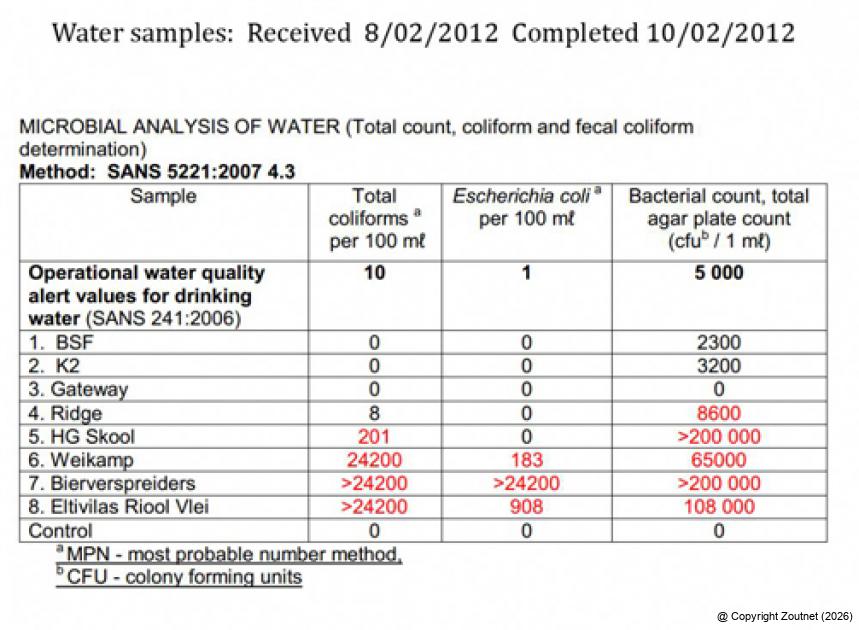
The SRPA used a certified company to do water tests for their association and had the water tested at eight different locations. Of the first five locations, the water samples at two locations were unfit for human use. The last three samples were taken at locations where sewage spillage has occurred for years.
Results show not all water is safe to drink
News Date: 16 April 2012
Following weeks of dirty drinking water, the Soutpansberg Ratepayers Association (SRPA) gave the Makhado and Vhembe Municipality an ultimatum of 10 days to provide them with their weekly water test results.
In the meantime, the ratepayers conducted their own tests.
“It has been weeks now that the residents of Louis Trichardt have been struggling with contaminated water,” the SRPA states in a letter to the municipal manager, dated 19 March.
The SRPA said that they used a certified independent company to do water tests for the association.
“We hereby request the tests done by either you [Vhembe] or the Makhado Municipality, proving different results. Please make sure we get the results within 10 working days. If the results are not given within the 10 working days, we will assume that the results are the same as ours and we will then publish the tests results in our possession,” states the letter from the SRPA. No response was received from the municipalities.
The SRPA had the water tested at eight different locations.
Water was tested at an outside tap in Tshikota, an outside tap in the town’s downtown area, Gateway Lodge, Ridgeway College, Louis Trichardt High School (outside tap), at the dam in the grazing camp near the Sinthumule/Kutama road, at the sewerage pump station near SA Breweries and at the sewerage dam at the Eltivillas sewerage pump station.
The water samples from Tshikota and Louis Trichardt downtown was fit for human use. Bacteria were present, but the level was still below the recommended limit for drinking water. The water at the inside tap at Gateway Lodge was fit for human use. The water at Ridgeway College’s outside tap was not fit for human use. Bacteria were present and the counts were above the recommended limit for drinking water.
The water at the outside tap at Louis Trichardt High School was also not fit for human use. At the last three locations, there have been sewerage spillages for years and the water there was unfit for human consumption. At the grazing camp, the report states a likelihood of contamination from vegetables and other crops eaten raw, and milk from cows grazing on pastures will result in the transmission of human pathogens. The report warns that the E.coli count at the industrial area near the breweries was extremely high, indicating untreated sewerage.
“As the chance for infestation increases with the amount of E.coli present, the risk involved with recreational contact can be seen as high,” reads the report. The same warnings apply to the Eltivillas sewerage dam.
The samples were taken on 8 February. The SRPA recommended that samples be repeated at the two schools and that was done on 22 February.
In the second round, the test results showed that at the outside taps of both schools the water was still not fit for human use. The coliforms, E.coli and bacteria counts were above the recommended limit for drinking water. The report states that bacterial counts should be much lower and should preferably contain no coliforms. “It is unacceptable to have Escherichia coli (E.coli) in drinking water, as it indicates recent faecal contamination and indicates that other human pathogens such as Vibrio cholera (cholera) and Salmonella typhi (typhoid fever), rotar virus and protozoan parasites can be present,” the report states. The samples were tested and the report compiled by QMS Agri Science. The SRPA sent copies of the letter with the ultimatum to the national Minister of Environmental Affairs, Ms Bomo Edna Molewa, the national Minister of Cooperative Governance and Traditional Affairs, Mr M R Baloyi, the MEC for Cooperative Governance and Traditional Affairs, Mr N C Motsepe, and the Public Protector.
Minister Baloyi responded and said that he had refered the matter to MEC Motsepe “to closely monitor the situation and interact with your association towards sustainable solutions to the problem of water in your town.”
Written by
Linda van der Westhuizen
Linda van der Westhuizen has been with Zoutnet since 2001. She has a heart for God, people and their stories. Linda believes that every person is unique and has a special story to tell. It follows logically that human interest stories is her speciality. Linda finds working with people and their leaders in the economic, educational, spiritual and political arena very rewarding. “I have a special interest in what God is doing in our town, province and nation and what He wants us to become,” says Linda.

ADVERTISEMENT: