

ADVERTISEMENT:
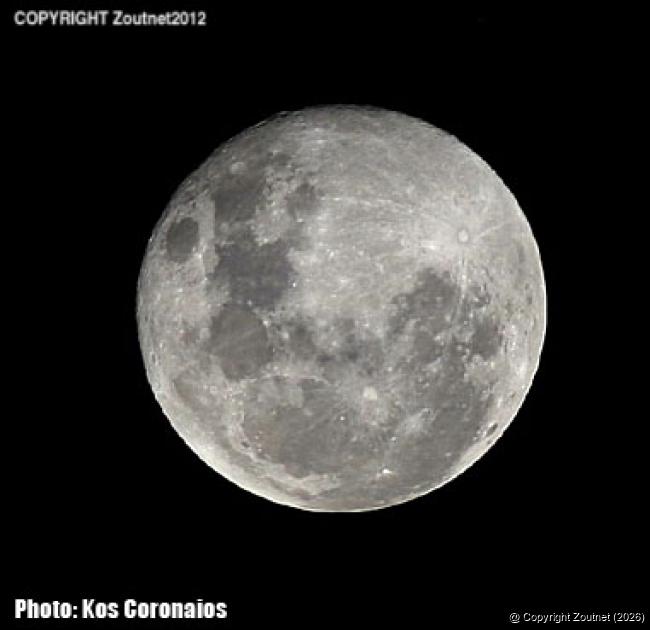
Picture of the moon taken during the partial lunar eclipse in December 2009
Once in a Blue Moon
News Date: 29 August 2012
August 2012 is a month with two full moons and is commonly referred to as a Blue Moon month.
Blue in name only and not in colour, as a blue moon is usually defined as the second full moon in one calendar month. The first full moon of the month was on 1 August and the second will be on 31 August.
Of course there are historical examples of the moon actually turning blue. It appeared blue in the sky when the Indonesian volcano Krakatoa exploded in 1883. The dust turned sunsets green and the moon blue all around the world for the best part of two years. In 1927, the Indian monsoons were late in arriving and the extra-long dry season also blew up enough dust for a blue moon. By the mid-19th century, it was clear that visibly blue moons, though rare, did happen from time to time, hence the phrase: "Once in a blue moon." It meant then exactly what it means today - a fairly infrequent event, not quite regular enough to pinpoint.
The other definition of a blue moon states that the blue moon is the third full moon in a season that has four full moons. Seasons are broken down into four of three months, starting from one winter solstice to the next. This, in turn, is referred to as a tropical year, with each year consisting of 12 full moons, three each in winter, spring, summer, and autumn, and each is named for an activity appropriate to the time of year (such as the harvest moon in autumn). Occasionally, however, a tropical year contains 13 full moons. By identifying the extra, 13th moon as a blue moon, the ecclesiastical calendar was able to stay on track.
Using the definition of two full moons in a calendar month, one sees that, over the next 20 years, there will be 15 blue moons, none occurring in February, which is shorter than a lunar cycle. No blue moon of any kind will occur in the years 2014 and 2017.
The most recent case of this phenomenon last occurred on 31 December 2009. The date also commemorated the end of IYA 2009 (International Year of Astronomy) and the Soutpansberg Astronomy Club and Limpopo Astronomy Outreach set up an astronomy display with telescopes at the Makhado Crossing, Louis Trichardt, to witness the last sunset of the year, as well as the last moonrise, which coincided with a blue moon as well as a partial eclipse.
Written by
News Correspondent
Correspondent journalists from all over the region supply us with news and sport articles.

ADVERTISEMENT: