

ADVERTISEMENT:
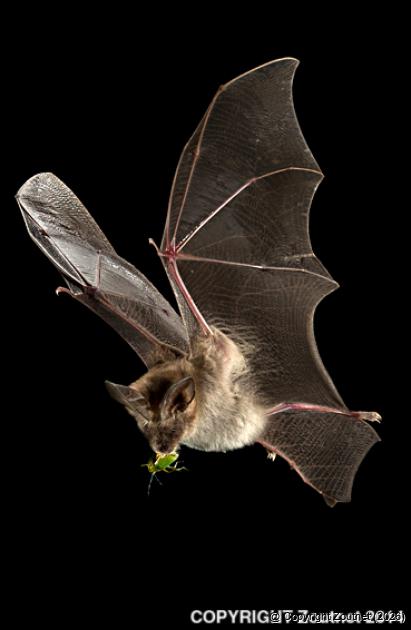
The Common Slit-faced Bat (Nycteris thebaica), eating a green stink bug in flight. It took a lot of patience, nearly 100 stink bugs and about 10 000 photographs to capture this particular photo. The photo is published courtesy of Merlin D. Tuttle.
Real-life Batman stresses importance of little critters
News Date: 01 May 2014
Although Merlin Tuttle does not zip around in a batmobile, he is a real-life Batman as he has dedicated most of his life to the study and advocacy of the conservation of bats.
This world famous bat biologist visited the Soutpansberg and hosted a bat appreciation evening at Ridgeway College last Wednesday. Merlin’s presentation was also one of the first public events that the school have ever hosted in their newly built school hall.
Audience members were blown away by his breathtaking photographs of these little night critters, that people should actually appreciate for the enormous role that they play in the ecological system.
Merlin and his wife, Paula, travel all over the world to study and photograph bats. They have been to places like West-Africa, Thailand and Latin America, just to understand bats better. Most recently, Merlin published his fifth article in the March issue of National Geographic, about tropical flowers found in Central America that use acoustics to attract bats to pollinate them. Before Merlin’s research, it was believed that these flowers were pollinated by humming birds.
For Merlin and Paula, this was their second visit to the Soutpansberg's bats. This time around, they were trying to photograph different species of bats eating stink bugs. They were lodged and assisted by two local researchers and their families from the University of Venda - Peter Taylor and Koos Steyn.
Peter and Koos have identified, based on DNA evidence found in the Common Slit-faced Bat’s droppings, that they are one of the major feeders on stink bugs. For macadamia farmers this is very good news, because stink bugs are a costly pest.
With the help of Koos and Peter, Merlin was able to photograph a slit-faced bat carrying a stink bug in its mouth – mid-flight at that! (See accompanying photo made available for publishing by Merlin).
It took Merlin, Paula and their assistant nearly 100 stink bugs and thousands of photos – in their portable studio – to take this one shot. The bats that were used as models were trapped and then coaxed by Merlin to carry a couple of stink bugs through an infrared beam that triggers cameras set up for the purpose.
Just by looking at some of Merlin’s photos it is not hard to believe that he has a passion for the conservation of bats. Amazingly detailed, these photographs freeze bats in action, showing the world just how beautiful and interesting these creatures can be.
For Merlin, his interest in bats started when he was a teenager, when he discovered a colony of gray myotis in a cave near his Tennessee home. That discovery, with the help and dedication of his parents, led to Merlin furthering his studies and a productive career dedicated to bat conservation.
It is now almost 52 years later, and in this time Merlin has established Bat Conservation International, and has undone centuries of destructive myths surrounding bats by focusing on the economic and ecosystem benefits that bats hold.
According to Merlin, bats are not the carriers of rabies but are actually beneficial creatures to have on your farm or in your garden. Apart from pollinating flowers, bats also act as pest controllers. In South Africa, bats are one of the key pollinators of the Baobab flower – an industry that generates millions in the Vhembe district alone. Recent studies also suggest that bats can feed on mosquitoes.
“Bats are far more important than what they are believed to be scary,” said Merlin. “There are still all kinds of discoveries to be made in the fascinating world of bats.Bats are not only fun creatures, but also profitable.”
Written by
Isabel Venter
Isabel joined the Zoutpansberger and Limpopo Mirror in 2009 as a reporter. She holds a BA Degree in Communication Sciences from the University of South Africa. Her beat is mainly crime and court reporting.

ADVERTISEMENT: