
“The deadline for removal of election posters is the day after the elections,” the Makhado Municipality said in a media answer this week.
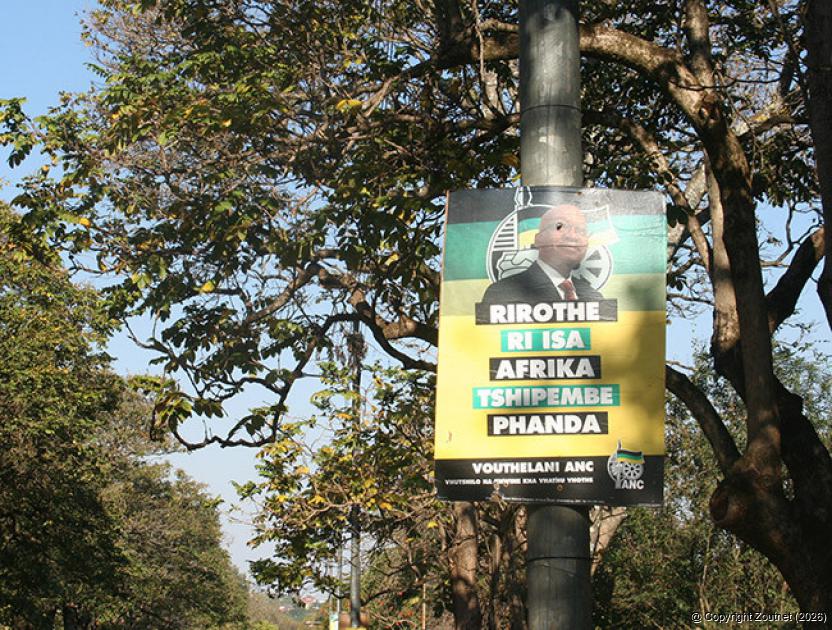
The municipality was spurred into action to remove ANC election posters more than four months after the national and provincial elections on 7 May this year.
The Zoutpansberger received numerous complaints about several ANC election posters in especially Anderson and Stubbs Street. They were still gracing the trees or poles for the greater part of September. Media enquiries about the political posters were directed per e-mail to the Makhado Municipality on 20 September and again on 29 September. On 6 October, no answer had been received and an ultimatum had to be given before an answer was received on 7 October.
“All the political parties are equally guilty of failing to remove their election posters. We have also removed posters for other political parties and we have proof of that,” said Mr Louis Bobodi, spokesperson for the Makhado Municipality.
This week, no election posters were to be seen in Anderson and Stubbs Street. Two COPE election posters were seen in Joubert Street. “We removed the majority of our election posters a week after the elections. It is possible that we could have skipped a few here and there,” said Democratic Alliance Councillor Brian du Plooy.
The Electoral Commission of South Africa’s senior communications manager, Mr Marco Granelli, said this week that the erection and removal of posters is a municipal issue which is handled by local councils. “Most (if not all) have regulations in terms of which election posters must be removed by political parties within a specific time period after an election. The penalties for not complying with these regulations usually involve a fine,” Granelli said.
The fine in Cape Town for failing to remove election posters is R88.40 per poster or R126.90 per pasted poster, Sapa reported. In the city of Johannesburg, the fine for “illegal” posters is R1000 per poster. Johannesburg gave a seven-day grace period to remove election posters and Cape Town’s political parties had till 21 May to remove their posters. The eThekwnini council in Durban gave parties three months to remove their posters and fined them with R50 per poster afterwards.
“There is no by-law regulating the period of removal, since all the parties are expected to remove their posters or forfeit their application fees deposited,” Bobodi said.
Besides election posters, other posters can be seen on poles for prolonged periods of time. “There is not enough control and management on the side of the municipality to prevent posters staying up for protracted periods or to remove them on a regular basis. The question is whether some of these posters have even been put up legally?” Du Plooy said.
The specific media question on the removal regulations, the cost and the period allowed for ordinary (non-election) posters was not answered by Mr Bobodi.
