

ADVERTISEMENT:
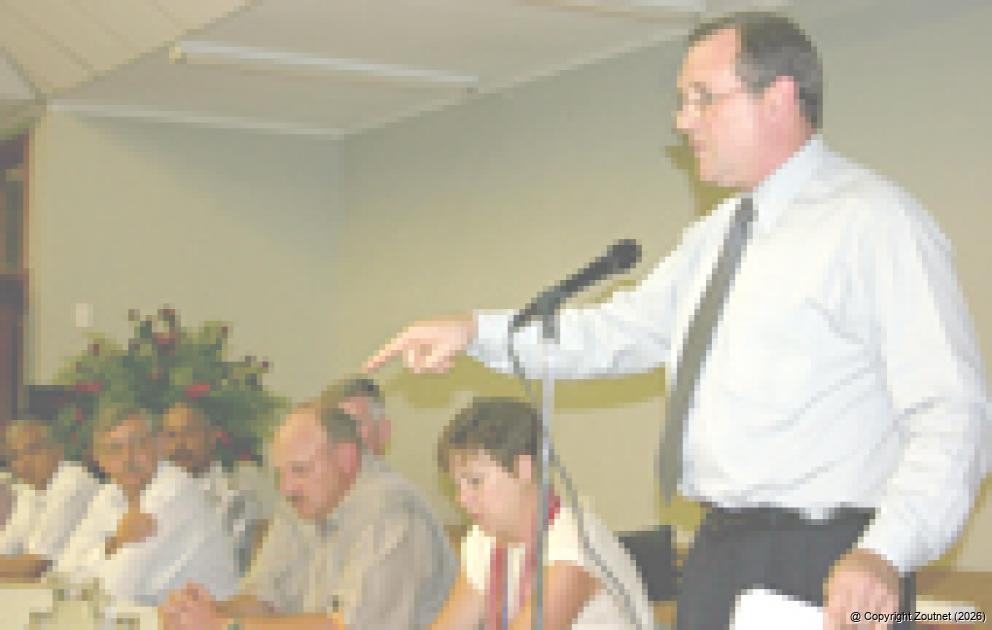
Mr André Naudé (far right), chairperson of the Chairpersons Association described the adverse effects of a one-eyed approach in respect of land restitution. To the left are some of the vice chairpersons of the CA. A decision was taken by the CA to insist on an implementation plan with time frames and code of conduct in regard to the restitution process.
CA insists on Code of Conduct
News Date: 15 April 2005
MAKHADO (LOUIS TIRCHARDT) - The land restitution process came under serious scrutiny, followed by a unanimous decision of the Chairpersons Association (CA) to insist on a proper implementation plan by the Land Claims Commissioner.
The motivation which led to a decision by the CA to insist on an implementation plan and code of conduct with regard to the restitution process with time frames was brought in a meeting of the CA on April 7.
“A one-eyed approach in respect of restitution, disregarding socio-economic consequences and skill drainage, is not acceptable and is currently a total mess where land owners, land claimants and all stakeholders in town are going to be adversely affected,” the chairperson of the CA, Mr André Naudé said.
The restitution ‘mess’ will lead to 110 000 job opportunities being lost, leaving 660 000 people in this province without income. This will happen because farm employees are not taken over in terms of Section 197 of the Labour Relations Act.
“If we lose Levubu, R500 million will be gone,” Mr Naudé said.
He sketched the grave consequences. Poverty in the area will be widespread. Farmers will relocate to other provinces, moving with their skills, money and infrastructure. This will result in a barren country and poverty. There will be a skill and brain drain and money is going to leave the area. Current businesses which have thrived for 65 years and longer will be destroyed. Churches may collapse. Farms are not bought as a going concern. Infrastructure will be sold, like game and cattle, which will be bought by farmers and members of other provinces. New infrastructure will have to be obtained, but banks might not be able to finance it, because land claimants cannot register bonds for 10 years.
Mr Jock Veldhuizen, area manager of Standard Bank, said that he would hate to see the closing down of branches in the area, especially after a period of enormous growth. Mr Veldhuizen said the effect of the loss of 10 000 jobs as a result of the closing of Sapekoe is clearly felt.
“What would happen if we lose Levubu?” he reiterated.
“Farming operations and tourism are the backbone of a rural area. If they collapse, the whole economy is going to collapse,” Mr Naudé said.
Ms Willie Botha from Soutpansberg Tourism said that farmers are also in the tourism business and that general agricultural activities are a tourist attraction in themselves. Ms Botha said that development and research showed that tourism comes to a halt as a result of land claims.
Land claimants suffer the same problems with this one-eyed approach of the Land Claims Commission.
“It is attempted by third forces to hijack their claims and the benefits in respect of their claims by some of the politically motivated commissioners. That is why the Moddervlei community also joined the ranks of the CA,” said Mr Naudé. He said that the CA cannot get involved in the merits of any claims or in politics. The CA can ensure that good and transparent governance practices are followed in order to create wealth and trust which are fair and unbiased to all stakeholders.
Mr Naudé said that a one-sided approach which does not integrate other departments does not constitute good governance.
“It should be addressed with a decision to try and instill good governance and bring the implementation team to its senses. Can’t they see the bigger picture? They are destroying the hopes and dreams of a whole community and their children with their ad hoc crisis management and unorganized style, while there is no proper integrated implementation plan linked to time schedules in place. There are no budgets in respect of the restitution process,” Naudé said. He said that, if well governed, the Limpopo Province can become the richest province in the country with many opportunities for all.
Vhembe Mayor, Mr Sam Moeti, who also attended the meeting, requested to receive the minutes and materials on the issues mentioned in order to study them and respond at a later stage. Mr Moeti expressed his appreciation for the CA as a “think tank” and expressed his desire to make use of the CA for guidance, proposals and suggestions.
Mr Moeti said that good governance, transparency and anti-corruption are principles that government respects.
“The government’s principle of Batho Pele or People First is sometimes not followed by officials,” he said.
Moeti said that the government is bound by legislation to respect communities and listen to them and explained that the IDP (Integrated Development Plan) invited expertise and emphasized the importance of interaction.
Written by
Linda van der Westhuizen
Linda van der Westhuizen has been with Zoutnet since 2001. She has a heart for God, people and their stories. Linda believes that every person is unique and has a special story to tell. It follows logically that human interest stories is her speciality. Linda finds working with people and their leaders in the economic, educational, spiritual and political arena very rewarding. “I have a special interest in what God is doing in our town, province and nation and what He wants us to become,” says Linda.

ADVERTISEMENT: