

ADVERTISEMENT:
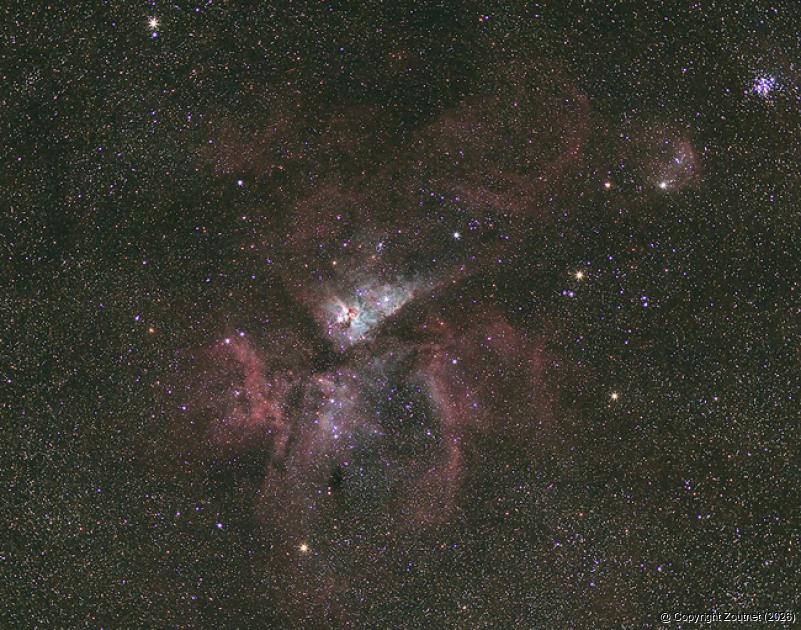
One of the images captured by local astronomer Mr Kos Coronaios and live-streamed to the White House in America as part of the White House’s annual Astronomy Night on 19 October. Seen here is the Great Carina Nebula. Photo supplied.
Local views make way to White House
News Date: 30 October 2015
On Monday, 19 October, early in the evening in Washington DC, the annual White House Astronomy Night began on the South Lawn of the White House.
President Barack Obama addressed the media and stargazers and part of the President's opening address at 19:30 included his saying: “We need to inspire young people to ask about the stars.”
Slooh, the online community observatory, was live-streaming the event to thousands worldwide and included live telescope views of deep-sky stellar objects as seen from different locations around the world.
Early Tuesday morning (20 October at 00:30), local amateur astronomer Mr Kos Coronaios of Louis Trichardt was setting up equipment for just that - live-streaming views of southern hemisphere deep-sky objects via the telescope to Slooh. Some of these southern hemisphere delights were the Tarantula Nebula (NGC 2070), a famous stellar birthplace on the outskirts of the irregular galaxy, the Large Magellanic Cloud, the globular cluster 47 Tucanae and Eta Carinae.
One of the images captured by Coronaios was the Great Carina Nebula. Seen as the jewel of the southern sky, the Great Carina Nebula is also known as NGC 3372, and spans over 300 light-years. As one of our galaxy's largest star-forming regions, the Carina Nebula is easily visible to the unaided eye at a distance of 7 500 light-years.
This image reveals remarkable details of the region's glowing filaments of interstellar gas and obscuring dust clouds. Wider than the full moon in angular size, the field of view stretches over 300 light-years across the nebula. The Carina Nebula is home to young, extremely massive stars, including the still-enigmatic variable Eta Carinae, a star with well over 100 times the mass of the sun. Eta Carinae is the brightest star near the image centre just left of the dusty Keyhole Nebula (NGC 3324). While Eta Carinae itself maybe on the verge of a supernova explosion, X-ray images indicate that the Great Carina Nebula has been a veritable supernova factory.
Written by
Andries van Zyl
Andries joined the Zoutpansberger and Limpopo Mirror in April 1993 as a darkroom assistant. Within a couple of months he moved over to the production side of the newspaper and eventually doubled as a reporter. In 1995 he left the newspaper group and travelled overseas for a couple of months. In 1996, Andries rejoined the Zoutpansberger as a reporter. In August 2002, he was appointed as News Editor of the Zoutpansberger, a position he holds until today.

ADVERTISEMENT: