

ADVERTISEMENT:
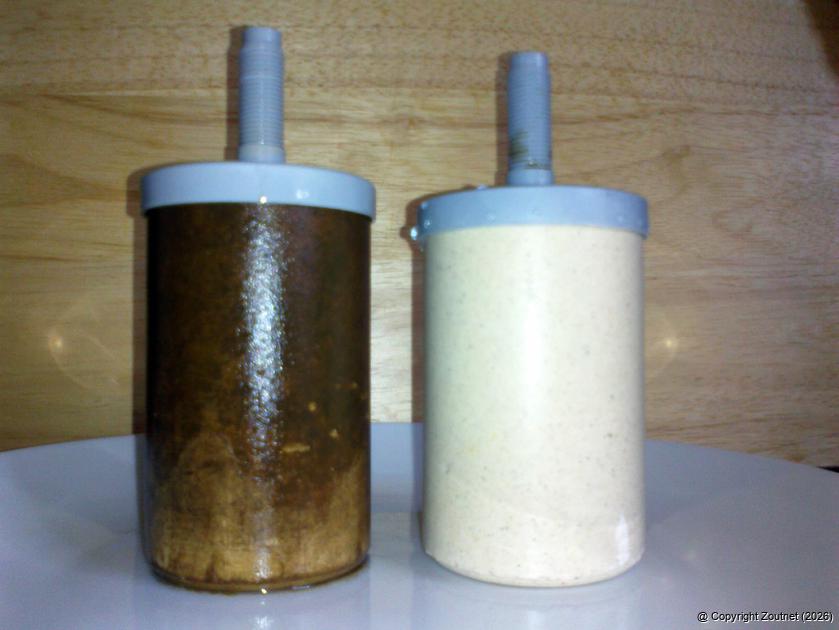
A water filter before and after it had to process municipal water. Photo: Angela Versari.
We failed-VDM
News Date: 07 March 2016
Following more than a week’s silence, the Vhembe District Municipality (VDM) admitted that they had failed residents, not only in the Louis Trichardt area, but the whole district.
The VDM was referring to the current burning issue on every single resident’s lips - water service delivery (or lack thereof). The newspaper requested answers from the VDM, following a complaint that the Democratic Alliance (DA) had filed with the South African Human Rights Commission (SAHRC) on 22 February.
Local DA councillor Mr Brian du Plooy said they had proof that the VDM had been supplying untreated water to residents since the beginning of February.
Apart from acknowledging certain key challenges that the VDM is currently facing, VDM municipal spokesperson Mr Matodzi Ralushai remained elusive about the claims made by the DA.
The DA’s SAHRC complaint followed an announcement by Du Plooy on 16 February that the water supplied from the Albasini Dam was not safe to drink. According to Du Plooy, they determined that the water had not been chemically treated for at least two weeks. He was forced to issue a public warning to residents, urging them to disinfect their water before use.
After eight emails and more messages, the newspaper was able to get a hold of Ralushai telephonically on Tuesday. He promised to answer to the DA’s allegations in a written email; however, this email is still forthcoming.
During the telephone conversation, Ralushai said that the VDM was well aware of the fact that they had let residents down. He quickly added that it was not due to a lack of trying.
Budgetary constraints seem to be the prevalent challenge that the VDM is currently facing. According to Ralushai, the municipality only receives so much revenue, which is not always enough to get around to all their service-delivery responsibilities.
“You must remember, the VDM supplies not only Louis Trichardt and Tshikota, but a vast area that includes many rural communities,” said Ralushai. “These rural communities do not always have the means to pay for services, and that places a further strain on the VDM,” added Ralushai.
During the conversation, Ralushai added that he had just returned from an operational municipal meeting where the water situation was discussed on an urgent basis. “The VDM has identified some crucial points that we plan to address immediately, so that we can do our duty and supply water to the district,” said Ralushai.
Some of the key obstacles that prevent the VDM from supplying water, explained Ralushai, was not only a lack of funds, but also vandalisation of water infrastructure, cable theft and a dilapidated water service network. “Nature is also not on our side,” Ralushai added. He explained that in several rural communities, the current drought is so bad that boreholes have started to dry up.
Ralushai stated that the VDM might approach the provincial government to assist with grant money on an urgent basis. “At this stage, we are just trying to fix all the leaks, but serious upgrades are a necessity now more than ever,” he said.
This seems to be just one of many strategies the VDM has proposed. According to Ralushai, an operational team is hard at work to first ensure that there will always be water in residents' taps. When these plans are fully implemented, the VDM will move to upgrade not only the Albasini Dam’s supply network, but several other water supply networks as well.
Ralushai said the VDM had also decided to keep the public informed about the workings of the operational team by means of several newspaper and media companies. The first project, he said, was expected to commence in the coming week or two.
In the meantime, both reservoirs in Louis Trichardt (Mowkop and Bergh Street) are supplying water to residents, albeit it dirty and smelly water.
According to Du Plooy, the water will be dirty for a little while longer until such time as the sediment has been flushed from the system. He explained that there was a sediment and sludge build-up in the pipe network because the reservoirs had run completely dry earlier in February. He further recommended that residents with water tanks should clean their tanks of the built-up sediment on the inside.
Written by
Isabel Venter
Isabel joined the Zoutpansberger and Limpopo Mirror in 2009 as a reporter. She holds a BA Degree in Communication Sciences from the University of South Africa. Her beat is mainly crime and court reporting.

ADVERTISEMENT: