

ADVERTISEMENT:
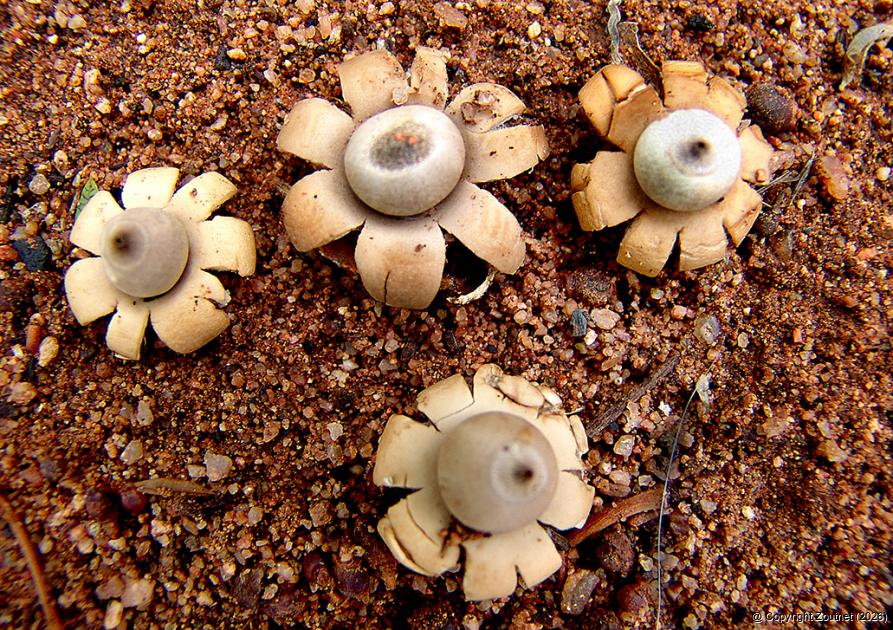
The Eartstar from the Geastrum species. Photo: Retha van der Walt.
Research highlights local fungi and lichen
News Date: 08 April 2016
The Soutpansberg is renowned for its diverse plant life and one might have thought that there is not much left to research, but the efforts of two local researchers are set to put the region on the map once again with regard to a species that has gone almost unnoticed for years.
Tuba and Retha van der Walt are spearheading the Fungi & Lichen Project, a survey and private research initiative to address the gap in knowledge regarding the biodiversity of these species in the Limpopo Valley. “Due to the harsh, dry climate and sporadic rainfall of the area north of the Soutpansberg, these species are still largely unexplored and research on the topic has never been undertaken before,” says Retha.
The ultimate aim of the project is the publication of a second area-specific field guide, following the publication of Retha’s Wild Flowers of the Limpopo valley in 2009. “Since the start of the project five years ago, the species list has grown exponentially. More than 800 specimens have been collected and this could increase even more before the initiative draws to a close,” says Retha.
The survey findings far exceeded Tube and Retha’s expectations and to date approximately 180 different fungi, lichen and slime mould species have been recorded in the study area, which includes the Mapungubwe National Park and World Heritage Site.
During the survey, fully annotated specimens are collected and spore prints are prepared. “These are essential as they assist researchers in the examination and accurate identification of species. As the planned publication would primarily be a visual guide, full colour photographs of good quality of all species in the veld, as well as detailed images highlighting distinguishing characteristics, will be included. The inclusion of microscopic spore images will further aid to proper identification,” says Retha.
The project is registered with SANParks as an official research project and all specimens are deposited in the National Collection of Fungi at the Agricultural Research Council in Pretoria. “Despite their importance, fungi are usually overlooked by scientists in biodiversity and taxonomy initiatives and activities, and apart from those groups that are commonly used as food, by the general public,” says Retha.
Retha explains that very few habitats and ecological niches in South Africa have been explored in terms of fungi. This, she says, is probably the result of the indigenous fungal diversity not being considered as a research priority and virtually all resources in South Africa having been directed towards economically important micro-fungi species over the past 50 years. “In South Africa there is only a handful of mycologists identifying and naming species. Furthermore, most surveys done on macro-fungi in South Africa are restricted to high-rainfall areas and the few publications available are based thereupon,” says Retha.
The identification of specimens collected during the survey is extremely challenging. Although specimens can be secured in the National Collection of Fungi at the ARC, a mycologist to assist with the identification thereof is not available. The lichen section at SANBI is also currently not functional. Therefore, the project relies heavily on international experts, as well as DNA analysis for proper identification to species level. “The importance of this survey is not only to provide baseline information, such as primary species occurrence and abundance in the Limpopo Valley area, but also to make these findings accessible to all. The survey will definitely yield new distribution records for known species and the possibility of recording species which have not been described is not excluded,” says Retha. She says it is hoped that this initiative would be the first step towards a better understanding, awareness and the conservation of these species, quoting Linnaeus: “If the names of things are neglected then the knowledge of them will also perish.”
Residents can now also get involved in the project. “Your support will enable the project to mushroom,” says Retha. People wishing to get involved can do so in three ways.
Option A would be to sponsor a species at R1 000 per species. “Your donation will cover the costs regarding the fieldwork, scientific identification, including DNA sequencing, preparation of a microscopic spore image and the photo editing for a specific species,” says Retha. To this end, a person can sponsor any species of their choice exclusively. In recognition, their name will appear as donor on the specific page in the final publication. They will also qualify for at least 25% discount when you purchase a copy of the field guide directly from the author, and stand a chance to win a framed original watercolour painting (with fungi as theme) by botanical artist Annatjie Greyling (draw date is 30 April 2016).
Option B would be for a person to sponsor a DNA sequencing at R480. This donation will cover the cost regarding a DNA sequencing to determine or confirm the identification of a single fungi specimen. Donors’ names will also be listed in the final publication while they will quality for a 15% discount in purchasing the field guide. Two watercolour prints from Greyling can also be won.
Option C entails a person's sponsoring a microscopic spore image at R100. This will cover the cost to prepare a microscopic spore image as further identification aid, while the sponsor will also get recognition in the final publication.
For more information about the project, or to get an updated list of what species are still available with regard to option A, phone Retha at Tel 079 209 6233 or send her an email at [email protected]
Written by
Andries van Zyl
Andries joined the Zoutpansberger and Limpopo Mirror in April 1993 as a darkroom assistant. Within a couple of months he moved over to the production side of the newspaper and eventually doubled as a reporter. In 1995 he left the newspaper group and travelled overseas for a couple of months. In 1996, Andries rejoined the Zoutpansberger as a reporter. In August 2002, he was appointed as News Editor of the Zoutpansberger, a position he holds until today.

ADVERTISEMENT: