

ADVERTISEMENT:
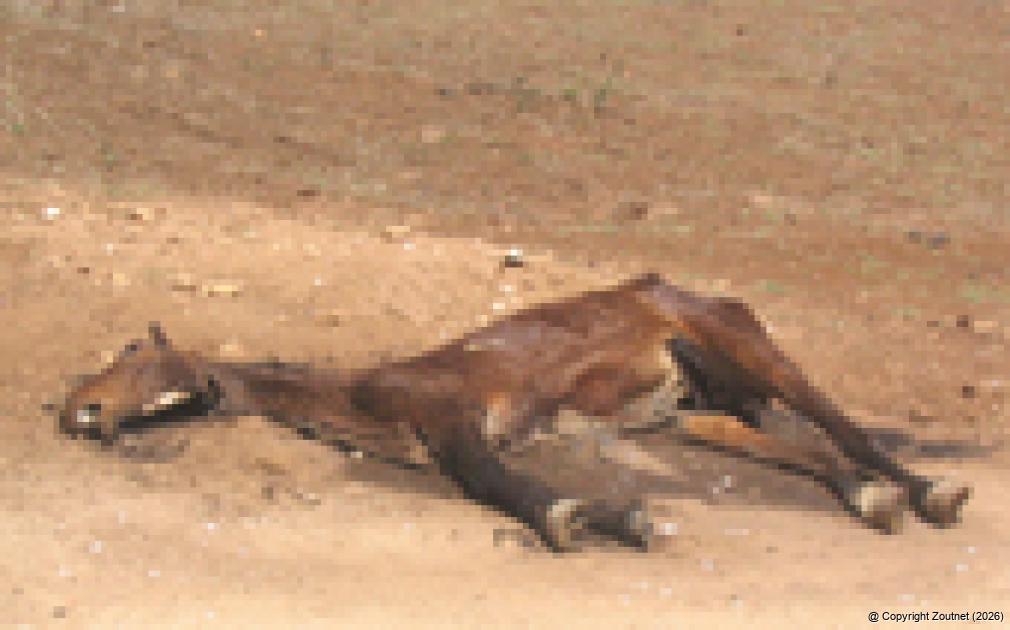
Animals are suffering and dying because of the lack of water around Mbhalati ka Hasani. This dead horse was photographed next to Hasani.
A struggle for survival as drought worsens
News Date: 14 October 2005
MAKHADO – As higher than normal temperatures are experienced and the rainfall in Vhembe and the entire province has dropped far below the normal rainfall, cattle are dying in Vuwani, Malamulele and in certain areas of the Giyani district, as a result of the lack of water and the poor grazing conditions.
During a visit to certain parts of Malamulele and Vuwani on Sunday, Mirror discovered that most streams and dams have dried up completely. The lack of water in the Luvuvhu river near the Hasani-Dakari and Mbhalati areas has a huge effect on the living conditions in the area. Residents of Dakari told Mirror that they get water once or twice a week in their taps. “We are now devastated, because the Luvuvhu river is also drying up and it is no longer flowing; we used to do our washing in this river and if it does not rain, we don't know what will happen,” said one resident.
Mirror learnt that the Luvuvhu river had once dried up in 1984. Because most areas are not irrigated within the Vhembe district, lack of rain has already caused crops of household farmers to wither and die. As the high temperatures are increasing the stress on plants and grass, most subsistence farmers in the villages have resorted to buying feed for their stocks. Even though it rained last week on Thursday in certain areas within the district, many individuals said the province should be declared a drought-stricken area.
In the bushes, one is often greeted by the stinking smell of dead animals. As certain families in the villages are judged by the number of cattle they own, the mortality of their stocks is leading them be counted amongst the poorest as a result of the drought.
The provincial spokesperson for Agriculture, Mr Kahathu Sadiki, said that the status of the drought is very unsatisfactory since the entire province received a below-normal rainfall of less than 30%.
“In all municipalities, the status of livestock is vey poor,” he said. “The avaibility of water is a serious problem, rivers are drying up, dams level are very low and grazing conditions are also extremely poor,” he said. Asked if his department has already initiated a drought-relief plan, Sadiki said “it has been designed long before, but as of now, the avaibility of funds is drying up.” He said that the funds made available for livestock by his department was R30 million, adding that, so far, they have utilised about R25 million on livestock feeds. Sadiki said that people must embark on water harvesting strategies during this drought period.
On behalf of the regional Department of Water Affairs and Forestry in Limpopo Province, Ms Leah Matlala confirmed that the status of dams in the Vhembe district, compared to last year at this time, was very low. She said that even boreholes were gradually drying up across the province. “We are appealing to people to start saving water,” she said. Matlala said that the level of the Nzhelele dam is 40% compared to 92,22% this time last year, the Munzhedzi is 36% compared to 99,80% of last year, Lupepe 46% compared to 99,90% of the previous season and Nwanedi 36% compared to 99,33% last year. She said that Ebenezer Dam’s level is presently at 18,8%, Tzaneen at 7,88%, while the Glen Alphine is at 4,8%.
The Limpopo Tourism and Parks Board (LTPB), which is custodian to 54 natural parks in the region, has raised concerns that the drought is affecting their natural reserves.
Limpopo is one of the hardest hit provinces in the prolonged drought that has plagued South Africa since early 2003. “The main cause for concern about the drought in tourism terms is how it will affect our natural reserves, where we have a number of game that rely on the land to sustain their existence. The park’s management has a sizeable budget for feeding the animals that reside in the nature reserves, therefore we are able to keep the animals well stocked with water and food,” says General Manager for Parks, Fixon Hlongwane.
On January 8, 2004, drought-stricken municipalities in Limpopo received R32,9 million from the national government. The money was given to communities to ensure that they have adequate access to water.
The money was transferred to district municipalities responsible for providing clean and safe water to one million people affected by drought conditions. This means that lodges and other accommodation facilities in Limpopo will not be adversely affected as local government is providing aid to ensure the smooth running of facilities that could have suffered because of the drought.
The Capricorn region received R5.3 million and has 159 000 people affected.
The Bohlabela district received R5.6 million and has 167 000 people affected, while Waterberg received R5 million and has 66 000 people affected.
In the Sekhukhune region, 112 000 people are affected, but government has supplied R5 million towards alleviating the situation.
In Mopani, R4.8 million has been provided for 197 000 affected people. In Vhembe, 256 000 people are affected and R8.4 million has been provided.
“We are taking all the necessary precautionary measures to ensure that the industry does not suffer because of the drought we are currently facing in the province.
“Our local government is working closely with Water Affairs to keep track of the situation and to ensure our readiness to deal with it as the tourism industry,” commented Mr Hlogwane.
The Department of Agriculture has announced that, in collaboration with the Provincial Disaster Management Committee, the province has allocated funds to assist private farmers.
According to the South African Weather Service, Limpopo will experience below-normal rainfall until the end of March 2006.
This means that there is a relative chance of rainfall but it is fairly low. Temperatures will stay between 30 and 35 degrees Celsius.
Written by
Nthambeleni Gabara

ADVERTISEMENT: