

ADVERTISEMENT:
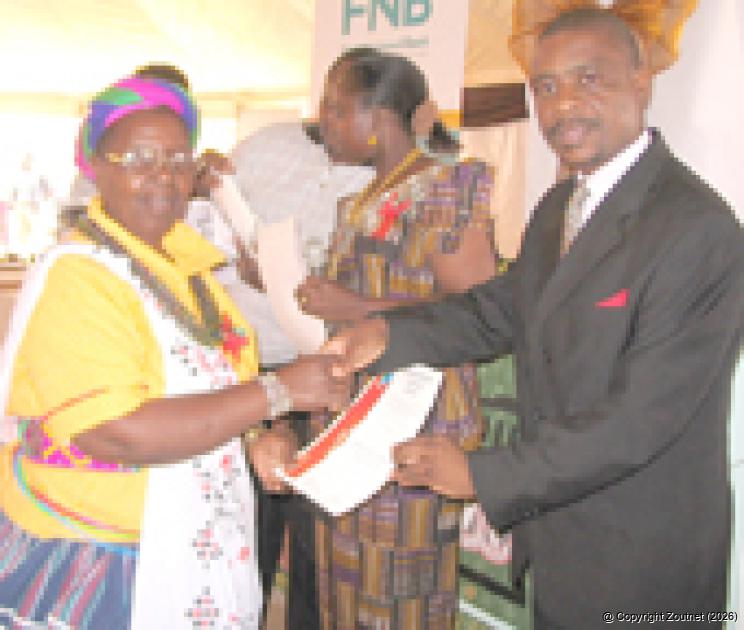
Cllr Rhulani Nkuzana hands over a certificates of long service to Mrs Valentia Maswanganyi, who has been working for 28 years at the Rivoni Society for the Blind. Photo by Kaizer Nengovhela
Rivoni Sciety celebrates 30 years
News Date: 28 October 2005
On October 21, 1975, Rivoni Society for the Blind was established by a Swiss woman, Dr Erika Sutter, and last Friday, the society celebrated its 30th anniversary.
Part of the celebration was an Eye Care Awareness Campaign, since it is estimated that more than 20 000 people are blind due to cataracts, while more than 40 000 are visually impaired. The society was initiated to prevent the spread of trachoma, a contagious eye disease that results in eventual blindness.
Rivoni Society for the Blind is a rural non-governmental organisation that is managed by rural people and has already developed from a community-based organisation into a training facility dedicated and commited to improving the lives of visually disabled people. Since its establishement by Dr Sutter, Rivoni has provided training to more 1 800 visually impaired people, according to Mr Dingaan Shishavele, chairperson For the Society's Council.
Shishavele said that, at the centre, they were not raising funds to pay personnel, but to initiate projects to empower their visually impaired people. He urged community members who are still hiding people with disabilities to take them to Rivoni.
As part of the Eye Care Awareness Campaign, a chief professional nurse at Elim, Tsakani Baloyi, told the meeting to visit their nearest clinics and hospitals when they experience eye problems, as failure to get early treatement will result in blindness.
On behalf of the donors, First National Bank’s Provincial Manager, Mr Peter Mafuna, said that the society has been able to increase its capacity to assist 150 people annually through the financial contributions made by his bank. “Not only do we feel privileged to have been part of the Rivoni Society’s growth over the years, but we feel privileged to have been part of the development of all those visually impaired and disabled individuals who have passed through the society’s doors,” says Mafuna.
According to Mafuna, FNB aims to identify community champions, like the Rivoni Society for the Blind, who are capable of working development magic and then give them the funds and support they need to carry out their work in the community. “By widely distributing money, we are able to meet many social needs and help a large number of South Africans across the country, which collectively contributes to our nation’s growth,” says Mafunu.
Last year, FNB contributed over R15.5 million towards more than 290 community upliftment projects, mainly in the fields of education, skills training and job creation, community care, public policy, safe communities and social re-integration. The bulk of support during the past financial year was targeted at programmes supporting communities in Gauteng, the Western Cape, KwaZulu-Natal, the Eastern Cape and Limpopo Province
The mayor of the Makhado Municipality, Cllr RS Nkuzana said that Rivoni's 30 years of service excellence has proved that, given the necessary skills and opportunities, blind and partially sighted people can make a valuable contribution to the well-being of their communities. He said that many of the people who were once admitted at the centre have gained freedom of movement and access to education. Some have been able to enter into mainstream educational lives, while others are gainfully employed in both the private and public sector. “Dependence on handouts and total reliance on welfare for assistance with huge financial implications have been reduced,” said Nkuzana.
Written by
Nthambeleni Gabara

ADVERTISEMENT: