

ADVERTISEMENT:
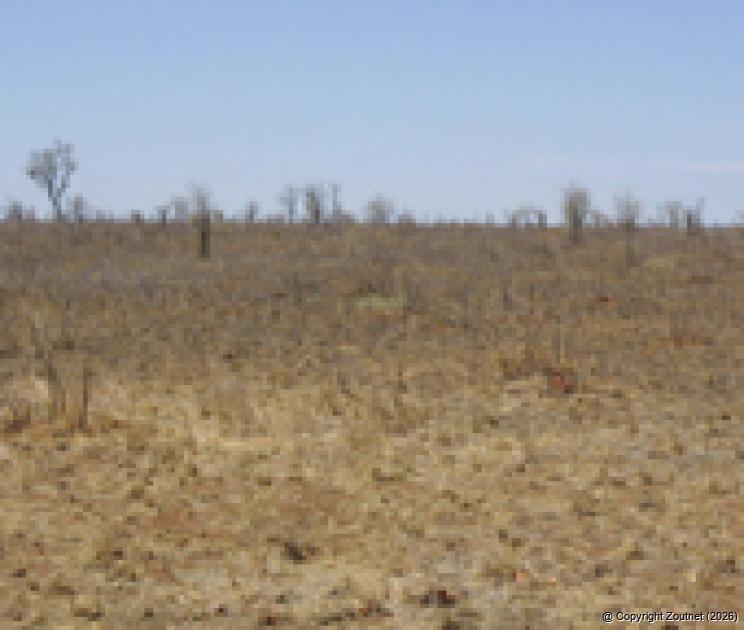
Welcome rains in parts of the KNP are sure to transform this almost desert-like stretch of parkland between Punda Maria and Shingwedzi into a “summer” wonderland. The picture was taken two weeks ago.
Kruger is dry, but not that dry
News Date: 11 November 2005
The recent heavy rains over large parts of the far northern regions of the Limpopo Province also extended into the Kruger National Park (KNP).
Over the last couple of months, visitors to the park grew more and more concerned about the seemingly devastating effect the current drought situation has had on the park. Between Punda Maria and Shingwedzi, very little grazing is visible and at Shingwedzi notices were put up that this popular rest camp might have to close if the water situation did not improve.
The Zoutpansberger this week contacted park officials to find out more about the impact the drought has had on the park. We learnt, however, that the picture is not that bleak.
“Although the situation has been called a ‘drought’ (particularly by the media), we don’t necessarily see it as such,” said Mr Raymond Travers, media relations officer for the KNP. He said that a drought would suggest that an area has had considerably less rain than it would normally have during the rain season.
“Although there are numerous definitions of ‘drought’ it is generally defined as a total annual rainfall amount of 75% or less than the long-term average annual total. Our rain season normally stretches from around October to around April and although the first ‘good’ rains might have been a bit late, we still cannot refer to this season as a ‘drought’ as we don’t know what the future might hold,” said Travers.
Travers said that the other way South African National Parks (SANParks) looks at the situation is that there are normal fluxes in rainfall cycles and these are part of the natural cycle of a savannah ecosystem. SANParks research has shown that some species do well in wetter periods while others prefer drier periods and perhaps these drier periods are just as important for biodiversity as the wetter periods.
“As other researchers will tell you, the driest period to affect the KNP was the 1991/92 drought and, particularly if we continue to experience rainfall as we did this weekend, we will probably be well above the norm,” said Travers. Rainfall figures for the park for the three days prior to November 7 are Skukuza (84.3mm), Shingwedzi (5.8mm), Phalaborwa (17.4mm), Satara (38mm), Punda Maria (6.2mm), Vlakteplaas (2.6mm), Shangoni (56mm), Woodlands (21mm), Mooiplaas (10.3mm), Mahlangeni (34mm), Letaba (18mm), Olifants (14mm), Houtboschrand (35.6mm), Kingfisherspruit (40.5mm), Nwanetsi (20.9mm), Lower Sabie (52.6mm), Crocodile Bridge (37.6mm), Stolsnek (87.3mm) and Pretoriuskop (80mm). No rain fell at Pafuri during this period.
This said, Travers added, however, that there is a water shortage situation in the northern areas of the park which (in particular) affects their camps and other tourist facilities.
“This stems mostly from the fact that the major rivers (which have catchment areas outside the KNP) are not flowing as strongly as they should be. Although the Shingwedzi River is a problem, by far the most critical is the Olifants River and we have had to put stringent water restrictions into place at the camps affected by this river,” Travers concluded.
Written by
Andries van Zyl
Andries joined the Zoutpansberger and Limpopo Mirror in April 1993 as a darkroom assistant. Within a couple of months he moved over to the production side of the newspaper and eventually doubled as a reporter. In 1995 he left the newspaper group and travelled overseas for a couple of months. In 1996, Andries rejoined the Zoutpansberger as a reporter. In August 2002, he was appointed as News Editor of the Zoutpansberger, a position he holds until today.

ADVERTISEMENT: