

ADVERTISEMENT:
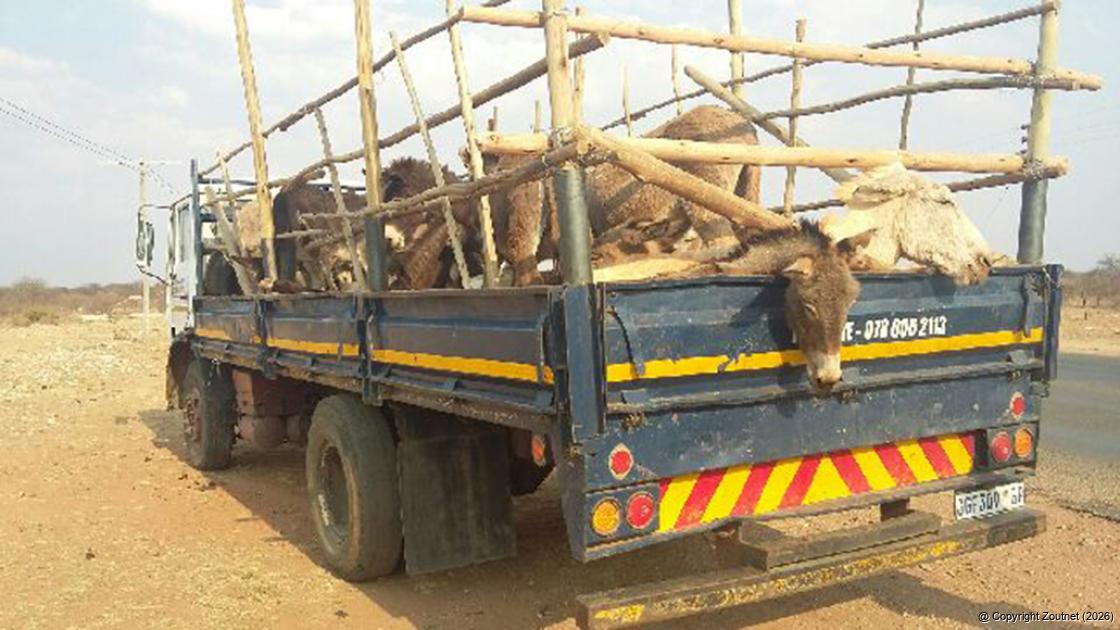
The load of donkeys that had to be put down by the Polokwane SPCA. Photo supplied.
Family outraged after being labelled as thieves
News Date: 07 November 2016
Forget the Chinese; apparently local and cross-border donkeys get stolen to be fed to lions.
TZN pointed an accusing finger to the well-known lion farm, Popallin Safari Ranch, 40 km from Tshipise, bordering the Limpopo River. No other lion farms were mentioned in the report. These claims by the newspaper, however, fell apart under the slightest of scrutiny.
According to the Bezuidenhout family, who are the owners of the ranch, they view the slanderous claims of the newspaper in a very serious light. They have approached an attorney to seek legal advice. “We are furious about the lies written in TZN,” said Mrs Monica Bezuidenhout on behalf of the family.
The Zoutpansberger/Limpopo Mirror approached her for comment when TZN’s articles started popping up on social media and receiving plenty of rather harsh comments.
Owner Mr Peet Bezuidenhout was accused by one of his employees of working in cahoots with organised syndicates. The worker is cited as one Mr Patrick Ndou. He claimed that Peet would buy stolen Zimbabwean donkeys to feed the lions that form part of the ranch’s white lion research project.
TZN quoted Ndou as saying: “It is not a secret that Popallin Ranch Peet is a market for stolen donkeys. In fact Peet [Bezuidenhout] uses his workers, who are Zimbabweans, to link up with thieves who then sell him stolen donkeys,” he said.
It would seem, however, that the newspaper based their claims on dodgy sources. According to Monica, they have kept record of every worker in their employment for the past 22 years and could find no record of a Patrick Ndou. She said that they had invited the reporter who had written the article for TZN out to the farm, so he could see for himself how Popallin’s setup works. “We definitely do not steal the donkeys we feed to the lions, and we have precautions in place to ensure we do not buy stolen donkeys,” explained Monica.
During the hunting season, the lions receive their meat from Popallin’s game farm. The remainder of the year, donkeys are sourced from surrounding villages. “In every village, we first visit the chief of that village, and he then accompanies us to the sellers. Once a price has been agreed upon, a document is signed by us, the seller, and the chief,” said Monica.
Monica said they would never buy donkeys from Zimbabwe because they are often disease-ridden. “We live near the border’s quarantine area, hence we take strict measures to prevent stray donkeys and cattle from entering our farm,” said Monica.
Monica further explained that the so-called donkeys that were “rescued” from Popallin early in October (as mentioned in TZN) were stray animals that had wandered onto the stretch of no-man’s-land between the border and the Limpopo River. TZN further reported about an anti-stock-theft meeting that would have taken place in Musina.
The police’s stock theft unit in Musina confirmed this week that they were not aware of any such meeting taking place, nor were they aware of any of the organisations that had supposedly attended such a meeting. According to the unit, the real problem is the lack of proper border control. In addition, the villagers apparently steal animals from each other.
It has been years since a proper border fence existed between South Africa and neighbouring countries, and stray animals can literally walk where they please. Wire fences get stolen, no matter how many times they are repaired. Monica said that her family, including all of their neighbours along the border, have put their hope in a new fence of which the construction will commence early next year.
Another threat to the Limpopo donkey populations is the Chinese.
Earlier in October, the NSPCA (National Society for the Prevention of Cruelty to Animals) expressed concern about the growing trend to slaughter donkeys to sell their hides. It is suspected that the hides are finding their way to the Chinese black market, where they are used to make traditional medicine.
Hence the NSPCA was particularly pleased by a sentence handed down in the Polokwane Magistrate’s Court last Wednesday, 26 October.
In October, Sougson Manasseh, Madihiwa Mjasha, Target Murima and Amoni Chirwa - all foreign nationals - were arrested while they were travelling from Limpopo on their way to an abattoir in Randfontein. On their truck they transported 41 donkeys.
Adult male and female donkeys with foals were all transported together, with most of the animals in a state of collapse, being crushed, dead or dying and had to be euthanized.
The four men were sentenced to eight months’ imprisonment without the option of a fine. In addition to this sentence, all four also received an extra two months’ imprisonment to run concurrently with the eight months for residing illegally in South Africa.
Written by
Isabel Venter
Isabel joined the Zoutpansberger and Limpopo Mirror in 2009 as a reporter. She holds a BA Degree in Communication Sciences from the University of South Africa. Her beat is mainly crime and court reporting.

ADVERTISEMENT: