

ADVERTISEMENT:
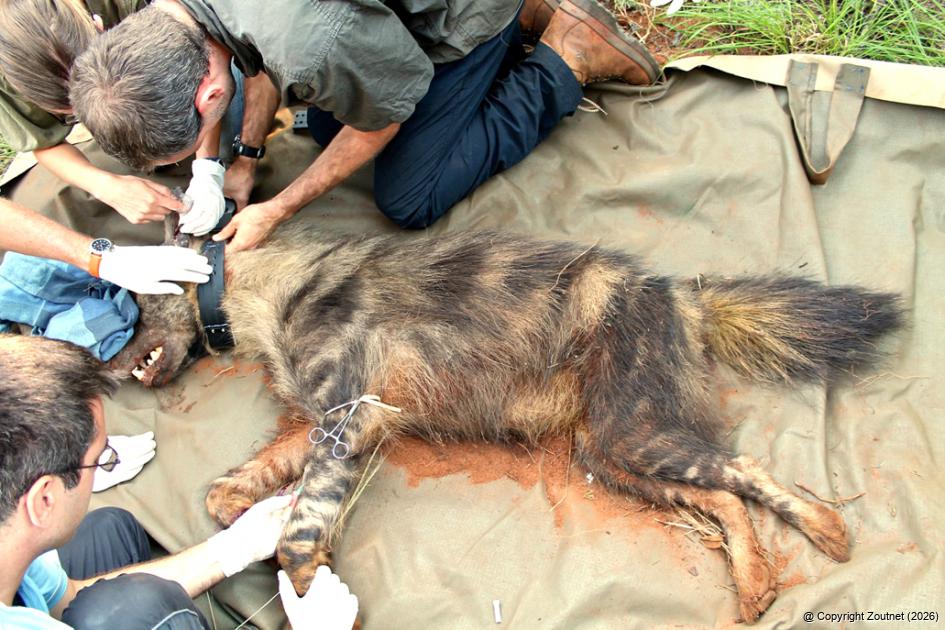
Katy and her team busy fitting a GPS collar to one of the Soutpansberg’s indigenous brown hyenas as part of her PhD research into the relationship between the brown hyena and humans. Photo supplied.
Study to shed light on brown hyena interaction
News Date: 12 November 2016
Katy Williams, who has been studying brown hyenas in and around the Soutpansberg Mountains for her PhD research with Durham University in the United Kingdom, has completed her research and is ready to present her findings to the public.
Residents interested in Williams’s findings are invited to join her on 26 November at 14:00 at the Nimeng Safaris Entertainment Club (on the R523 Waterpoort Road near Vivo). There is no cost to attend and everyone is welcome.
Williams used interviews, camera traps, GPS collars, and scat analysis to investigate relationships between humans and brown hyenas in the Soutpansberg. Some of her findings make for interesting reading.
Her research found that brown hyenas are shy, nocturnal animals that are infrequently sighted, and that in and around the Soutpansberg Mountains, they have a varied diet and consume 48 different prey species. Williams’s research also found that there is a high overlap between the brown hyena's diet and the leopard's diet, suggesting that they scavenge food from leopards regularly. “Less than 10% of the brown hyena diet is from cows, goats, and sheep. All evidence suggests that consumption of domestic species is predominantly from scavenging rather than hunting. As a scavenger, brown hyenas provide important ecosystem services by clearing carcasses and reducing disease transmission,” said Williams.
Williams remarked that many commercial farmers have positive attitudes towards hyenas and appreciate their presence if they do not endanger livestock or expensive game species. “This is not the case amongst most members of a small rural community. Hyenas are closely associated with witchcraft and feared as a result. Greater education, especially aimed at young people, is required to replace negative cultural constructions of animals with positive and realistic understandings that emphasize the valuable contributions hyenas make in the environment,” said Williams.
Brown hyenas have large home ranges (95.04 km2 to 169.79 km2) and use game farms preferentially over other land use types. “Although camera trap data suggests that hyenas avoid areas of high human activity, human-wildlife conflict, either aimed at brown hyenas or at other species, is threatening brown hyena survival on private land,” said Williams. According to Williams, one third of interviewed commercial farmers reported problems with brown hyenas. Ten brown hyenas were reportedly killed as a response to depredation or the risk of depredation in the past five years. “Non-selective threats such as snaring and road collisions are often disregarded, but in northern Limpopo Province where hyenas prefer roads to non-roads and where socio-economic conditions associated with snaring are rife, hyenas may be more vulnerable to these risks than targeted persecution. Drivers should employ greater awareness of predators on roads. Combatting snaring is a difficult and slow process that needs to begin immediately and should unite education, law enforcement, and job creation, especially in the ecotourism sector,” said Williams.
In the western Soutpansberg Mountains, Williams found that the brown hyena density is estimated at approximately three hyenas per 100 km2 and is similar to estimations at other study sites in southern Africa. “Montane environments such as the Soutpansberg Mountains offer a temporary shelter for hyenas from human activity. If the local leopard population does not recover from its severe human-induced local decline (an over 60% decline between 2008 and 2015), brown hyenas, especially in mountainous environments and on non-protected land, will face repercussions,” said Williams.
In order to protect hyenas, Williams said, it is vital to safeguard leopards and other large carnivores that they depend upon for food. “It is suggested that farmers adopt sustainable non-lethal approaches to protect their animals from depredation, such as using livestock-guarding dogs and kraaling livestock,” said Williams. For assistance with predation problems, Williams invited the public to phone Philip Faure at the Primate and Predator Project at tel. 071 841 8361.
Williams thanked all the local landowners and residents who supported this research. For more information on her research or the public research talk, she can be emailed at [email protected] or by phoning her at Tel 071 055 9557.
Written by
Andries van Zyl
Andries joined the Zoutpansberger and Limpopo Mirror in April 1993 as a darkroom assistant. Within a couple of months he moved over to the production side of the newspaper and eventually doubled as a reporter. In 1995 he left the newspaper group and travelled overseas for a couple of months. In 1996, Andries rejoined the Zoutpansberger as a reporter. In August 2002, he was appointed as News Editor of the Zoutpansberger, a position he holds until today.

ADVERTISEMENT: