

ADVERTISEMENT:
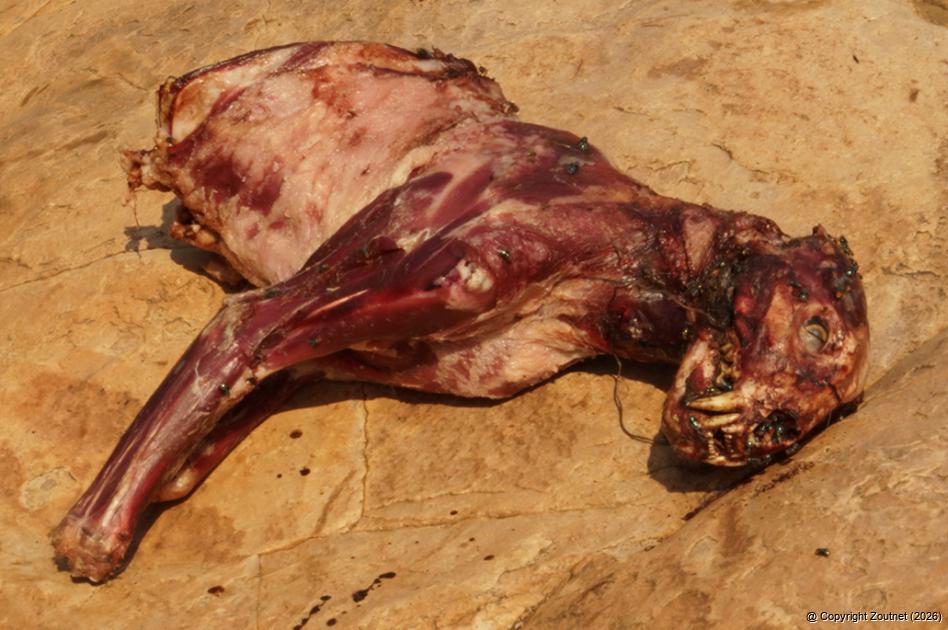
While busy with a snare sweep a volunteer group made this sad discovery; a leopard carcass that had been killed in a snare. Photo supplied.
Snaring might be linked to a bigger bush-meat syndicate
News Date: 13 November 2016
Poaching is an ongoing problem in the western Soutpansberg conservancy. Recently, a grim find in the Medike Mountain Sanctuary suggested that a larger bush-meat trade syndicate is operating in the region.
On Sunday, 16 October, the Primate and Predator Project (PPP) and Soutpansberg Centre for Biodiversity and Conservation (SCBC) organised a team of volunteers to conduct a snare sweep in Medike.
The group scoured the forested area near the Sand River and cleared a total of 75 active snares. Apart from the snares, the group also discovered two bushbuck carcasses, the remains of a juvenile baboon and a jar of poison hidden away in the brush. “The dense concentration of snares suggests this is not subsistence poaching, but instead points towards a larger bush-meat-trade syndicate operating in the area,” said the PPP’s community engagement officer, Mr Philip Faure.
The following day, the team discovered a leopard carcass close to the area of the snare sweep. The carcass was freshly skinned, with numerous dog tracks and footprints surrounding the scene. Coagulated blood around the neck and throat confirmed the leopard had been caught in a snare.
This discovery further added to the PPP’s theory of an organised syndicate trading in bush meat. Traditionally, wire snaring has been a popular harvesting method to supply rural communities with fresh meat, because they are inexpensive, effective and easy to obtain, set and conceal. However, as the global supply of natural resources is increasingly strained due to rapid human population growth, the scarcity of resources and economic opportunities throughout most of Africa results in more snares being set to generate an income rather than sustain a family. This in turn results in a negative impact on the environment.
Snares, explained Faure, are non-selective and can also kill animals that are not intended for consumption, like the leopard or baboon. “Unfortunately, the impact of snaring on our local wildlife is difficult to quantify, due to the secretive nature of bush-meat poaching. Also, landowners often don’t know about set snares on their land and poachers often move away from an area, abandoning active snares,” said Faure.
Leopards are a protected species in South Africa and listed as “Vulnerable” by the International Union for the Conservation of Nature. The PPP, a research station located in the mountains, has been monitoring the leopard population in the western Soutpansberg since 2008 and has found a shocking 66% decline in leopard densities during the last eight years.
The general public can help by removing snares when found in the field and by reporting incidents of poaching directly to the Limpopo Department of Economic Development, Environment and Tourism. In addition, Faure encouraged landowners and their employees to do a monthly snare sweep themselves.
For any assistance, Faure can be contacted at 071 841 8361 or by sending him an email at [email protected]
Written by
Isabel Venter
Isabel joined the Zoutpansberger and Limpopo Mirror in 2009 as a reporter. She holds a BA Degree in Communication Sciences from the University of South Africa. Her beat is mainly crime and court reporting.

ADVERTISEMENT: