

ADVERTISEMENT:
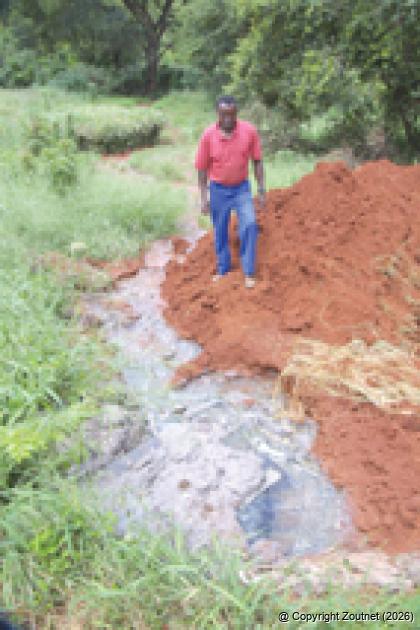
Raw sewerage flowing uncontrolled into natural water catchment areas holds a very real danger of bringing about a full scale Typhoid fever outbreak. This photo of raw sewerage draining into the town’s Green Belt area along President Street due to continuous problems with blockages was taken last week.
Residents told not to panic over Typhoid fever outbreak
News Date: 10 February 2006
Mr Phuti Seloba, provincial spokesperson for the Department of Health and Social Development, said on Wednesday that residents need not panic with regard to an outbreak of Typhoid fever.
Following up on a tip from a member of the public to investigate a confirmed case of Typhoid fever at the Louis Trichardt Memorial Hospital, the Zoutpansberger’s investigation revealed 12 confirmed cases of Typhoid fever in and around town over a period of three weeks. Four of the patients who tested positive for the disease live in town, while the other patients are from Sinthumule, Tshikwarani, Indermark, Madombidzha, Magau and Munzhedzi. A couple of months ago, an outbreak of this deadly disease caused several deaths at Delmas in Mpumalanga.
That the 12 cases of Typhoid fever went unannounced for three weeks sparked concern as to the seemingly “casual” way the authorities were treating this highly infectious disease which, according to the World Health Organisation, kills some 600 000 people out of the approximately 16 million cases annually.
Further investigation showed that the local office of the Department of Health was only aware of one case of Typhoid fever which, according to legislation, is a notifiable disease and has to be reported immediately. The case on record was the first one, on January 18.
Upon inquiry at the Louis Trichardt Memorial Hospital on Tuesday, the hospital’s spokesperson, Mr Norman Kutama, said that he was aware of 11 cases. On Wednesday, Mr Kutama said that the number of confirmed cases was indeed 12. He did not want to elaborate on the cause of the disease. When asked why the local Department of Health had not been not informed about the other 11 cases, Mr Kutama said that, as a district hospital, they report directly to the district and provincial offices and not to the local office. He also added that two patients were still being treated at the hospital on Wednesday after contracting the disease. Mr Kutama then referred the matter to Mr Seloba.
Mr Seloba said that although the occurrence of Typhoid fever is very unusual and very serious, residents need not panic.
“We have everything under control,” Mr Seloba said.
Asked whether the 12 confirmed cases of Typhoid fever could be classified as an outbreak, Mr Seloba said no. He said that although 10 cases or more is seen as an outbreak, these 10 or more cases must come from a specific area within a very short period of time. This, he said, is not the case in this particular instance as the cases are spread over a large area over several weeks.
Mr Seloba was also asked why his department had not responded to the matter sooner. He replied that, in “isolated” cases such as this one, which does not “qualify” as an outbreak, they receive monthly reports from hospitals and clinics. He said he had received a verbal report from the Louis Trichardt Memorial Hospital on Tuesday, strangely enough on the same day that media enquiries were made. A written report was sent to him on Wednesday, the same day that health inspectors were sent out to investigate the occurrence of the disease. Mr Seloba concluded by saying that no new cases of Typhoid fever were reported by Wednesday.
Typhoid fever is an infectious, feverish disease with severe symptoms in the digestive system in the second phase of the illness. It can be fatal, but antibiotics are an effective treatment. The mode of transmission is through both direct and indirect contact with the faeces or urine of a patient or carrier. The principal vehicles of spreading are contaminated water and food. Flies also help spread the disease. Continuous problems with the town’s insufficient sewerage system and the possibility of ground water contamination with regard to the municipal boreholes therefore hold a very real danger. Only humans can be infected, so infection comes from another human who is either ill or a healthy carrier. One can try and protect oneself from contracting the disease by maintaining a hygienic lifestyle.
Written by
Andries van Zyl
Andries joined the Zoutpansberger and Limpopo Mirror in April 1993 as a darkroom assistant. Within a couple of months he moved over to the production side of the newspaper and eventually doubled as a reporter. In 1995 he left the newspaper group and travelled overseas for a couple of months. In 1996, Andries rejoined the Zoutpansberger as a reporter. In August 2002, he was appointed as News Editor of the Zoutpansberger, a position he holds until today.

ADVERTISEMENT: