

ADVERTISEMENT:
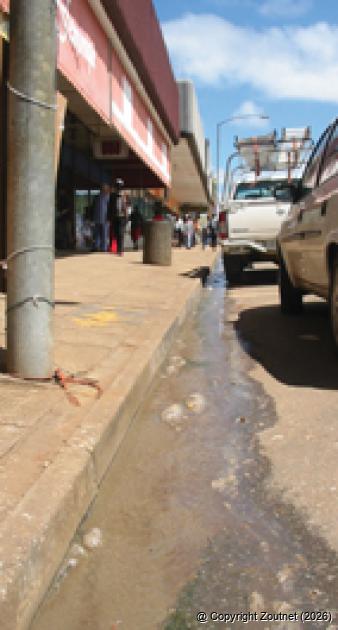
Solid, raw human waste running alongside the kerb in Songozwi street right in the middle of the town’s CBD a few meters from the entrance of a prominent eating place, had pedestrians, motorists and shop owners staring in revulsion and disbelief on Wednesday. The obnoxious effluent entered the street from a storm water drainage pipe. This is one of several examples illustrating the sorry state of the town’s existing sewage system.
Disaster looming
News Date: 10 March 2006
The town’s property market is booming with a seemingly frantic dash by developers trying to cash in on the upward market trend. The rapid growth in the property market, however, has sparked fears that the town is heading for an ecological disaster.
This could not be more so with regard to the town’s existing sewage system. Already overloaded and totally inadequate, present and future developments will place an even bigger burden on the system. Raw sewage spills occur on almost a daily basis throughout town and the health risk involved, especially when seen against the backdrop of the recent outbreak of typhoid fever in the area, is reason for great concern. Many people believe that it is just a matter of time before the town of Makhado (Louis Trichardt) “drowns” in its own human waste, should authorities not see to it that the existing system and sewage treatment plant is upgraded or replaced as a matter of urgency.
Problems with the existing sewage system came to the fore mainly after the completion of the Kutama Sinthumule Maximum Security Prison. When the prison was opened, it doubled the amount of raw sewage ending up in the system. As the system was not designed for this, blockages started to occur and still do so until today. What is disturbing is that, as part of an agreement between Council and the SACM (South African Custodial Management), an amount of R13million was paid over to Council by SACM for the upgrading of the sewage system. This did not happen and Council has yet to explain what had happened to the money.
In the meantime, development continues with no clear indication from authorities that the problems with the town’s existing system would be addressed. According to Council statistics, 379 new structures were approved in town during 2005. This included 305 new houses and some 43 businesses. Already this year, another 76 new structures were approved, including 65 houses. It is clear that the town is heading for disaster if you add to this future developments such as the Makhado Crossing shopping centre, the planned development of 200 plus houses and buildings north of Stubbs Street and the development of a further 150 houses, a garage and a one-stop shop next to the Thohoyandou Road opposite the show grounds.
The most shocking revelation about the town’s prevalent sewage problem, however, came on Tuesday during an interview with Council’s Director Technical Service, Mr Masindi Mapholi. Despite earlier media reports stating that the sewage crisis in town would be addressed, Mr Mapholi said that no provision has made at this stage for the upgrading or replacement of the town’s defunct sewage system and treatment plant in Council’s annual budget to be tabled later this year. He did, however, state that he had fought hard to have Council budget an amount of close to R17,5million for the sole purpose of upgrading the existing sewage treatment plant as well as the Eltivillas, Industria Street and Vlei Street sewage pump stations. This also included plans to build an additional sewage treatment plant on municipal land on the corner of Byles and Industria Streets at an estimated cost of about R15million to help alleviate the problem. Mr Mapholi’s proposal was, however, turned down as Council apparently received a directive from higher authorities to channel all available money to the water supply. He said he cannot understand why this was done as water and sanitation go hand in hand, but that he will continue in his efforts to obtain the money needed to address the town’s sewage problems. Mr Mapholi said he was busy working on a new proposal and was optimistic that he would succeed in having it included in Council’s 2006/7budget as the need for good sanitation was highlighted by the recent typhoid scare.
Asked why Council is allowing massive development to continue despite the fact that the existing sewage system cannot handle the workload, Mr Mapholi said that although they have problems with the system, everything is under control. By now, however, it is obvious that aspects of the town’s infrastructure are unable to cope.
Written by
Andries van Zyl
Andries joined the Zoutpansberger and Limpopo Mirror in April 1993 as a darkroom assistant. Within a couple of months he moved over to the production side of the newspaper and eventually doubled as a reporter. In 1995 he left the newspaper group and travelled overseas for a couple of months. In 1996, Andries rejoined the Zoutpansberger as a reporter. In August 2002, he was appointed as News Editor of the Zoutpansberger, a position he holds until today.

ADVERTISEMENT: