

ADVERTISEMENT:
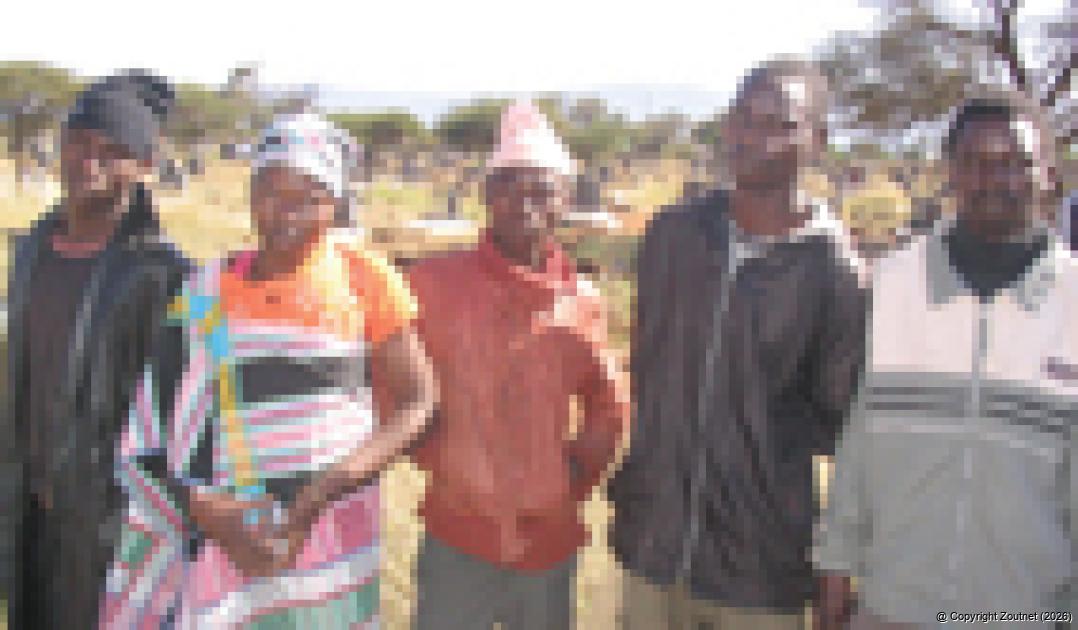
The children of the late Mrs Maria Munonoka, photographed at the Madombidzha graveyard.
Body exhumed to remove “muti and strange things” from coffin
News Date: 12 May 2006
Less than a month after Mrs Maria Munonoka (58) of Madombidzha was buried at the local graveyard, her children, with the support of community members, exhumed her body on Wednesday with the idea of removing “muti and other strange things” from the deceased’s coffin.
The deceased died after a two-day illness on April 6, this year and was buried on April 15, at the Madombidzha cemetery. The only daughter of the late Munonoka, Patricia (24), told Mirror that the digging up of her mother's body was not aimed at determining the cause of the death or to perform an autopsy on the body, but to remove muti, a knife and a stick allegedly put in her mother's coffin by a traditional healer, who is a close relative, hours before her mother could be laid to rest.
Patricia claimed that the traditional healer smeared muti on the body, pricked both sides of her mother’s ribs with a needle and put a stick on her head in full view of Patricia. “She also smeared an okapi knife with muti before she forced my mother's fingers closed around the knife, as if she was holding it,” she claimed.
As the actual exhumation of a buried body is known to be expensive, Patricia said that the exhumation of her mother’s body was free. “During the process when the traditional healer was performing her strange ritual on the lifeless body of my mother, I was out of my mind, with no idea how to stop her or even to tell other family members. Later, after the burial, I came back to my senses and I began telling everyone what I had seen,” said Patricia. Asked about the relationship between her mother and the traditional healer before her mother passed away, Patricia said “what I know is that they were on good terms.”
The deceased’s son, Azwifaneli Munonoka(28), added that if evil things were to be discovered in his mother's coffin, they as the family would take legal action against the traditional healer in question. The deceased's husband, Mr Daniel Mogweng, said that he would be happy if the strange things allegedly put inside his wife's coffin could be removed and thrown away. “I've never seen this in my entire life and it pains me whenever I think about it,” he said.
It is common practice that an environmental health officer must be present at the exhumation of a body to ensure that there is no threat to public health; nevertheless, community members dug up the body without a health officer being present. The health and safety of the people doing the exhumation were not taken into account, as they were exhuming the body without protective clothing such as gloves, masks and task lights.
Instead of commencing with the exhumation as early as possible to ensure maximum privacy, residents started the digging process at about 10:00. Members of the Tshilwavhusiku SAPS, led by their station commissioner, Supt Shirinda, were monitoring the situation, while standing outside the graveyard. As there was no coroner to facilitate the search for the muti and the knife in the coffin, residents began to demand that the police should go and collect the traditional healer, so that she could open the coffin and remove her things.
Cllr Jenneth Matumba of the Makhado Municipality intervened, allowing for a compromise to be reached that the coffin would be opened at a local funeral undertaker in full view of all family members and certain members of the community.
Exhumations can take a long time to organise, but Patricia said that, after her first applications were turned down at the Tshilwavhusiku magistrate’s office, she immediately went to request permission from the Tshiozwi territorial council as well as the Makhado Municipality, who approved the application on May 3, 2006. An affidavit was also made at the Tshilwavhusiku SAPS by Lawrence Munonoka.
After examining the coffin and body of the deceased, the family found a knife, several needels and a container with an unknown substance.
Written by
Nthambeleni Gabara

ADVERTISEMENT: