

ADVERTISEMENT:
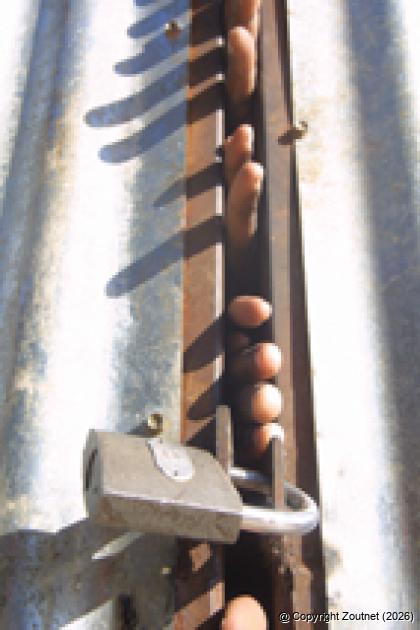
Locked up like animals … The Department of Labour, together with the SAPS, slapped a probation on a local business on Tuesday after it was discovered that management had locked up seven female employees for extended periods of time. In the photo, the seven employees are still trapped behind the corrugated steel doors locked from the outside.
Locked up like animals ...
News Date: 02 June 2006
The Department of Labour slapped a probation notice on a local business on Tuesday after it was discovered that the management had locked up seven female employees for extended periods of time.
Following a tip-off by a member of the public, the Zoutpansberger discovered that seven women, employed by Limpopo Harvest in a locked storeroom in the industrial area, were working in a forced-labour situation. On a daily basis the women were locked up in a corrugated storeroom, with no windows, running water or toilet. While a lot of the goods in the room were flammable, there was only one fire extinguisher.
When the women wanted to relieve themselves, they sent a Please call me message to management, who then drove from wherever they might be at the time to unlock the store room.
“Sometimes, they didn’t come when we sent them a message and we were forced to wait until they came to unlock at 13:00 when we went to lunch,” said one of the women. The women started working before 08:00 and stopped at 17:00.
They worked as general workers. When locked up in the store room, the women were packaging packs of popcorn, beans and other groceries.
“We are here because of poverty. We are treated like slaves; our boss regards us as things. We've tried several times to tell him about our safety, but he kept on telling us that he was praying to his Almighty to protect us,” they alleged.
On Tuesday, senior members of the local SAPS and from the Department of Labour at Makhado were informed and responded swiftly. When Mr Percy Masebe from the Department of Labour phoned the manager to come and unlock his employees, he claimed to be delivering stock. A few moments later, a female relative arrived with two small children to unlock the store room. Representatives from the Department of Labour had to assist her to unlock the store room after it took her more than five minutes to unlock the two padlocks.
“Let me explain; we decided to lock them up, because they were stealing our stock. We used to keep this place wide open,” said the woman. She further alleged that, what also influenced the decision to lock the employees in the store room, was because somebody had stolen R60 000 in March this year at the storeroom. Asked why a security company was not hired to keep a close eye on the storeroom, the woman asked, “Can you trust a security guard?”
Upon his arrival, the apparent owner of the building, Mr Aslam Akoo was calm, but after some conversation with the representatives from the Department of Labour lost his cool and shouted that he was going to close the business down and that as of then, all the employees were dismissed. His message to the local newspapers was to seek legal advice if they planned on printing anything that was said.
Mr Akoo went on to claim that everything on his premises was 100% legal. A municipal official, Mr Smuts Jacobs, arrived at the scene and pointed out that, to his knowledge, the business was not even registered with the municipality.
“If it were registered, an acceptability license certificate was supposed to be hanging somewhere here,” he said. When Mr Akoo argued that it was registered, the female relative intervened and asked Mr Jacobs how and where she could make an application.
Masebe said that locking up workers in a work place with no safety measures, running water or toilet is not allowed and is tantamount to forced labour.
“What is happening in this labour organisation is slavery,” said Masebe. Mr PJ Tladi and Mr P Mangale from the provincial Department of Labour in Polokwane also came to investigate. Asked about the steps to be taken against the employer, Tladi said that, as a matter of urgency, they would issue a probation notice to prevent the employer from locking up his labourers. He said that a probation notice was a very serious warning.
“Our local department will come to check from time to time if the employer is adhering to the instruction given to him,” he said.
On Wednesday the owners of the business visited the newspaper and said that they realise it was a mistake to lock up the workers. “It was just a temporary measure, which we now regret,” the manager said. He said that the premises is no longer locked and the workers can move around freely.
Written by
Andries van Zyl & Nthambeleni Gabara

ADVERTISEMENT: