

ADVERTISEMENT:
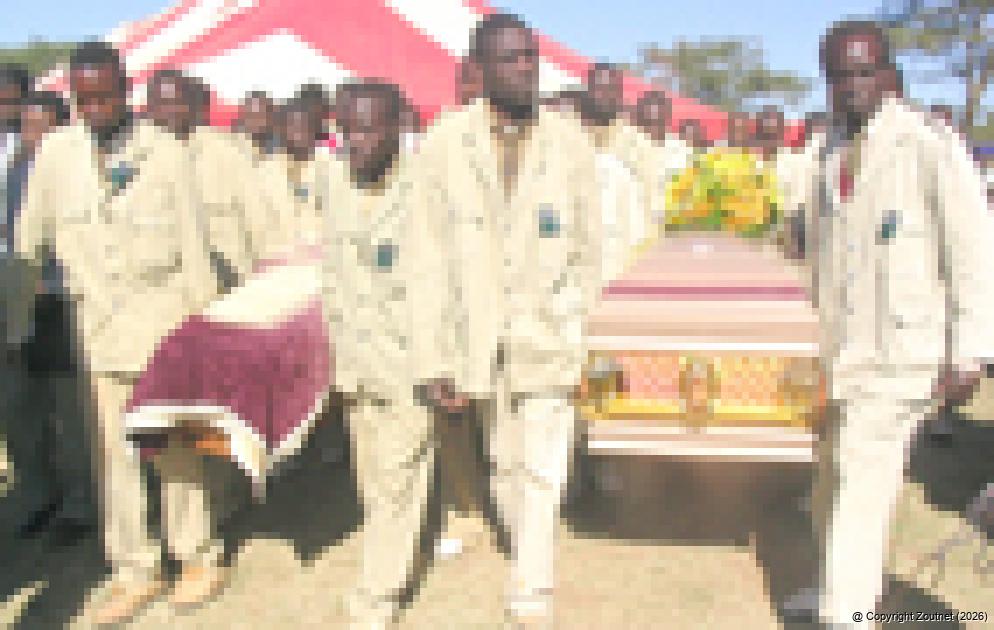
Members of the Zion Christian Church (ZCC) are carrying the coffins of the late John Baloyi and Joseph Maano to their last resting place.
John Baloyi laid to rest, but his legacy remains ...
News Date: 02 June 2006
World-acclaimed wood carver John Baloyi (42) was laid to rest in his yard at Ha-Mashamba during an emotional funeral service on Saturday.
Also laid to rest, but at a local cemetery, was a young aspiring artist, Joseph Madume Maano (27). The two met their untimely deaths on May 15, when their vehicle crashed into a bus at the Elim-Ledig and N1 road.
Baloyi, who was affectionately known as Sure, started woodcarving at the age of nine in 1973. Apart from carving, he also did pottery, mat weaving and puppet making. He dropped out from school in Grade 10 and went to Johannesburg where he worked in one of the mines. After realising that making sculptures was his real talent and destiny, Baloyi resigned to concentrate on wood carving.
In 1995, he developed an idea of selling most of his sculptures to get money to build an art gallery in his yard. After a decade, he realised his dream. On May 28 last year, he officially opened his 'rural art gallery' in his kraal at Ha-Mashamba. Judge Albie Sachs from the Constitutional Court also attended the opening of the gallery.
Baloyi did not receive support in the form of resources or financial aid from the local municipalities and the provincial government. During his lifetime, Baloyi was well known for teaching young people from the surrounding villages to do artistic wood carving. His students include a professor from the University of South Africa as well as wood carvers from abroad.
In 2004, Baloyi was amongst the South African artists invited to attended the launching of a musical event, The Lion King, in the Netherlands.
He carved different kinds of sculptures; some depict the Tsonga tradition, while others depict historic events. One of his historic sculptures about Napoleon is exhibited in the Sandton Convention Centre, sending a message to the people that leaders must refrain from invading other foreign countries. Baloyi became more popular in 2003 when his Godzilla-like sculpture was taken to “stand guard” at the entrance of the Constitutional Court. Most of his sculptures can be found in Holland, Canada, and Australia while others were bought by various galleries, corporations and private collectors from other European countries.
During the funeral service, a local sculptor, Mr Thomas Mafemani Kubayi, made a blistering attack to the MEC for Sport, Arts and Culture, Mr Joe Maswanganyi's department. Kubayi accused Maswanganyi's department of failing to work effectively with wood carvers in the province. "This department must be called the Department of Sport and Culture, because it is doing absolutely nothing for us. You don't come to visit us, but when one of our colleagues is no more, you decide to come. We are used to see your vehicles passing on the road," he said.
Kubayi further attacked local school principals and their teachers for organising trips for learners to see sculptures carved by carvers from their region in galleries in other provinces.
"I wonder how the principals feel when they are told that the sculpture was carved in their district. We expect them to bring these children to this gallery; we can even teach them how to do woodcarving," he claimed.
Mr Maswanganyi confirmed that his department was not doing enough with regard to working with artists, but he urged sculptors also to start engaging themselves with his department in their respective areas.
"The government is not suppose to be seen as an instutition to assist artists, but we must be seen as a market," he said.
According to Maswanganyi, the government, local municipalities and other parastatals must buy sculptures from the artists themselves. As part of economic development, Maswanganyi said that the Limpopo province had reached a trade investment agreement with the Japanese government. He said that these would also open a market to the artists. The regional manager of Limpopo Tourism and Parks for the Vhembe region, Mr Mavhungu Elias Musitha, said that Baloyi's death is a great loss to the tourism industry, given the fact that he had died while he still had a lot to offer to the local and international communities. "His good work makes us to regard him as still alive and we will continue marketing his sculptures as believe that he left a legacy.”
Dr Stefan Cramer of the Heinrich Böll Stiftung Southern Africa said "Baloyi is dead! This terrible truth has to still sink deeper into our minds. But his spirit lives on in our fond memories of Baloyi as a person and through his art. His sculptures will be his permanent legacy to us." Baloyi is survived by three wives, six children and three brothers.
Written by
Nthambeleni Gabara

ADVERTISEMENT: