

ADVERTISEMENT:
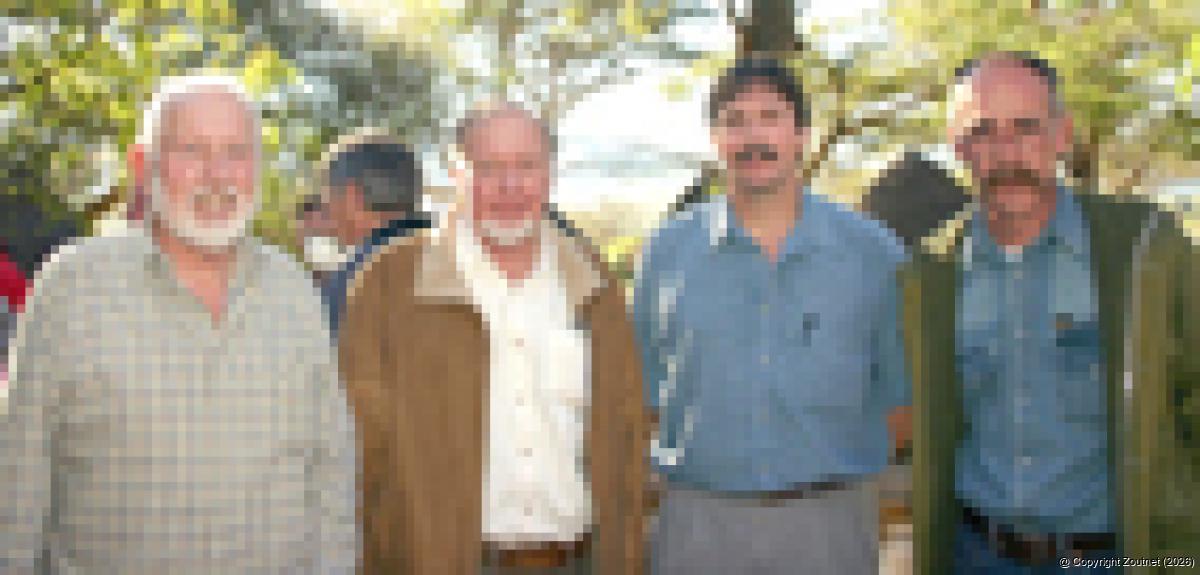
A meeting between directors of the South African National Biodiversity Institute and local biodiversity scientists took place on July 3 at the Limpopo Tourism Information Centre. From left are organizers Mr Herbert Berger and Prof Ian Gaigher, and the SANBI directors, Messrs Chris Willis and Gideon Smith.
Soutpansberg a candidate for botanical garden
News Date: 07 July 2006
Could the Soutpansberg possibly be selected as the location of a national botanical garden?
The mention of a national botanical garden to be developed somewhere in the Limpopo, made local biodiversity scientists catch their breath in the hope that the location could be the Soutpansberg.
“It is too early to say,” said Christopher Willis, Chief Director: Garden and Horticultural Services of the SANBI (South African National Biodiversity Institute) during a meeting with biodiversity scientists. The meeting took place on July 3 at the local Limpopo Tourism Information Centre.
“At the moment, we are only conducting exploratory visits in the Limpopo province. The SANBI will still liaise with relevant stakeholders for a possible site for a national botanical garden,” Willis said. The stakeholders will include the local government and the other levels of government.
The meeting between the SANBI and the biodiversity stakeholders was set up with the aim of initiating coordination between local scientists and the institute.
“A botanical garden would be the cherry on top,” said Herbert Berger, organizer and member of the Soutpansberg community interested in having a coordination centre between the SANBI and scientists of the region. The meeting was chaired by Prof Ian Gaigher of the Lajuma Research Centre.
The need for scientists in the region to coordinate with a statutory body came to the fore when local scientists held a workshop at Lajuma in May, 2003. Following the workshop, an impressive publication on the environmental, biological and cultural assets of the Soutpansberg saw the light. All the contributors and editors were local scientists or community members at the time. The scientists work mostly in isolation and would like the SANBI to establish a coordination centre or biodiversity institute in the area.
The SANBI was established two years ago and succeeded the National Botanical Institute. Their core functions include biodiversity conservation, sustainable use research and overseeing National Botanical Gardens (NBG’s). The SANBI falls under the Department of Environmental Affairs and Tourism and reports to the DEAT Minister.
One of the many SANBI initiatives is to establish new NBGs or biodiversity reserves in the Northern Cape, Eastern Cape, Limpopo and NorthWest, the four provinces which do not currently have any national botanical gardens. There are eight national botanical gardens in the country. The botanical gardens generate R23 million, of which the famous Kirstenbosch generates R18million and is the only self sustained garden.
A botanical garden is defined as an institution holding documented collections of living plants for the purposes of scientific research, conservation, display and education.
An interesting fact that was mentioned by the SANBI representatives was that the University of Limpopo, formerly known as the University of the North, obtained initial outside sponsorships to the value of R20million to establish a botanical garden at the University. The ideal would be that every province would establish several botanical gardens.
A national botanical garden or NBG, however, has many criteria. The NBG should include a large area of relatively undisturbed representative natural vegetation. The landscape should vary and preferably include mountainous and flat areas as well as varying environmental conditions. There should be potential for a landscaped portion. There should be a perennial river or a reliable water supply. The community should support the idea. The NBG should ideally be accessible, within a 30km catchment of 250 000 people and be easily accessible to educational and research institutions. Concerning the land where the NGB is established, there should be no land claims on the land and the landowners should be willing to lease, transfer or sell the land.
Written by
Linda van der Westhuizen
Linda van der Westhuizen has been with Zoutnet since 2001. She has a heart for God, people and their stories. Linda believes that every person is unique and has a special story to tell. It follows logically that human interest stories is her speciality. Linda finds working with people and their leaders in the economic, educational, spiritual and political arena very rewarding. “I have a special interest in what God is doing in our town, province and nation and what He wants us to become,” says Linda.

ADVERTISEMENT: