

ADVERTISEMENT:
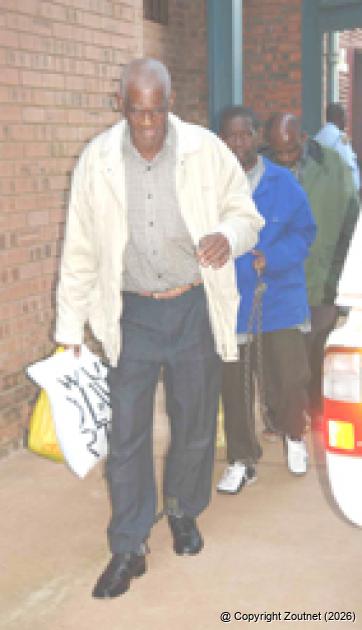
Accused number 4, Balanganani Munyai (85), followed by Tshimomo Munyai (45) and Mukondeleli Phosha leaving the Thohoyandou High Court this week.
Shocking details revealed in "Muti 5" murder case
News Date: 15 September 2006
An accused in a high-profile ritual murder case, Shumani Dzebu (31), explained in a packed Thohoyandou High Court how he took part in the murder of an unidentified man with his co-accused, Tshimomo Munyai.
Dzebu testified that he had visited Tshimomo Munyai in October 2004 at his home at Tshandama, to deliver some herbs. “He asked me to accompany him to his field so that he could deliver food to his worker. He gave the food to his worker and pulled me aside. He said he wanted to teach me something that would make me a good traditional healer. He went back to his worker and moments later, he told me that his worker was dead because he had poisoned him. He said he needed some body parts and promised to give me R20 000 if I assisted him in removing them. I denied his request and he became angry, and that was when I became afraid and assisted him.”
Dzebu testified that Munyai started by chopping at the man’s leg and “he asked me to bend it so that he could easily break it. I did not assist him when he removed the ribs and hands. I only put a dry piece of wood below the deceased’s head so that he could cut it off without difficulty. That day he gave me R1 000 and told me not to tell anyone. He asked me to fetch some wood for him when he was burning the parts to remove the skin from the bones at Gundani Mountain.”
The four traditional healers and a Bishop of the Apostolic Holiness Church pleaded not guilty, when the trial started last Thursday. Shumani Dzebu (31), Mukondeleli Phosha (54), Edson Tshimomo Munyai (45), Balanganani Munyai (85) and Bishop Joseph Ramafamba (72) pleaded not guilty before Judge Ephraim Makgoba. The case is expected to be finalized today (Friday).
Amongst other charges, the five are charged with murder, conspiracy to kill, trading in human body parts, attempted murder and robbery, following incidents that took place at Makonde-Shadani on October 22, 2005 and Mafukani village on November 7, 2004. All of them denied participation in the two ritual murders.
A promising soccer star, Maanda Sendedza (27), whose private parts and tongue were sliced off, was found dead and his girlfriend, Nyelisani Sidimela (18) was found laying helplessly next to his body. Her lips had been sliced off. Sendedza’s trousers and cell phone were missing. Phosha and Dzebu were allegedly found in possession of Maanda Sendedza’s private parts, tongue, cell phone and trousers. They were also allegedly found in possession of Nyelisani Sidimela’s removed lips.
The headless body of a 40-year-old unknown man was discovered at Mafukani, outside Thohoyandou, in November 2004. After an intensive investigation, the traditional healers cooperated with the police and dug up the skull and ribs on the banks of the Mbwedi River in Tshidzini village.
In a confession made at the Thohoyandou Magistrate’s Court late last year, Shumani Dzebu confessed that he had taken part in the killing and the removal of body parts from both Maanda Sendedza and Nyelisani Sidimela. He also took the police to the scene of the ritual murder and explained how it had happened. However, he took everyone by surprise when he told Judge Ephraim Makgoba on Thursday that he had not confessed of his own free will as he was forced to make the confession by police officers who had assaulted him shortly after his arrest.
Part of the confession indicated that the second accused, Mukondeleli Phosha, told Dzebu that he needed the blood of a lion and its bones, the blood of a mamba, a tiger skin and the fat of a python. Dzebu said that, after delivering the said things, Phosha told him that he needed human body parts.
“I told him human body parts would land me in prison but he told me that he would mix some muti for me which would make me to be brave and not be arrested.” The confession continued and said Dzebu used an axe to kill Maanda Sendedza and was also supposed to remove the private parts and buttocks of Nyelisani Sidimela but he couldn’t because time was against him. He delivered the body parts to Phosha, who said he needed them roasted. Dzebu couldn’t roast the body parts but Phosha roasted them himself. The confession says Dzebu accepted R1 000 from Phosha on the day of the body parts’ delivery.
Dzebu told the court about his alleged torture by the police: “Shortly after my arrest, I was taken to the bush at the Nzhelele area where I was tortured. A balaclava was placed on my face and four police officers assaulted me, forcing me to confess to that I had chopped Maanda Sendedza and his girlfriend. I was also hit with chairs and tortured with electricity at the SAPS offices in Sibasa. I had no other alternative, but to confess to the killings because I feared for my life. I was confused, frustrated and in pain.”
Dzebu’s legal representative, Desmond Mphaphuli, insisted that his client had not made the confession voluntarily as he was allegedly tortured. He said his client was threatened, assaulted and he was not alerted about his constitutional rights, insisting that the said confession was invalid and it should not be taken as serious evidence before the court.
Despite all this, the state maintains that the confession was made freely and all procedures had been followed. The Director of Public Persecutions, Bethuel Manyuha, dismissed Dzebu’s claims of intimidation and torture and indicated that all procedures had been followed when he made his confession. He said Dzebu was told of his constitutional rights and he chose to make the confession of his own free will.
The late Maanda Sendedza’s wife, Tsumbedzo Maguvhe, identified the Motorola C115 phone, brown purse, gray trousers, black belt and a pair of canvas shoes belonging to her late husband, which were brought before the court as exhibits. They were found in possession of Dzebu, who told the court that he had received them from Phosha. Dzebu’s wife, Rudzani, also confirmed to the court that she knew the axe that was also brought to the court as evidence. She said the axe belonged to her husband.
Four police officers, a magistrate and an interpreter also gave evidence, denying that Dzebu had been forced to make a confession. The Commander for Serious Violence Unit in Vhembe, Captain Emanuel Mphephu, said they had made an application to Vodacom to trace Maanda Sendedza’s cell phone, which they later recovered from Dzebu. Dzebu changed the victim’s sim card but the IME number confirmed that the phone had belonged to Maanda Sendedza. Dzebu told the police that he bought the phone from an Indian shop in Thohoyandou. This led to his arrest after the clothes of Maanda Sendedza were also recovered in his house at Muledzhi village and he confirmed that he had taken part in the ritual murder. Dzebu later indicated that he got the clothes and cellphone from Phosha.
Dzebu added: “He owed me money for herbs which I delivered to him and he gave me the cellphone. I don’t even know where he got it. He also gave me a plastic bag with clothes and told me that Tshimomo Munyai would come and collect it from me. I was arrested before Tshimomo could collect the clothes from me.” Dzebu said he asked Phosha about his axe which he earlier forgot at his house. “He told me I would get the axe when I came to collect the balance he owed me. He later told me that my axe was at Shadani bush and I found it at the scene of the murder.”
Ritual murder survivor Nyelisani Sidimela was called to give evidence on Monday. She was under tight security because she is still under the State Witness Protection Programme. Still recovering from the ritual murder ordeal, Nyelisani’s mouth was covered with a white dressing. When asked to identity Bishop Ramafamba among the five accused, Nyelisani surprised everyone when she pointed out Balanganani Munyai (85) as the Bishop. After a break, she was given another opportunity – that was when she pointed out Bishop Ramafamba.
Bishop Ramafamba’s legal representative, Sammy Netshifhefhe, said his client had to be acquitted from the murder charge and was therefore not expected to give evidence in the witness box because there was nothing linking him to the case. He argued that his client did not take part in the ritual murder and he was framed because it was impossible for a victim to fail to point out a person who harmed her. He further argued that Nyelisani was influenced to implicate the Bishop because there were unauthorized visitors who met her while she was under treatment at a Gauteng hospital.
“She struggled to point him out even when she claims to have prior knowledge about him. It will be unfair for my client to testify because he was not pointed and it would obviously be a violation of his constitutional rights. It is clear that the victim was only told about the name Ramafamba but she does not even know him personally.” However, the state refused the acquittal application on Tuesday and indicated that it was still too early to consider an acquittal.
Written by
Wilson Dzebu

ADVERTISEMENT: