

ADVERTISEMENT:
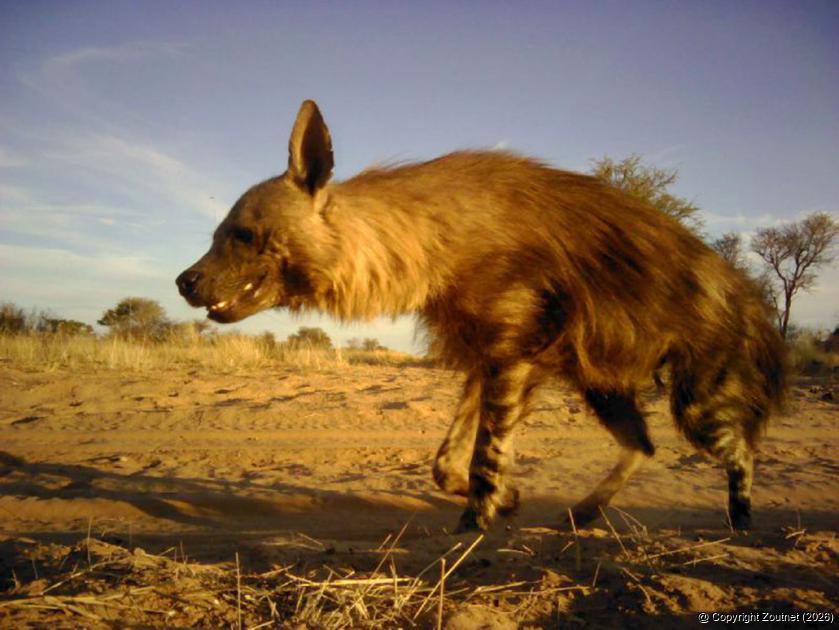
A brown hyena captured by one of the many camera traps as part of the research project. Photo: Panthera.
Soutpansberg included in national brown hyena survey
News Date: 29 June 2018
Although the Kruger National Park is a haven for much of South Africa’s wildlife, it is not an ideal home for the secretive and submissive brown hyena, also referred to as the wolf or strandwolf. Land outside of protected areas is vital to their survival, and Dr Katy Williams, a postdoctoral researcher at the University of Mpumalanga, has been finding out why.
New research led by Williams and her colleagues used data from 984 camera trap stations situated at sites in seven South African provinces to determine which factors affect land usage by brown hyenas. Panthera, an international organisation dedicated to the conservation of wild cats, primarily ran the surveys in partnership with the South African National Biodiversity Institute and other stakeholders. Camera traps were set up in national parks, nature reserves, game farms, and cattle farms. Three of the study sites were local, namely Lajuma and adjacent private properties, Venetia Limpopo Nature Reserve, and Zingela Nature Reserve.
“The results indicate that land usage by brown hyenas is driven by human disturbance and co-occurring predator species. Higher levels of activity by humans on foot and spotted hyenas had a negative effect on brown hyena land usage, while higher levels of vehicle activity and leopard activity had a positive influence,” said Williams.
According Williams, brown hyenas strongly avoid areas with high levels of activity by spotted hyenas. “The more dominant spotted hyenas steal food from brown hyenas and may even kill them. Some protected areas like Kruger host high densities of spotted hyenas and as a result, brown hyenas are largely extirpated in these areas,” said Williams.
Williams found that brown hyenas prefer to occupy areas where leopards are more abundant. “Leopards preferentially utilise resource-rich environments hidden from people. These areas may also provide favourable conditions for brown hyenas. In addition, brown hyenas are almost exclusively scavengers and may secure food from leopard kills,” said Williams.
Human disturbance also affects the areas that brown hyenas occupy. Williams’s research determined that brown hyenas actively try to avoid areas with high human foot traffic. This may be because humans present a threat to brown hyenas’ survival through poaching, legal hunting, or damage-causing animal control. Surprisingly, brown hyena occupancy was higher at sites with greater vehicle activity. “Vehicle-based eco-tourism is conducted across many of the study sites, and in these areas, vehicle presence may indicate preferable conditions such as low human foot traffic and high levels of prey species,” said Williams.
The findings of Williams’s study will help to inform conservation strategies for brown hyenas across their international range. Private landowners can contribute to and benefit from brown-hyena conservation as well. “As predominantly scavengers, brown hyenas clean up dead animals naturally and lower disease transmission. With a reliance on nonprotected areas for survival, brown hyenas need livestock and game farmers who are willing to coexist with them as much as farmers need them to provide important ecosystem services through their scavenging behaviour,” said Williams.
Written by

ADVERTISEMENT: