

ADVERTISEMENT:
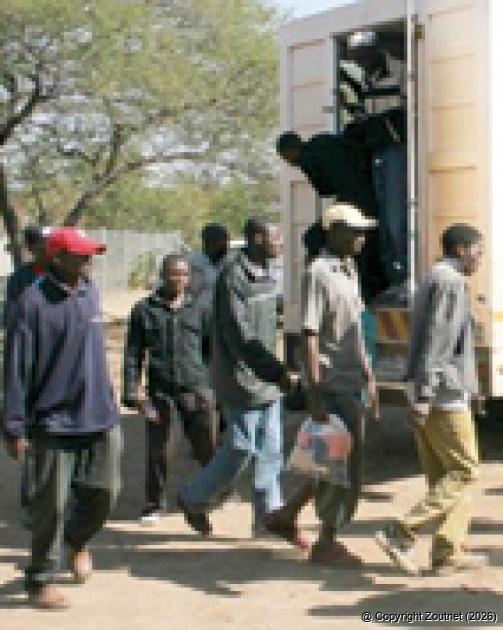
Illegal Zimbabwean immigrants disembark from an SA Home Affairs truck at the International Organisation for Migration (IOM) centre in Beitbridge.
The ongoing problem of illegal immigrants from Zimbabwe
News Date: 18 May 2007
Half of the Zimbabwean illegal immigrants, mostly women, who are deported from South Africa through the Beitbridge border post are shunning humanitarian assistance offered by the International Organization for Migration (IOM) reception and support centre in the border town as they opt to cross back into South Africa illegally.
The IOM program manager, Mr Nick van der Vyver, told Mirror that the deportees preferred to cross back to South Africa illegally. Van der Vyver said they have handled 110 685 deportations since the IOM was opened last year. He said, however, that out of those deported during that period, 56 024 registered for assistance while the remainder shunned it.
"You will realize that an average of about 50% of those deported from South Africa continue to shun our assistance and instead prefer to cross back. They approach cross-border drivers who assist them to cross the border illegally for exorbitant fees," he said.
IOM reception and support center was officially opened on 31 May last year by the governments of South Africa and Zimbabwe
The illegal immigrants approach unregistered cross border transport operators commonly known as omalayitsha, who then smuggle them through Beitbridge border post to Gauteng for fees ranging from between R1 000 - R2 000. The transport operators will have bribed their way past police and immigration officials on both sides of the border.
However, some of the deportees resort to using undesignated entry points along the crocodile-infested Limpopo River to enter South Africa illegally, oblivious of the dangers of either drowning or being attacked by crocodiles.
At the IOM support center, deportees are offered shelter, food and transport to travel to their respective homes. The center has a budget for food for about 10 000 people every month.
Van der Vyver expressed concern over the continuing smuggling of minors out of Zimbabwe into South Africa by the unregistered cross-border transport operators.
The children are normally smuggled into the country during the school holidays in Zimbabwe. "Our worry is that these children are being treated like commodities and often they are harassed, resulting in some of them becoming confused," he said.
According to IOM, about 65% of the males deported register for assistance while only 35% of female deportees seek the same assistance. Of those deported illegal immigrants, 40% are from areas that include Bulawayo, Chiredzi and Chipinge.
Van Der Vyver said the highest number of deportees handled at the center was recorded in January when the South African Home Affairs Department deported 21 000 illegal immigrants from the neighbouring country through the Beitbridge border post.
Of those deported, 11000 were assisted by IOM with food, shelter and transport to travel to their homes.
Recently, over 1600 Zimbabweans were brought back from South Africa aboard 16 luxury coaches hired by the Department of Home Affairs. Last week, police in Musina rounded up 511 Zimbabweans during a blitz aimed at flushing out illegal immigrants settling in the country.
However, despite constant deportations, which are conducted every day, scores of Zimbabweans continue to cross the border into South Africa illegally as they flee the economic hardship in their country. The Zimbabwean economy continues to sink with the inflation rate now hovering at around 2000 % and unemployment pegged at 80 %.
The deteriorating situation in the neighboring country has also had a negative impact on the economy of Musina border town, which constantly received a boost from Zimbabwean cross-border traders. However, due to the economic situation in that country, the number of traders flocking into the town has drastically gone down over the past months. According to the Musina Chamber of Commerce, there has been a drop in trade by 50 % since the beginning of the year and this was attributed to the economic situation in Zimbabwe as the stream of cross-border traders from that country has virtually dried up during the past months.
Written by
Mashudu Netsianda
Mashudu Netsianda is our correspondent in Beit Bridge, Zimbabwe. He joined us in 2006, writing both local and international stories. He had worked for several Zimbabwean publications, as well as the Times of Swaziland. Mashudu received his training at the School of Mass Communication in Harare.

ADVERTISEMENT: