

ADVERTISEMENT:
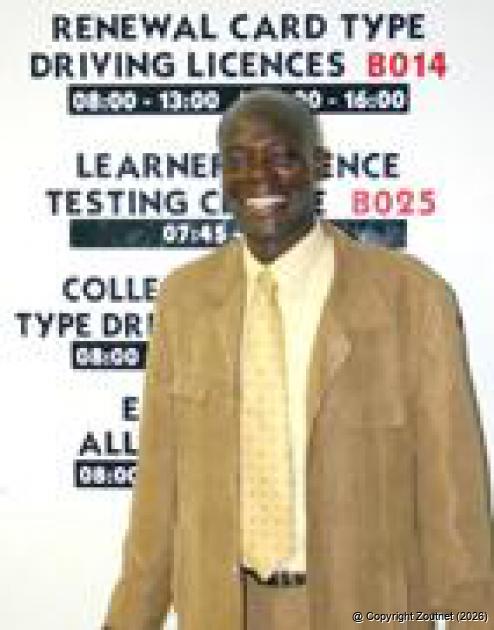
Mr Peter Magwala, official spokesperson of Makhado Municipality, said that notices with prominent large lettering, like the one he is standing at, will be put up to inform the public of exactly what documentation they should have with them before getting into the queues.
Despite promises, problems at licensing department continue
News Date: 13 July 2007
Problems at the licensing department still evoke the anger and frustration of members of the public.
"It is a lie! The Makhado Municipality did not open at 07:00 for the queue to enter," said one exhausted customer, who spent the best part of the day on Thursday last week in the licensing queues.
Mr Peter Magwala, official spokesperson of Makhado Municipality, said on Monday (9th) that the municipality maintains the extension of hours from 07:30 till the last client is helped, which is according to Batho Pele principles.
"This morning, we opened from 07:00 and served from 07:30. Because the cashiers work late in the evening, they cash up the following day between 07:00 and 07:30."
Person who should "sign" disappears
One client’s horror story started before seven in the morning last week.
"I was twentieth in the queue but when the doors opened around eight, everybody ran for a seat and I ended up being thirtieth in the queue."
Five hours later, she thought that her nightmare to renew her driver’s licence was through, but was told that she needed a signature from a person who had left for the testing grounds and that there was no other person who could sign. End of story.
Is it the system or the human factor?
"It is definitely the system," says the Makhado Municipality’s spokesperson.
On hearing of the client’s dilemma with the signature, Mr Magwala said that "there is no signature needed." Magwala invited her to write a letter, giving the exact details so that the case could be investigated. "She may remain anonymous," Magwala said.
Another client said that it was his fifth day in the queues. Those sitting for long hours are also becoming aggressive towards those who push themselves in front, some allegedly agents who are paid to do the tedious work of queuing.
"During the school holidays, the demand increases at the driver’s license section, but the main problem is with the registration and renewal of vehicles," Magwala said.
He also said that they prefer people to start at the back of the queue once they have left the queue for whatever reason.
Slow people, slow system?
"The problem is with the people, not the system" said some customers. "I can see for myself that these people are slow, punching one key at a time," said one member of the public.
Many clients have made the observation that, in some queues, only three clients are helped in one hour.
"The problem is not with the persons. Our officials have been trained properly," Magwala said, however.
The Makhado Municipality maintains that the problem is with the eNatis system, which is slow, often cutting out for an hour or two. The eNatis system cost the country R408million and was said to have up-to-date technology, designed to limit visits by the public to traffic departments.
I can help them
One lady told the Zoutpansberger that she had experience in licensing departments and would offer her service voluntarily to speed up the process.
"Must we just see how our people are standing in long queues, while we can help?" To this offer Mr Magwala repeated that the problem was not with the persons serving but with the system. He said, however, that they did not have a problem with any person who wanted to share his/her experience.
Solutions
Mr Magwala offered positive solutions, some of which also had been mentioned by members of the public.
* We shall develop a system according to which those who come very early can be given tickets with numbers to avoid the running for the chairs.
* We are planning to add one or two additional terminals where people can be served, maybe an added terminal for registered dealers
* We will place notices with large lettering to inform the public of exactly what documentation they should have with them before getting into the queues.
* We could get a person to roam around to help customers to check whether they are in the right queue and whether they have all their documentation.
Written by
Linda van der Westhuizen
Linda van der Westhuizen has been with Zoutnet since 2001. She has a heart for God, people and their stories. Linda believes that every person is unique and has a special story to tell. It follows logically that human interest stories is her speciality. Linda finds working with people and their leaders in the economic, educational, spiritual and political arena very rewarding. “I have a special interest in what God is doing in our town, province and nation and what He wants us to become,” says Linda.

ADVERTISEMENT: