

ADVERTISEMENT:
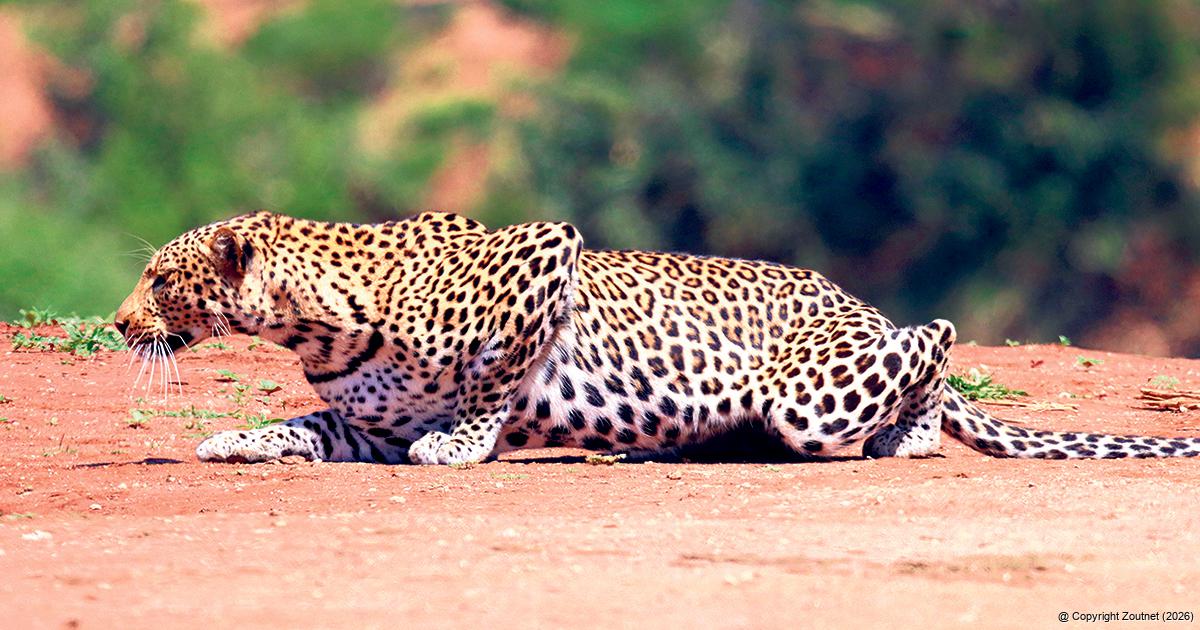
Last week’s sighting, however, indicates that some leopards are indeed left in the Soutpansberg and apparently more than people think.. Photo taken by Anton van Zyl and for illustrative purposes only.
Leopard sighting shows Soutpansberg is still their home
News Date: 31 March 2023
The issuing of a warning that a leopard was spotted trying to make its way into a residential area of Louis Trichardt last Wednesday night, 22 March, caused quite a stir in town. The warning was issued by the Makhado Police and spread like wildfire on social-media groups. Many residents were, however, doubtful of this, shrugging it off as fake news.
Makhado police spokesperson sergeant Irene Radzilane confirmed, however, on Thursday morning, 23 March that the police had indeed issued the warning. Radzilane stated that around 21:00 the previous evening, a motorist travelling on the N1 north had almost collided with the leopard as it had crossed the N1 near the arrestor bed just outside of Louis Trichardt. The leopard was crossing from the Komatiland plantation side across the N1 into New Town.
“The motorist went to the police station to report the incident,” said Radzilane.
Following the incident, Mr Isaac Lukoto of the office of the Department of Economic Development, Environment and Tourism in Louis Trichardt responded by saying that leopards are not uncommon to the Soutpansberg, which boasts a healthy leopard population.
Since the mountain range is its natural habitat, Lukoto said that chances were that the leopard had already returned to its more protected surroundings. Having said that, he still asked residents to remain vigilant and to not try and capture or kill the animal when spotted. He urged members of the public to rather call the local authorities to report any sighting. Their office can also be contacted at Tel 082 904 5812.
The leopard sighting once again raised questions about the Soutpansberg’s leopard population.
The Zoutpansberger last wrote about the Soutpansberg’s leopard population in April 2017 when it ran an article about the sharp decline in leopard numbers because of illegal killings. This was after conclusion of a long-term study by researchers from the department of anthropology at Durham University in the United Kingdom (UK). The study found that leopard density (the number of leopards per 100 km²) in the Soutpansberg had decreased by 44% between 2012 and 2016 and by 66% since 2008.
The research project, under the then guidance of Dr Sam Williams, aimed to understand more about the threats these big cats are facing. Dr Williams explained the significance of the decrease they found. “If the current rate of decline is not slowed down, then there will be no leopards left in the western Soutpansberg mountains by 2020. This is especially alarming, considering that in 2008 this area had one of the highest leopard population densities in Africa,” said Williams in a press release at the time, issued by the Durham University marketing and communications office.
Last week’s sighting, however, indicates that some leopards are indeed left in the Soutpansberg and apparently more than people think. For instance, one farmer (who wanted to remain anonymous) told the newspaper of how he had once had a problem with a leopard taking his young cattle calves. Bait was placed, along with cameras to notify the farmer when the leopard took the bait. Video footage later revealed that instead of one leopard, six or seven different leopards were in fact taking the bait to feed.
That local golfers have spotted leopard tracks at the Soutpansberg Golf Course is also no urban legend. Local mountain bikers have also reported leopard tracks and indications of recent kills by leopards while cycling in the mountain. One of the many single mountain-biking tracks in the mountain is even dubbed “Leopard Spoor”.
But what could have forced the leopard sighted last week to venture into town? Many believe that this might be the result of a change in habitat or of food scarcity. That baboons are on a leopard’s menu as food is a well-known fact. Recently, troops of baboon have been spotted moving further and further into Louis Trichardt’s residential areas.
The Zoutpansberger managed to track down Dr Williams, who led the long-term research study until 2016. He indicated, however, that he was no longer involved with the project and referred the newspaper to a colleague of his, Professor Russell Hill, a professor of Evolutionary Anthropology at the Department of Anthropology, also at Durham University.
Hill said that they were still busy with leopard research in the Soutpansberg. He said that they were aware that a stable and reasonably sized leopard population was present in the mountains. “The leopards are generally wary of humans, preferring the steep slopes and denser vegetation. However, because the mountains are surrounded by human habitation, leopards may move through these areas to reach other areas of preferred habitat. Typically, they move at night and at times when people are less active. Leopards also tend to avoid major roads, but will cross them to move between areas. My expectation would be that this is a leopard moving between areas rather than entering the urban spaces,” Hill said.
Written by
Andries van Zyl
Andries joined the Zoutpansberger and Limpopo Mirror in April 1993 as a darkroom assistant. Within a couple of months he moved over to the production side of the newspaper and eventually doubled as a reporter. In 1995 he left the newspaper group and travelled overseas for a couple of months. In 1996, Andries rejoined the Zoutpansberger as a reporter. In August 2002, he was appointed as News Editor of the Zoutpansberger, a position he holds until today.

ADVERTISEMENT: