

ADVERTISEMENT:
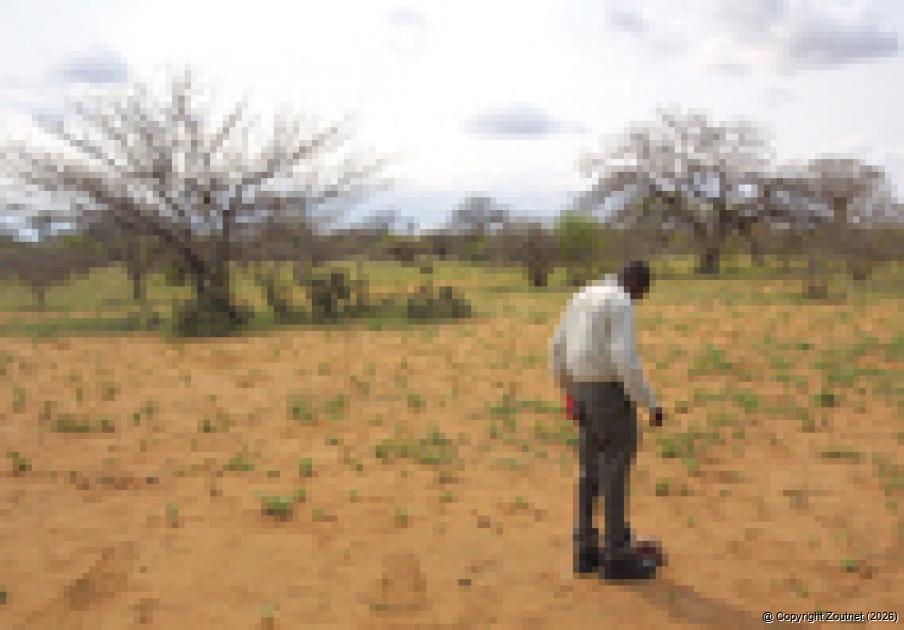
Mr Kuda Muchenje, technical manager for the Chapudi Coal Project, at the previous drill site which has already been rehabilitated successfully. This site was drilled a year ago.
Mining giants activities no threat to residents
News Date: 19 October 2007
Although news of the mining giant Rio Tinto’s interest in the possibility of coal mining within the Waterpoort farming community caused great concern amongst farmers, the message from Rio Tinto is clearly not to panic, as there is still a lot to be done before a coal mine could become a reality.
According to both Mr Mac Mashinini, community relations officer, and Mr Kuda Muchenje, technical manager of Rio Tinto involved with the Chapudi Coal project, there is still a lot more to be done with regard to exploration. They indicated that the farmers and other community members will always be kept well informed of any further activities.
Mr Mashinini told the Zoutpansberger that Rio Tinto has always done everything in the open and will gladly share information with all those affected, as well as the media.
The name of the proposed coal project in Waterpoort is the Chapudi Coal Project, named after the farm where the first signs of coal were discovered some time ago with the drilling of the first borehole.
According to Mr Muchenje, the coal was discovered some 40m to 50m deep behind the Soutpansberg Mountain and stretches as far as 34 kilometres toward the Kalkbult Farm in the east.
Mr Muchenje said that the coal they were interested in was not deeper than 200 meter and was perfect for open-cast mining. If it is deeper than 200 meters, however, it will qualify for shaft mining and that is an option Rio Tinto will not easily consider, due to the risk of the ground collapsing.
In order to show Rio Tinto’s openness with regard to the public point of view, the Zoutpansberger was taken to a drill site and showed around. This drilling took place on the Grootbomen farm, east of the Chapudi project.
According to Mr Muchenje, this site is within a fault, causing a dramatic downfall, which makes the coal deeper than 200 meters. Drilling still has to be done in order to determine how deep the coal is and to conduct thorough tests.
The boreholes are all part of the exploration process to determine the depth of the coal and the availability of water.
This issue is very important, considering that a power station would require a lot of water. Even more important is that there must still be enough water for the local farmers to make use of. Muchenje told the Zoutpansberger that the last thing they as Rio Tinto want to do, is to compete with farmers over the water and if it isn’t enough, water will have to be brought in from another source. Muchenje and Mashinini showed the newspaper around a drill site. It has been made safe and the necessary precautions have been taken to clear the site of all material which can cause contamination or pollution. Mr Muchenje said that the current exploration was all about doing things the right way. Sadly, there were some companies in the past who tried to take shortcuts, but Rio Tinto has standards which have to be upheld at all times. The three main aspects Rio Tinto concentrates on are general safety, the environment and the community.
The Zoutpansberger was also taken to a drill site which had been completely rehabilitated. Mr Muchenje proudly showed the Zoutpansberger that the rehabilitation process has been successful and that the tell-tale signs of drilling activity have been covered completely.
Photos taken of the site before and after drilling shows that the terrain is looking just like it did before the drilling took place last year, proving that rehabilitation is possible. According to Muchenje, drilling is usually done along the gravel roads in already existing open spaces, which means that trees aren’t removed unnecessarily.
Other boreholes visited were completely sealed. Those that were not sealed were either going to be used by the farmer, or were used to conduct further tests with the water.
Muchenje told the Zoutpansberger that if a farmer wanted to use a borehole, they did not seal it and signed over responsibility to the farmer. However, Rio Tinto could refuse to leave a borehole open if there was any possible risk.
The water which is being tested is to determine already existing contamination, the amount of water which is available and the fluctuation of such water.
Both Mr Mashinini and Mr Muchenje are currently busy visiting farmers who did not attend the information meeting held a while back. According to Mr Mashinini, farmers, community members or any other people who would like more information on what they are doing or what Rio Tinto is all about, are more then welcome to contact him on tel. 082 909 7001.
Written by
Riaan de Swardt

ADVERTISEMENT: