

ADVERTISEMENT:
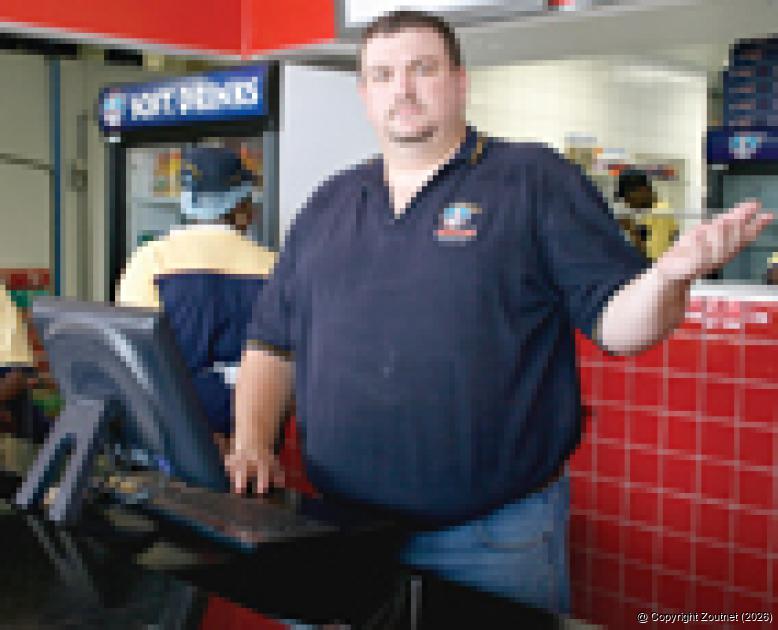
Mr Corné Smith, owner of Roman’s Pizza in Louis Trichardt, said the latest interruptions hit his concern exactly at peak morning and evening vending hours, causing serious losses in business revenue and frustration and disappointment for his clients.
Dark days for local business as Eskom leaves them powerless
News Date: 14 December 2007
Eskom’s latest nationwide power outages caused havock, inconvenience and serious financial losses locally. A senior spokesperson for the local Chamber of Commerce says Eskom’s handling of the problem can have a devastating long-term effect on private enterprises and local job creation efforts.
Monday morning’s unannounced power cuts caught almost the entire business community unawares – despite Eskom’s official assurance that "in most cases customers can be informed of interruptions in advance".
Prominent local businesman Mr Robert Rauch said the present pre-warning system for Eskom’s massive load shedding schedule is totally ineffective and should receive serious attention in the interest of the general wellbeing of trade and industry. Mr Rauch, running an internationally renowned food-processing enterprise in Louis Trichardt, confirmed large-scale losses in production, due to the latest power cuts.
The entire community was affected by this week’s load shedding. Private households, together with all business concerns, felt the impact. In some instances, businesses had to close down during the power cuts, with resultant losses in business and income. Elsewhere, expensive emergency back-up systems had to be activated at high cost. Banks, bakeries and food-processing businesses, together with other manufacturers, were faced with losses in production and revenue. Clients were inconvenienced at autotellers, where their banking cards were "swallowed" when the power went off. Many could also not make deposits that need to be processed electronically. In the manufacturing trade, where the quality of the end product sometimes depends on an uninterrupted processes within a specific time frame, losses were in certain instances massive and unavoidable, due to the lack of an effective pre-warning system.
A spokesperson for a major motor tyre business in Louis Trichardt, Mr Wayne Steyn, said the entire business came to a halt because none of the tyre-fitting and balancing equipment could be operated without electricity. The retread manufacturing component of the business suffered major losses, due to interruptions which occurred at crucial stages in the manufacturing process.
"Apart from the direct loss in production, material and business, we are also faced with unproductive running expenses, like salaries for our more than 30 staff members who are present but unable to render any profitable service," he said. Mr Steyn said if Eskom could give reasonable pre-warning of the specific times of power shedding within a specific area, production times in crucial manufacturing processes could be adapted accordingly.
The manager of a local fast-food franchise in Louis Trichardt, Mr Corné Smith, said the latest interruptions hit his concern exactly at peak morning and evening vending hours, causing serious losses in business revenue and frustration and disappointment for his clients.
People who tried to access Eskom’s website, which purports to give complete schedules for the power shedding, reacted with anger and frustration. The load shedding schedules are available on the website www.eskom.co.za. Customers are warned, however, that the schedules are applicable to the current situation and they should check regularly "as the situation can change from time to time." Those who tried this say it is almost impossible to access the website when power is available to do so and the available information does not allow for timeous planning.
Business concerns relying heavily on electronic equipment suffered serious damage during power surges when the power came back on, resulting in damage to computers and other appliances.
Eskom has implemented nationwide load shedding from Monday this week, due to a national capacity shortage. Load shedding is expected to continue for the rest of the week.
In a media statement Eskom said this week that the capacity shortage is mainly due to high levels of maintenance and unexpected plant failures over this period.
"With 24% of our total generating plant on unplanned and planned outages, we are approximately 2500MW short on demand," said Erica Johnson, Eskom’s managing director of systems operations and planning. Load shedding occurs when there is not enough electricity available to meet the demand from all customers, which results in interruptions in supply to certain areas.
According to the statement, Eskom controls the manner in which it rotates the available electricity amongst all customers through load shedding schedules. These schedules are drawn up to ensure that a few areas do not bear the brunt of shortages.
"By spreading the impact, affected areas are not interrupted for more than two hours at a time and in most cases customers can be informed of interruptions in advance," reads the statement.
Eskom once again urged consumers to conserve energy by switching off non-essential appliances and equipment and to consume electricity sparingly.
"The more electricity South African consumers can save by switching off non-essential appliances, or not switching them on, the fewer power outages there will be," reads the statement.
Eskom advised people with special needs, such as medical support equipment, to notify their medical practitioners so that special arrangements can be made. When Zoutpansberger enquired about the specific nature of the "special arrangements", the Eskom spokesperson was vague and said application forms should be filled out for such assistance at the local branch office of Eskom.
The energy supplier has also advised the public that when the power goes off, it is safer to turn off or, even better, to disconnect any electrical appliances that were in use. One light can be kept on, to alert you when the power returns. When the power comes back on, it may do so with a momentary surge, which can damage electronically controlled appliances such as computers, television sets, VCRs and DVDs, according to the Eskom statement issued this week.
Written by
Frans van der Merwe
Frans van der Merwe is a freelance journalist with more than 40 years experience in the newspaper industry. Apart from newspaper reporting, he was also involved with radio news, news reading, training and marketing. He has been living and working in Louis Trichardt since 1991.

ADVERTISEMENT: