

ADVERTISEMENT:
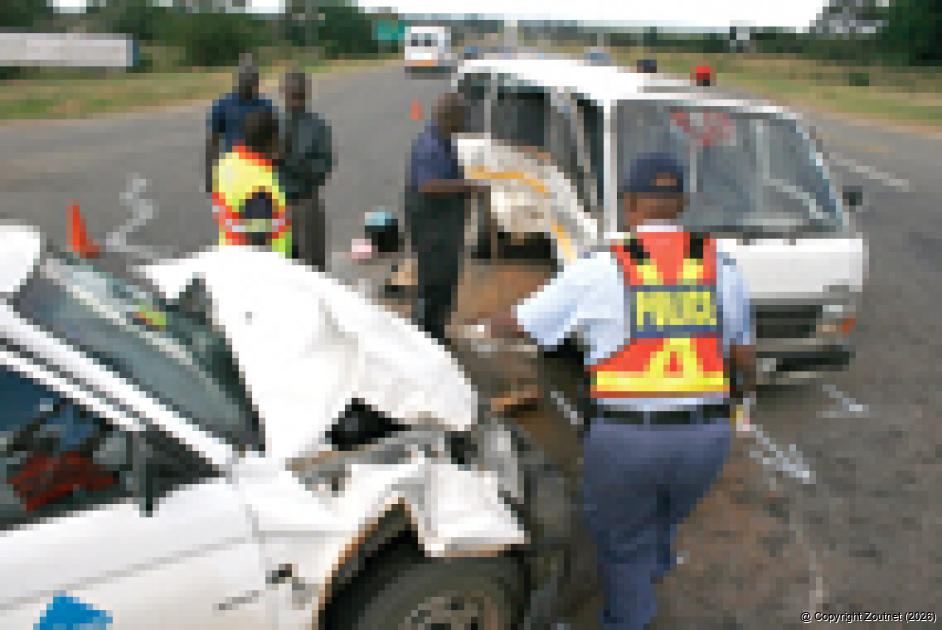
The dangerous N1/Elim intersection was the scene of yet another accident on Wednesday morning when a Telkom bakkie and a minibus taxi collided with each other. Fortunately, no fatalities were reported, but several people were injured. Appeals to the South Africa National Road Agency, who is the responsible authority, to look at ways to make the crossing safer, seem to fall on deaf ears.
Appeals to make intersection safer seems to fall on deaf ears
News Date: 08 February 2008
As traffic volumes on the region’s road increase, the possibility of vehicle accidents also increases. Although difficult to predict any accident, there are, however, some areas that are more prone to vehicle accidents. These areas are often referred to as high-accident zones.
One such place which earned itself the reputation as a high-accident zone is the N1/Elim intersection just south of Louis Trichardt. This intersection has, over the years, been the scene of many an accident, several of them fatal. Among those who have died at this intersection, was well-known local and international sculptor John Baloyi (42) in May 2006.
At the intersection, there are stop signs for traffic from Elim and Ledig, with an 80km/h speed limit for N1 traffic travelling both north and south. This speed limit on the N1 south is increased to 120km/h just a few metres past the intersection. Over peek periods and when the nearby CVO Skool Zoutpansberg comes out, traffic from mostly the Elim area backs up for a considerable distance.
At this point, two things happen. Firstly, motorists travelling from Elim who are trying to turn onto the N1 to Louis Trichardt become frustrated while waiting in the long queues and take dangerous chances by crossing the intersection in front of vehicles travelling at 80km/h and faster. Secondly, because the long queues obstruct the view of motorists travelling south on the N1, it often happens that vehicles travelling from Elim, wishing to join the N1 south and passing the queue on the left, end up in front of vehicles travelling south.
Rondebosch resident Mr Kobus Posthumus, whose property borders the intersection, said three weeks ago that he had had enough. He himself was the victim of a vehicle accident at the intersection on December 21 during which his brand new Toyota was completely wrecked.
"After my crash, I heard that there had been four other accidents that same weekend. Something has to be done to make this crossing safer, before more people die. Why can’t they just erect a four-way stop street or traffic light? This is a recipe for disaster," said Posthumus.
Following this, the Zoutpansberger established that the Makhado Municipality had apparently requested the South African National Road Agency Limited (SANRAL), under whose control the N1 falls, in 2002 already to erect a four-way stop at the intersection, due to the high frequency of accidents. A call was made to SANRAL spokesperson Ms Wendy Watson to inquire about the municipality’s request and what SANRAL is planning to do to address the issue. This was followed up with an e-mail to her on January 22, outlining the problem and requesting a response.
On Wednesday, January 23, a reply e-mail was received from Watson, stating that this was a new query and that she could only respond to it by Monday, January 28. No response was received, however, and another e-mail was sent to Watson to remind her. Again, no response was received.
On Wednesday morning, February 6, disaster struck again. News came that a minibus taxi and a Telkom bakkie had collided at the intersection. Fortunately there were no fatalities, but several people sustained injuries. Later it came to light that it had already been the second accident at the intersection this week.
In the meantime, the Zoutpansberger is still waiting for a response from SANRAL. Another e-mail was sent to Watson, informing her of the crash.
Written by
Andries van Zyl
Andries joined the Zoutpansberger and Limpopo Mirror in April 1993 as a darkroom assistant. Within a couple of months he moved over to the production side of the newspaper and eventually doubled as a reporter. In 1995 he left the newspaper group and travelled overseas for a couple of months. In 1996, Andries rejoined the Zoutpansberger as a reporter. In August 2002, he was appointed as News Editor of the Zoutpansberger, a position he holds until today.

ADVERTISEMENT: