

ADVERTISEMENT:
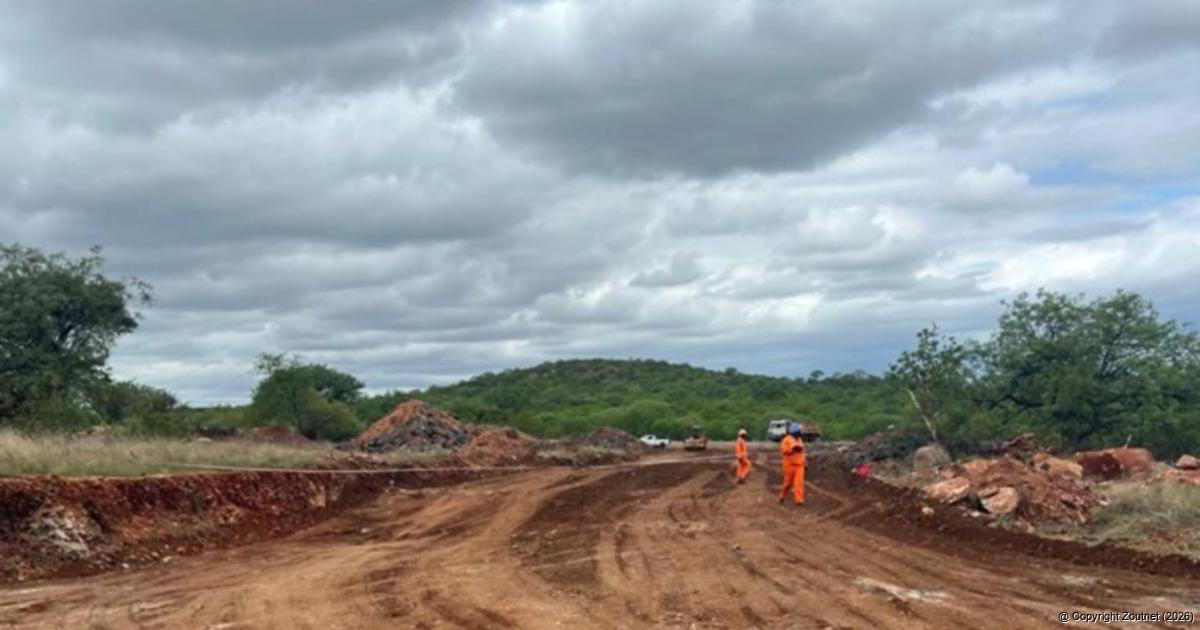
At the northern site Tshiamiso Trading started with road construction, but stopped. The report states that transfer of ownership of the land has not yet been finalised. R50.4 million of the R200 million contract was paid to the company. Photo: Living Limpopo
MMSEZ dream suffers as promises fail to materialise
News Date: 19 June 2025
Almost a decade after first being grandstanded by the government, the Musina Makhado Special Economic Zone (MMSEZ) remains little more than pie in the sky for many, with the only people seeming to benefit from its existence thus far being those on the MMSEZ state-owned company (SOC) payroll and, of course, the multitude of consultants, service providers and tenderpreneurs. The project has all but ground to a complete standstill, but, says the MMSEZ SOC, they have new plans to kickstart the project again.
This came to light in a recent report compiled by Dr N F Mphephu, chairperson of the MMSEZ board, addressed to the portfolio committee of Limpopo Economic Development, Environment and Tourism (LEDET), dated 28 May this year. The report followed recent questions in Parliament about the project's progress and an oversight visit by the LEDET portfolio committee to the northern and southern sites just north of the Soutpansberg in Limpopo. With hundreds of millions of rands already spent by the government to keep their highly controversial mega industrial park dream in the heart of the Limpopo Valley alive, it would also seem that little or nothing has come of the billions of rands promised in investor support.
A copy of Mphephu’s report was also sent to the Limpopo Economic Development Agency (LEDA) chairperson of the board, Mr C Lithole. LEDET and LEDA stand central to the day-to-day wheeling and dealing of the MMSEZ without, it seems, much government interference.
This became evident in a recent written reply to a question asked by the Democratic Alliance’s Mr Toby Chance in the National Assembly in May. Chance asked the Minister of Trade, Industry and Competition (DTIC), Mr Parks Tau, to give a breakdown of the costs already incurred on the MMSEZ project; the projected total cost; and who is funding the project, including private stakeholders and what amount is funded by his department.
In response, the minister said that the DTIC has not provided any funding for the project and that the project is funded by LEDA; therefore, all questions should be directed to LEDA.
Billions still needed?
A similar question about cost was asked by Chance in the National Assembly in January this year, when the DTIC minister said that the MMSEZ had indicated that they had “secured via the Provincial MTEF for the period 2020/21 – 2026/27, R1,070 billion in order to complete the basic infrastructure necessary”. Furthermore, the minister said that the DTIC’s Industrial Zones Programme was assisting the MMSEZ entity with technical infrastructure advisory support to ensure the development and implementation of infrastructure is done on time and within budget. At that stage, the minister indicated that the estimated funds required to complete the bulk infrastructure was R2,270 billion and, according to the MMSEZ entity, from the R1,070 billion MTEF allocation, they had already received R510 million to date and a further R1.2 billion was still required.
What was spent and who benefited to date?
In his report, Mphephu gives a list of consultants, service providers and contractors who have benefited to date, the bulk of whom are consultants. To date, just over R85.2 million has been approved, of which just over R67.5 million has been paid to consultants. Of the just over R56.6 million approved for service providers, including the ESKOM, just under R40 million has been paid out. According to the report, three contractors have so far benefited, including Tshiamiso Trading, who received R200 million and R99.3 million contracts respectively for internal roads and stormwater, and for the construction of bulk sewer and wastewater treatment works. A contract for R134 million was awarded to Rembu Construction, also for the construction of bulk sewer and wastewater treatment works, and although the report states that they had been paid in full, it is doubtful whether they have started construction.
R50 million “down the drain” already?
Given the amount spent on consultancy fees, one would have assumed that everyone had done their homework. Apparently not.
Among the issues that brought development of the MMSEZ to a halt – with specific regard to the northern site (Artonvilla) – was that Tshiamiso Trading began with bush-clearing operations for the construction of roads because it was taken for granted that the remainder of the land was owned by the developers. It was not. It turns out that the land belongs to a different state organ, and a transfer of ownership needs to take place first. The report states that they assumed this process would be expedited, which was not the case.
Tshiamiso Trading has since been halted from proceeding with the R200 million contract. They subsequently terminated their internal-roads and stormwater contract with the MMSEZ after being paid just over R50.4 million. Tshiamiso is claiming more money from the MMSEZ, citing non-payment for standing time. This dispute is currently in litigation.
Tshiamiso Trading is no stranger to legal challenges and has a somewhat questionable reputation regarding its tender processes.
Regarding the MMSEZ northern site, Tshiamiso Trading is also accused of unlawfully removing white rock materials. These materials, transported to the MMSEZ site by Tshiamiso Trading, were reportedly taken from a third party without the owner's consent or any formal agreement or compensation.
Contractor problems not the only legal headaches
Although the MMSEZ southern site was gazetted as a Special Economic Zone in 2017, it also turns out that the northern site at Artonvilla has yet to be gazetted. The report states that the Limpopo Government had indicated they would be submitting a request before the end of June 2025 to gazette the northern site. Again, it would seem that the cart was placed before the horse.
The report also highlighted other legal challenges experienced with interested parties. “It must be highlighted that since the pronouncement of the South site, there has been fierce oppositions, dissenting views and pushbacks from some interested parties. These are in the main from environmental lobby groups. Some of these objections are, the Environmental Impact Assessment that was approved by the competent authority in accordance with the NEMA, is being subjected to the judicial review by the lobby groups at the High Court of South Africa, Polokwane Division,” the report reads.
Notwithstanding this, the report says there has not been any interdict against the development. “Therefore, all activities leading to the development, including township establishment processes, are expected to proceed. The challenge that these strong oppositions present to the township establishment is that the township establishment application should be beyond reproach and be premised on reasonable, clear and justifiable scientific facts,” the report reads.
Investors hesitant to invest despite pledges
When the MMSEZ was officially announced by the South African government - when President Cyril Ramaphosa publicly announced it in September 2018, following his return from the Forum for Africa and China Cooperation - it came with the promise of an initial investment value of more than R40 billion. To date, little of that money appears to have materialised.
The report states that of all the initial investors, only the Kinetic Development Group (KDG), a China-based company, has come to the party, with a R16 billion investment deal - this for the establishment of a ferrochrome plant upon obtaining township establishment and plant EIA approvals at the southern site.
To better understand just how dire the MMSEZ’s position is regarding investors, one only has to take a look at the Democratic Alliance’s Mr MM Mdluli's question to Minister Tau in the National Assembly, also in May, about investor contributions.
In reply, it was stated that a verification process was conducted to ensure that prospective investors identified were assessed for their credibility, timelines and readiness to locate in the SEZ. Their findings indicated that there was an investment value pledged of R8.647 billion, of which R2.115 billion has been verified and validated from the eight prospective investors. According to MMSEZ, no investment commitments have been paid as the zone is not operational as yet.
And then lastly, where is the water coming from?
Amidst all the wheeling and dealing to get the MMSEZ project up and running again, one of the biggest questions still remains – where is the water going to come from? The demands for water for both sites were determined in the infrastructure masterplans. On the basis of these demands, the MMSEZ approached the Water Services Authority (Vhembe) and the catchment management agency (DWS) in the region to determine whether they have sufficient capacity - either from treated or raw water - to supply the developments.
For the northern site, reads the report, Vhembe agreed that it could provide the MMSEZ with some of its allocation for raw water to kickstart the development. This allocation will be sufficient to develop the entire site. The DWS outlined its project of bringing treated water from Zimbabwe to the region for the future development of the site, which will be supplied via pipeline. “For the south, a few boreholes were drilled in order to start the development of the site. For further development, a pipeline needs to be built to connect to the bulk pipeline from Zimbabwe. Furthermore, two dams are earmarked to be constructed in future to specifically provide water to the site as it grows,” the report reads. As far as could be determined, plans for the Musina Dam are being advanced, and a tender for the feasibility study has been awarded.
Still selling the dream
The report’s main aim is not only to give feedback on the project thus far, but also to expand on the 2025 to 2030 five-year plan of action by the MMSEZ to kickstart the project again. Considering the stage that the entity finds itself in, this strategy is mainly focused on infrastructure development and therefore provides a guide as to how resources should be allocated over the next five years. We will be taking a closer look at these timelines in follow-up articles.
Written by
Andries van Zyl
Andries joined the Zoutpansberger and Limpopo Mirror in April 1993 as a darkroom assistant. Within a couple of months he moved over to the production side of the newspaper and eventually doubled as a reporter. In 1995 he left the newspaper group and travelled overseas for a couple of months. In 1996, Andries rejoined the Zoutpansberger as a reporter. In August 2002, he was appointed as News Editor of the Zoutpansberger, a position he holds until today.

ADVERTISEMENT: