

ADVERTISEMENT:
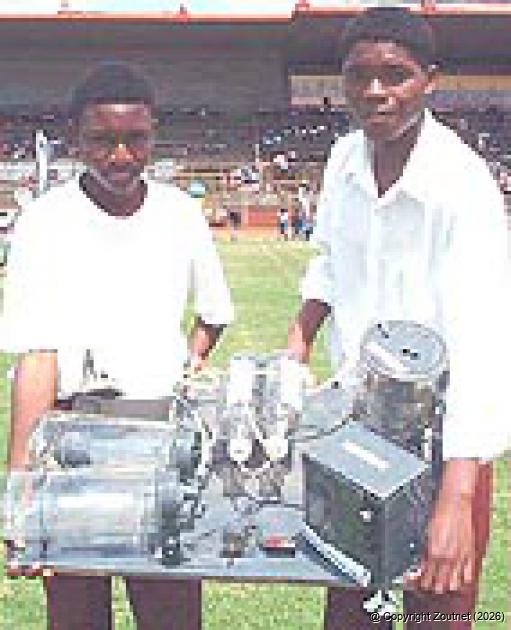
The young scientists Respect Muvhango (16), left, and Fulufhelo Selamolela (17), display the power station they built.
Students turn water into electricity
News Date: 19 November 2004
MBILWI - Two young aspirant scientists built a mini power station that is water dependent, which successfully provides an energy source for devices such as mobile phones, calculators and radios. The new technology can provide an alternative energy source to rival wind and solar power, although it will need a huge quantity of water to work on a commercial scale.
Fulufhelo Selamolela (17) and Respect Muvhango (16) are Grade 11 learners at Mbilwi Secondary School near Thohoyandou.
The project has won several awards, which include Best Energy Project (Regional Science Expo 2004), Best Project Award (District Science Expo 2004), Gold Medallists (Regional Science Expo), and they also participated in the National Science Expo held at the University of Pretoria on October 2.
Although the young scientist used cheap material like old plastic and tin containers, electric wires, cardboard boxes, pipes and old radio motors, their project has recently been the talk of the town and they proved beyond doubt that it works!
“We now dream of international acclaim and we believe that we have set a clear example that even rural folks like ourselves can invent something that can benefit the whole world,” said Fulufhelo.
He continued to explain how the project works: “The process starts in the cold water tanks where distilled water is transferred to hot cylinders. The hot water cylinders change water into steam and the steam is then cooled in the cold water cylinders where electric sparks are trapped to form a current which is transported to a transformer. The transformer distributes power to the motors and the energy is finally distributed as electric-ity.”
Fulufhelo said their power station is fitted with a switch to control the amount of voltage needed for the specific use.
“The voltage must be controlled carefully to support the equipment with the maximum power required. We are still prepared to invent more new technology to contribute in the improvement of scientific knowledge of our communities,” said Fulufhelo.
Fulufhelo and Respect’s Science teacher, Mr Sydney Nembulu (42), said he is proud of the boys because they are a symbol of hard work and success.
“They did everything on their own and we only guided them where necessary. Their skills must be nurtured because they are our future scientists who will come up with more inventions to uplift our communities. By winning several wards, it clearly indicates that the young boys are committed, and I believe that other learners will learn from them. South Africa needs young and creative brains and this is a sign that we have plenty of them in our area, but all they need is proper guidance and encouragement,” said Nembulu.
Written by
Wilson Dzebu

ADVERTISEMENT: