

ADVERTISEMENT:
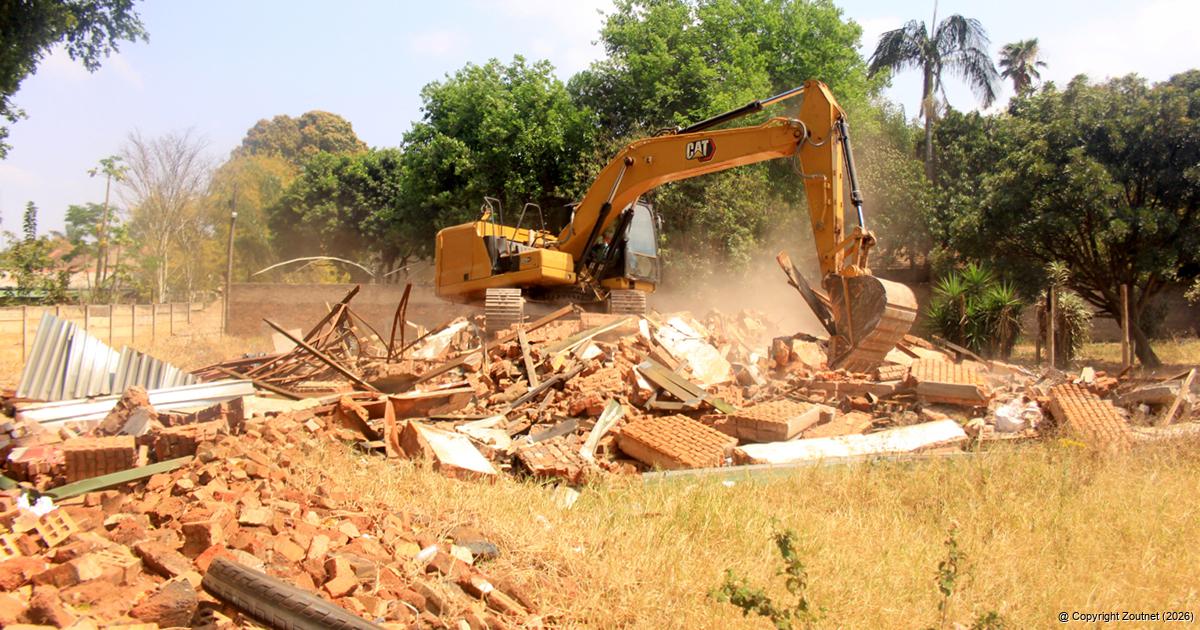
Sex workers on Grobler Street in Louis Trichardt shouted at municipal workers as the house that they referred to as their “office” was demolished on Friday, 19 September. Photo: Thembi Siaga.
Sex workers threaten price hike after 'offices' are demolished
News Date: 26 September 2025
By Thembi Siaga and Kaizer Nengovhela
The Makhado Municipality’s demolition blitz last week was welcomed by Louis Trichardt residents, though not all were pleased to see their homes of the past few years destroyed. As the walls of one derelict building began to crumble, the sex workers who stayed there shouted obscenities at municipal workers, even threatening to increase the tariffs for their “services.”
The house on the corner of Grobler and Joubert Street, from which the sex workers operated, is just one of several structures flattened by teams from the Makhado Municipality. The operation, which began on 12 September, was led by Mayor Dorcus Mboyi.
Last week, this newspaper reported on the demolition of an illegal recycling plant operating from premises in a residential area. The municipality not only removed all the rubbish but also demolished the structures that had been built on the site illegally. The local pastor who had operated the recycling plant since 2019 was fined R733,709.80.
Neighbours who had endured the inconvenience of living next to a dumping site were relieved that the municipality had finally started enforcing its by-laws. Backed by the South African Police Service, the Department of Home Affairs, and local security companies, the municipality demolished more than a dozen illegally occupied buildings and cleared businesses operating in defiance of municipal regulations.
The municipality said repeated warnings had been issued before the demolition, including public notices, pamphlet distribution, loud-hailing campaigns, and on-site warning boards.
Local municipalities are obliged to enforce compliance with land-use schemes and building regulations. If property owners ignore warnings, the municipality can apply to a court for an order to demolish illegal structures or prevent further illegal building. Property owners are also responsible for the cost of cleaning the property and removing the structures.
Makhado Mayor Dorcus Mboyi said the crackdown was only the beginning. “More raids are coming, and more illegal businesses will be shut down. Makhado will never be a playground for lawlessness. We welcome legal businesses and rightful occupants, and we will not stop until every street is safe and compliant.”
But the sex workers who witnessed their “office” of the past couple of years being demolished last Friday were less impressed. The house they occupied had partly burned down a couple of years ago and had been left deserted.
When municipal teams arrived with TLBs and graders, the sex workers began shouting, accusing them of not respecting their rights and dignity.
One worker, who asked not to be named, said: “The municipality workers call us names, and today they have destroyed our office. You are hurting us. Take us as people, like you do when you ask us to vote. You come here during elections to ask us to vote — how?”
The women said they used the building as both their home and office. Its destruction has left them vulnerable, forcing some to consider using nearby bushes. They also warned that they might increase their fees as a result.
Residents living nearby said they were at their wits’ end with illegal activities at the premises, which they said was used as a brothel and a drug house. Complaints included frequent drunken fights, deliveries at all hours, and the burning of stolen plastic cables behind the property.
“There is always shouting and fighting among the sex workers about customers or money, and condom wrappers litter the street,” said one resident. He added that the house also served as a “safe house” for criminals, and that complaints to the authorities were ignored.
Another sex worker, who asked to be identified only as Fridah, said the municipality had never consulted them before demolishing the building. “They started demolishing the houses where we used to sell our bodies, saying protocols were not followed,” she said. “Many of us have children who rely on us. Some of us are here because of poverty, unemployment, or abusive families. It is tough to survive in this business, especially with competition from other sex workers.”
Written by

ADVERTISEMENT: