

ADVERTISEMENT:
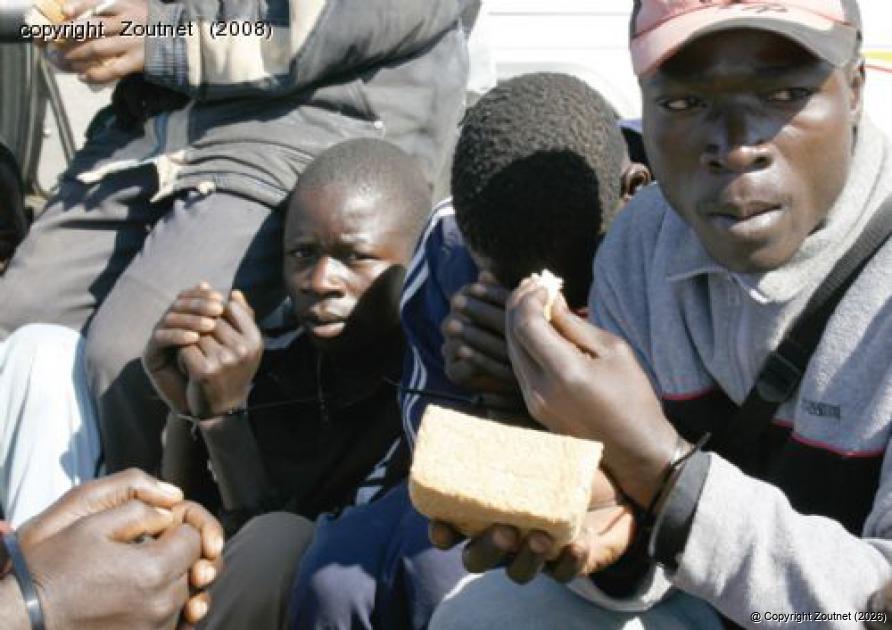
A group of hungry Zimbabweans after they were caught trespassing on farms north of the Soutpansberg.
Preparing for the worst - UNHCR meet to discuss Zim crisis
News Date: 09 May 2008
During the past week, representatives of the United Nations High Commissioner for Refugees (UNHCR) urgently discussed contingency plans with relevant stakeholders in the north of the Limpopo Province involved in giving care to fleeing Zimbabwean citizens, which include pregnant women and a growing number of unaccompanied Zimbabwean children in Musina and Louis Trichardt.
Several international agencies involved in emergency services to refugees have already established offices in Musina and in Louis Trichardt. Both towns, together with the capital city of Polokwane, have been identified as centres for the establishment of facilities to harbour refugees.
The consensus of opinion amongst stakeholders at this stage is that the Zimbabwean refugee problem presents South Africa with a unique situation which cannot be dealt with effectively by existing official structures and procedures. Serious questions arose about the legality of continued deportation procedures, in the light of the latest political situation in Zimbabwe.
While the national Department of Home Affairs and the South African police officially denied any knowledge of an increase in the number of people crossing the South African border from Zimbabwe this week, international agencies, including the United Nations High Commissioner for Refugees, took cognizance of a stream of several hundreds per week, applying for assistance at established emergency centres in Louis Trichardt and Musina. Contingency plans for the handling of refugees were presented by UNHCR representative Sede Groot to stakeholders during a meeting held at the Musina show grounds on Wednesday last week. The Musina Municipality confirmed earlier this year that a venue for the establishment of a serviced temporary tent town to accommodate refugees has been identified and that plans are afoot to meet any emergency in collaboration with other departments.
When she was asked what special precautions are being taken to ensure that Zimbabweans fleeing from the present crisis in that country are informed about their right to asylum and are protected against deportation into a situation of persecution, the chief director of communications at Home Affairs, Siobhan McCarthy, said there was no crisis in the present movement across the border. The department has a contingency plan in place to manage such eventuality. She said there were clear guidelines for asylum seekers.
Whilst denying any signs of a crisis in the number of Zimbabweans crossing the border, neither the police nor Home Affairs could give any statistics of the number of Zimbabweans being removed on a daily basis from the SAPS offices in Louis Trichardt to Musina and Beit Bridge for deportation. Ms McCarthy could only confirm that some 1 500 "illegal immigrants" had been deported during April this year from the Lundella centre.
In response to a question about what precautions the SAPS were taking to ensure that its members respect the non-refoulment principle of international law at all times, with regards to people now being deported to Zimbabwe, the national communications department of the SAPS denied "any involvement by the SAPS in the deportation of Zimbabweans." A spokesperson said the SAPS only gave transport assistance to Home Affairs, when needed, but was in no way involved in the administration of the deportation action. The non-refoulment principle implies that a person may under no circumstances be deported back to a situation where persecution can be expected.
On the issue of unaccompanied children, who seem to be rounded up at random and deported across Beit Bridge, a social worker, who requested not to be identified, said social services and official children’s homes in Zimbabwe were, to a large extent, non-functioning. To deal with these children in a responsible way, until the situation in Zimbabwe has normalized, not just places of safety but also interim places of education are needed to take care of them. Destitute Zimbabwean children who are removed from the streets of Musina and escorted across the bridge for further processing in Zimbabwe return almost without exception.
"There are children’s homes, but there is no food," said one such Zimbabwean teenaged orphan, who was back in Musina less than a week after being "returned home to Masvingo."
"I come here, because here is food," he said, while inspecting the contents of a rubbish bin. He walked some 40km in his desperate bid to return. When he was taken to the clinic with signs of dehydration and hunger, complaining of severe stomach pains and headache, he was despatched with a packet of painkillers.
"If it is against international law to return an adult person to a country where persecution can be expected, how can it be in order to return a child to a situation where it is impossible to survive?" the social worker asked.
In the Vhembe district, the number of refugee children reached such a volume that officials declared it impossible to handle these children in the prescribed and internationally acceptable way, by opening juvenile court proceedings in each case. The available places of safety in the Limpopo Province are filled to capacity and even when there is room, these institutions make no provision for the continuation of the education of refugee children temporarily being accommodated there.
During the first three days of this week, eight children of school-going age reported at the two refugee assistance centres situated in Louis Trichardt. Some of them had already left school in Zimbabwe during October last year. A church organization temporarily shelters them.
Written by
Frans van der Merwe
Frans van der Merwe is a freelance journalist with more than 40 years experience in the newspaper industry. Apart from newspaper reporting, he was also involved with radio news, news reading, training and marketing. He has been living and working in Louis Trichardt since 1991.

ADVERTISEMENT: