

ADVERTISEMENT:
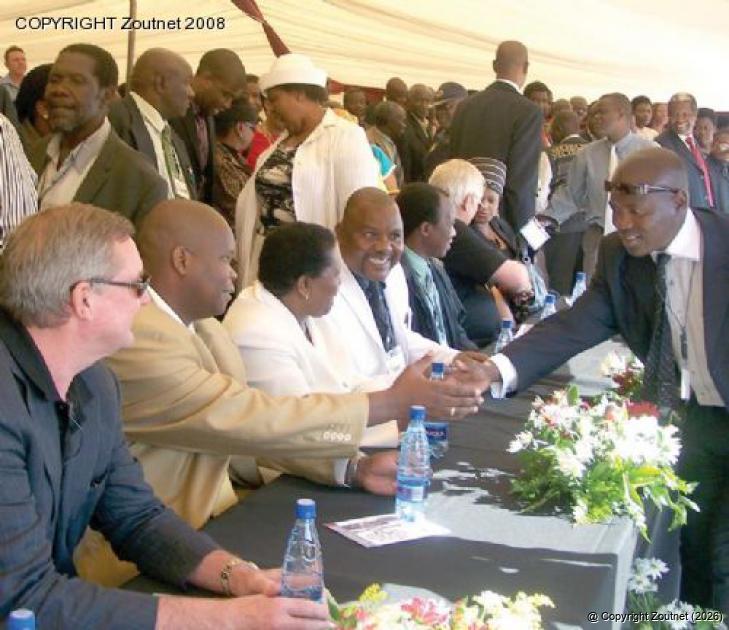
The launch of the Coal of Africa Limited mine at Mudimeli on Friday was attended by a number of dignitaries, amongst them the Minister of Mineral and Energy Affairs, Ms Buyelwa Sonjica, and Thovhele Toni Ramabulana (middle). The mine will bring development and a financial boost to the small, indigent village.
New coal mine for Soutpansberg
News Date: 06 June 2008
The small village of Mudimeli just north of the Soutpansberg has just received a huge financial boost.
Coal of Africa Limited (CoAL), an Australia-based coal mining company, launched its operations on Thursday, May 30 at the village. For this poor community, this mine’s operations will mean an enormous increase in financial activity and infrastructure.
In his address to welcome all the dignitaries and guests, Khosi vho Phineas Mudimeli expressed the wish that CoAL would make use of local people in their operations before employing people from outside. He also stressed that the school children present should take education seriously to enable them to enter the competitive job market. He condemned the xenophobic attacks which had taken place over the past weeks very strongly.
Australia’s High Commissioner to South Africa (SA), Mr Phillip Green, stressed the fact that Australia has strong trading ties with SA, evidence of which can be found in the A$15billion that country has invested in SA so far. He indicated that the community of Mudimeli would definitely benefit from the mine’s presence as around 1 000 jobs would be created by the mine’s operations. He stressed, however, that the mine’s influence would be limited and that the resources available would have to be managed carefully.
These sentiments were echoed by Mr Simon Farrell, the CEO of CoAL. He stressed that the company would need the support and cooperation of the local chief. In this regard, he indicated that the new mining laws of SA insist that any mining undertaken must be done in conjunction with the community within it operates. To that effect, the company will be investing in local employment, quality universal basic education, basic health care services, as well as investment in the area. The mine will hopefully be operational from the second half of 2009. To facilitate the improvement of education in the area, the mine is making R10 million per year available in the form of bursaries for students who wish to study in mining-related fields. The scholarship fund will be called the Thovhele Tony Ravele Mphephu Ramabulana fund, and the recipients will be known as the King’s Scholars.
In his response, Ramabulana emphasized that the mine’s operations would have to be a positive influence on the local community, especially in terms of job creation. He expressed the hope that CoAL would provide essential social development in the area. He also condemned the xenophobic attacks on foreigners, saying that SA sometimes needed to employ people from elsewhere in Africa if people here did not have the necessary skills. He expressed his joy that unemployment in the region will go down and congratulated CoAL on their achievements so far.
In turn, the Minister of Mineral and Energy Affairs, Ms Buyelwa Sonjika, expressed her appreciation for the artists who performed at the function, acknowledging that Africans express their identity through their culture. She, too, condemned the xenophobic attacks on foreigners. She indicated that SA is a major supplier of mining products to the rest of the world and that 59 different kinds of minerals are mined here. She stressed that, in the past, very little of the country’s mineral wealth had found its way to the people and these people had very little opportunity to develop their skills, mostly because they were not the co-owners of the resources. She highlighted that women used to be excluded from certain jobs in the past, such as mining engineering. However, since the law was changed in 1997, women have taken their place in this field.
Sonjika expressed the hope that the mine would bring development and essential benefits to the community and indicated that the government would be monitoring the situation closely, making sure that the land was rehabilitated while the mine operated. She also promised that the government would hold workshops with the community to empower them. When asked about the influence of the mine on the supply of coal to Eskom, in order to help alleviate the current shortage of the resource, she allayed fears that the coal produced locally would go for export.
"The current legislation specifies that our country’s own needs must take priority over companies’ export quotas," she said.
Written by
Nic Hoffmann

ADVERTISEMENT: