

ADVERTISEMENT:
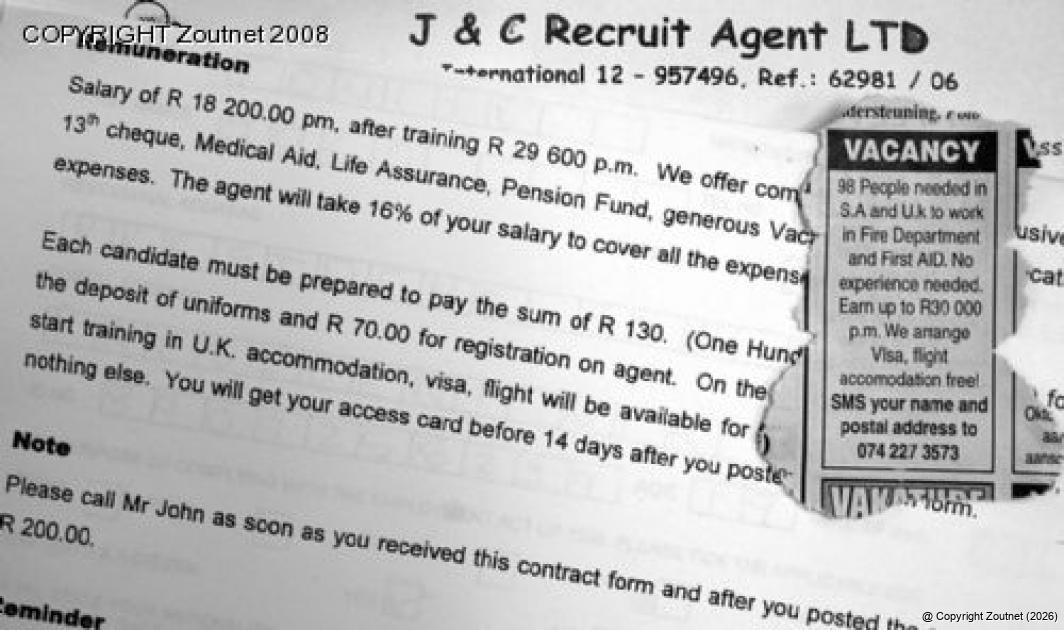
The documentation received by the young reader who reacted to the advertisement in the Zoutpansberger. He was promised a starting salary of R18 200 per month, with no experience needed.
If it sounds too good to be true, it is too good to be true
News Date: 10 October 2008
Remember the saying “if it sound to good to be true, it probably is?”
How is this for a good deal? By merely sending your name and postal address per SMS to a recruitment company, you are automatically selected as part of a group of 98 people to receive fire and first aid training for work in
But wait, there’s more … Your package also includes a 13th cheque, medical aid, life insurance, pension fund, generous vacation leave and relocation expenses. Furthermore, you will be sent for special training in
Sound too good to be true? That is because it is not true, it’s a scam.
But this is exactly what a recruitment company from
Shortly after sending his name and postal address to the company, the young reader received a letter from the recruitment agency, under the letterhead J&C Recruit Agent LTD, stating “Congratulation on your application being successful.” The letter promised all of the above “benefits”. Excitement turned to suspicion as the young man had not even filled in any application form. What caused further suspicion was that the letter, badly written and full of spelling mistakes, specifically stated that the R200 postal order must be sent by fast mail first, before a “Mr John” is phoned with any queries. A friend of the family then phoned “Mr John” on the cell phone number supplied to enquire about the company. “Mr John” promptly ended the call by stating that the matter was none of the friend’s business.
The letter from J&C Recruit Agent then made its way to the Zoutpansberger. A company search for J&C Recruit Agent LTD yielded no results. Dialling the office number supplied for J&C Recruit Agent also continuously remained unanswered. The fax number supplied was then phoned. This turned out to be the landline number for another Kwazulu-Natal-based business, a butchery and workshop, which has nothing to do with J&C Recruit Agent LTD. The owner of the butchery and workshop informed the Zoutpansberger that he sometimes uses the number as a fax line and that he had received over 200 applications for all types of employment opportunities. In all cases, the business owner phoned the applicants, informing them that this was a scam. In many cases, proof-of-payment slips were also faxed through to his number. He said he had reported the matter to the police, but that nothing had come of it.
Armed with all this information (a company that does not seems to be registered anywhere, a non-answering landline number and fax number that is actually the landline number for another business) the Zoutpansberger decided to phone “Mr John”.
A mumbling “Mr John” did not even give the Zoutpansberger time to finish explaining the nature of the call. He hung up immediately after saying that he did not talk to journalists. He was again phoned and this time the Zoutpansberger was told by “Mr John” to “Please don’t ever call this number again. Please f@*k off.”
Judging by “Mr John’s” response, it would be safe to say that he is not running a legitimate business. But what can the ordinary man in the street do when confronted with these types of employment offers and scams?
The easy answer would be to report it to the police, but judging from conversations with some top cops, chances of getting a conviction in this regard are very slim and the bad guys know this. The amounts involved are so small that most people don’t even take the time to report it when they are scammed. When they do report it, the police are faced with the task of getting statements from complainants across the country. The process is costly and time-consuming, that is to say if they do manage to track down the suspect. The suspect almost always uses an untraceable pre-paid cell phone and a bank or post office account opened while using false identification. If a suspect is caught and the matter goes to court, complainants must often travel long distances, sacrificing their time and money with little compensation from the State. All the accused needs to do is to try and delay the case two or three times, hoping that complainants will lose interest and fail to attend court proceedings. The case is then almost guaranteed to be thrown out.
So, if it is so difficult to get a conviction in these cases, what else is left for people to do? The advice given by Mr Paul Crankshaw, editor of the publication Consumer Fair, is for consumers to stay clear of these kinds of offers.
“If you have been defrauded, tell the publisher of the newspaper or magazine where you got the advert about your experience - at least they can stop publishing the fraudster’s advert,” says Crankshaw. People can also report the advert to the Advertising Standards Authority at fax 011 781 1616 or write to
Written by
Andries van Zyl
Andries joined the Zoutpansberger and Limpopo Mirror in April 1993 as a darkroom assistant. Within a couple of months he moved over to the production side of the newspaper and eventually doubled as a reporter. In 1995 he left the newspaper group and travelled overseas for a couple of months. In 1996, Andries rejoined the Zoutpansberger as a reporter. In August 2002, he was appointed as News Editor of the Zoutpansberger, a position he holds until today.

ADVERTISEMENT: