

ADVERTISEMENT:
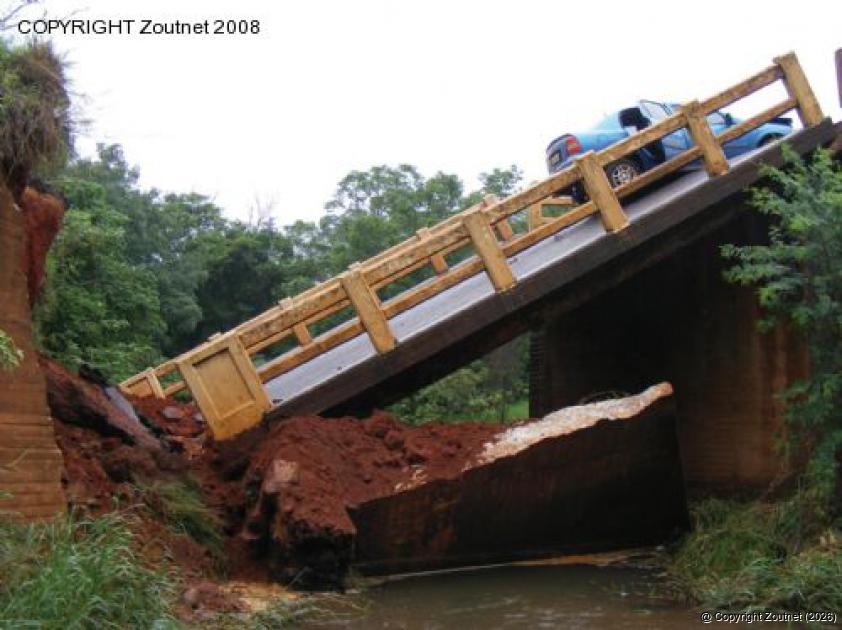
The bridge across the Lutanandwa River, along the road between Louis Trichardt and Thohoyandou collapsed, injuring several people in the process.
Collapsed bridge might take nine months to repair
News Date: 28 November 2008
Residents of Louis Trichardt, Levubu and Thohoyandou, as well as the surrounding areas, will now have to take a detour if they want to travel the road between Louis Trichardt and Thohoyandou via Levubu, after the collapse of the bridge over the Lutanandwa River last Thursday at around 10:15.
As far as can be determined, the bridge started falling in just before a taxi and a sedan were about to cross it on the way from Thohoy-andou. Upon seeing that the bridge was about to fall, the driver of the taxi accelerated, allowing him to reach the other side. Unfortunately for him, he lost control and the taxi capsized. A number of the passengers in the taxi were injured in the process.
The sedan was not fortunate enough to make it to the other side. The road surface collapse under the driver and the vehicle ended up hanging precariously from the collapsed bridge. At the time of going to press, only one person was still in the local hospital and one had been transferred to the provincial hospital in Polokwane due to injuries sustained during the incident.
In its reaction to the events, the TAU SA North said that this calamity could be traced to the effects of political interference in the appointment of people who are supposed to conduct inspections. According to Mr Stephen Hoffman, chairman of the Soutpansberg District Agricultural Union (DAU), chances are very good that the foundations of the bridge were damaged in the floods of 2000, after which no proper inspection had been done. Hoffman also indicated that farmers in the area, in conjunction with the Department of Transport, had cleared the road reserve and erected warning signs. He warned, however, that the detour through Levubu was putting unwanted strain on the road in that part, as it was never constructed to handle such large volumes of heavy traffic.
In a consultative meeting with the MEC for Transport, who had visited the scene, the MEC promised to lend assistance in cleaning the road reserve, renewing road markings, repairing the surface and cleaning drainage ditches. A temporary structure to accommodate traffic while the bridge was being repaired was also suggested.
According to a source in the office of the Department of Roads and Transport, the reason for the bridge’s collapse has not yet been determined. It is possible that the floods in 2000 could have caused some structural damage, but this is not evident. The bridge was constructed in 1954, when certain techniques and safety measures had not yet been used. It would appear that no steel bars had been used in erecting the supporting structures, which might have led to its collapse. Currently, most of the structure is buried under the debris, which means that further evidence will only become available once the collapsed section has been removed and examined.
With regard to a possible solution to the problem of providing a temporary structure or a detour bypassing the broken bridge, such as a causeway, the source indicated that either option is very costly and, since a detour already exists, it is highly unlikely that such an alternative will be explored. Repairing the bridge might cost between R1 and R3 million.
Another problem is that the South African National Roads Agency in Limpopo (SANRAL) has taken over the maintenance of the road and it does not currently have the financial resources to repair the bridge. Regardless of which option will be chosen, chances are very good that the road will not be accessible for use for at least nine months.
Written by

ADVERTISEMENT: