

ADVERTISEMENT:
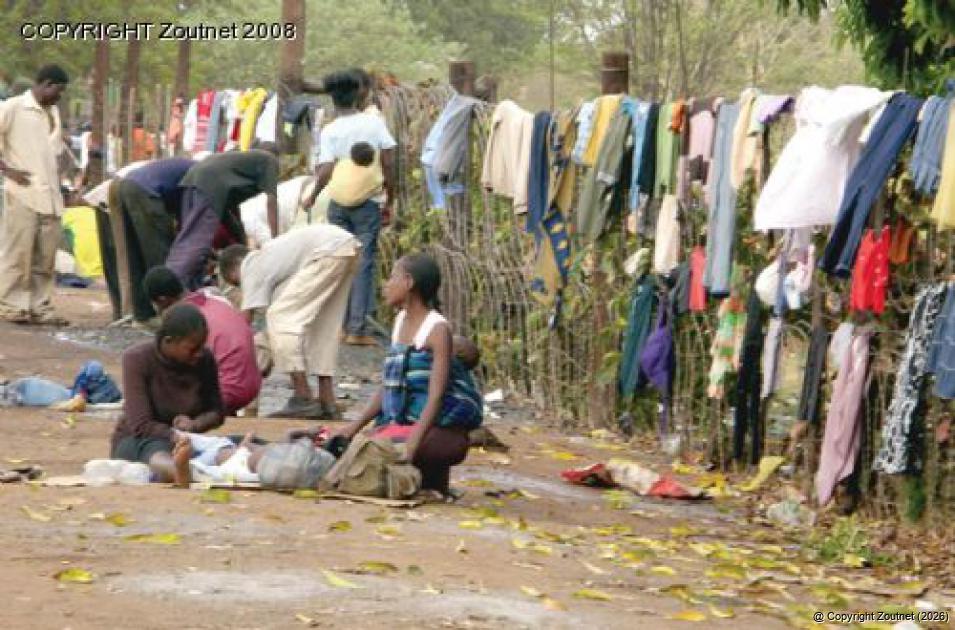
The conditions under which hundreds of asylum seekers are living at the Musina municipal show ground are appalling, sparking fears that it will contribute to the spread of the cholera disease. Babies’ nappies are changed on the dusty pavement, where scant food supplies are also being prepared in primitive, unsanitary conditions.
More cholera deaths, but situation in SA is stable
News Date: 28 November 2008
South Africa responded in a remarkably swift, professional way to the outbreak of cholera in neighbouring Zimbabwe and along the Limpopo border.
However, the appalling conditions under which hundreds of Zimbabwean asylum seekers in Musina are forced to live is cause for great concern. There is no refugee camp in Musina as the South African government has not given Zimbabwean residents fleeing their country refugee status. Earlier media reports which referred to a “refugee camp” probably referred to the semi-squatting conditions on the unserviced parking area at the municipal show grounds, where these people are seeking shelter. The present provision of a few chemical toilets and a watering point in the parking area is obviously under-estimating the crisis. A large and dangerous spill-over of sewage was evident last Friday alongside the parking area at the show grounds, the perfect breeding place for the cholera bacteria.
Babies’ nappies are changed on the dusty pavement, where scant food supplies are also being prepared in primitive, unsanitary conditions. At least one of the cholera patients treated at the rehydration facility last Friday at the Musina Hospital came from this parking area.
At the Musina Hospital, a team of highly trained professional nursing staff has been deployed at the two rehydration tents for cholera patients pitched in the garden of the hospital, where 168 cholera patients – mostly from Zimbabwe – have been receiving emergency treatment since last week. Most of them have been released in the meantime. Three have died.
According to provincial health department spokesperson Phuti Seloba, 27 patients are currently in the hospital. At Beit Bridge Hospital, more than a 1 000 cholera patients have been treated and, according to the World Health Organization, the outbreak in Zimbabwe has claimed 294 lives since September this year. Seloba says there was a very fruitful meeting between South African and Zimbabwean health authorities in Beit Bridge.
“We all realised that the problem is neither Zimbabwean nor South African. This is our common problem and we need to solve it jointly. We need to look at the health gaps and find a way to fill them by tackling the source of the problem,” he said.
According to the Musina Community Liaison officer of Health and Welfare, Mr Edward Malema, a number of Musina residents who were also treated for the disease were people who recently visited Zimbabwe. The Musina Municipality has, in the meantime, reassured resident that the town’s water is perfectly safe and that none of the incidents of cholera affecting local residents could be connected to the municipal water supply.
At least one resident, Mr Sadeep Gohil, begs to differ. He is back at work after a spell of cholera which had him in bed for eight days. He has never been to Zimbabwe and is adamant that he caught the bug from Musina’s municipal water.
About the fact that Zimbabweans must come to South Africa for treatment, most Zimbabweans interviewed are thankful for the fact that efficient treatment is available in South Africa.
“It is good to be here in South Africa, where there is medicine and care,” said Baron Mbedzi who hails from Harare.
Ms Rosina Purisa, who is awaiting her asylum papers while caring for her cousin’s toddler, Roseline, says: “It hurts. It is painful that in Zimbabwe there is no medicine or care. Those who can afford it can come here to South Africa. Those without money are dying.”
Zimbabwe’s health system has totally collapsed while doctors and nurses are grossly underpaid.
Written by
Frans van der Merwe
Frans van der Merwe is a freelance journalist with more than 40 years experience in the newspaper industry. Apart from newspaper reporting, he was also involved with radio news, news reading, training and marketing. He has been living and working in Louis Trichardt since 1991.

ADVERTISEMENT: