

ADVERTISEMENT:
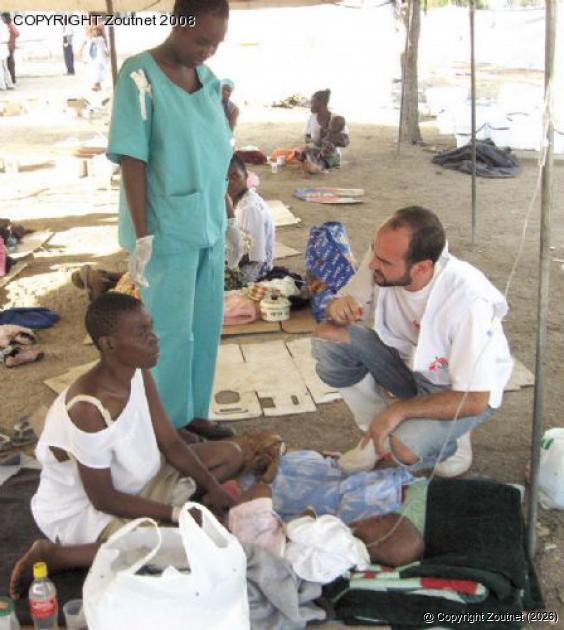
A doctor examines a mother and child suffering from cholera at Beit Bridge General Hospital.
South Africa promises to help Zimbabwe to deal with cholera crisis
News Date: 28 November 2008
South Africa has pledged to assist Zimbabwe in dealing with the cholera crisis, which has since spilled over into the neighbouring border town of Musina.
This was revealed during a stakeholders meeting involving health officials from South Africa and Zimbabwe, held in the border town of Beit Bridge in Zimbabwe on Sunday. Speaking during the meeting, the head of health care services in the department of health in Limpopo, Dr Mo Nkadimeng, said the government was equally concerned about the cholera outbreak in Zimbabwe, hence the need to join hands and assist the neighbouring country in fighting the epidemic, which has since claimed 63 lives at Beit Bridge District Hospital. At Musina Hospital, three people, two of them Zimbabweans and the other a South African, have since died after contracting the disease, while a total of 162 patients had been admitted to the hospital.
Nkadimeng said of those admitted to the Musina Hospital, 160 were Zimbabweans. The other two are a South African and a Zambian truck driver, who passed through Zimbabwe. The first case in Musina was detected on 15 November, following laboratory tests in which stool samples taken confirmed the disease.
“We are aware of the twinning agreement between the Beit Bridge and Musina municipali-ties and we therefore want to continue strengthening that relationship at national level with our Zimbabwean brothers and sisters. In light of that, we were sent by the South African government to discuss ways in which we can complement our Zimbabwean counterparts in fighting cholera along the border. We believe we are one people and whatever happens in Zimbabwe can also happen in South Africa, taken from the perspective that our people constantly cross borders to visit each other daily,” he said. “We definitely need to assist each other in mobilizing resources to contain the spread of cholera.”
The provincial medical director for Matabeleland South province in Zimbabwe, Dr Jabulani Ndlovu, said the cholera outbreak in Beit Bridge was first detected on 14 November after eight specimen tests conducted at the local hospital laboratory proved positive. By Monday, however, a total number of 63 people had died at Beit Bridge District Hospital. “We have since designated Beit Bridge District Hospital as a cholera center, following the outbreak, but a lack of adequate resources and manpower continues to impact negatively on us. We are therefore grateful to our South Africa coun-terparts who have apparently indicated that they would chip in and assist us in the fight against cholera,” he said.
Ndlovu said they had since set up local committees to monitor and assess the situation, with the help of international organizations such as Mecidins Sans Frontieres (MFS), the International Organization for Migration (IOM), UNICEF and the World Health Organization (WHO). The organizations have provided the local hospital with beds, medical supplies, drugs, food and preventive clothing for health personnel.
MSF has set up a cholera camp where victims are treated while IOM. The centre for deportees in Beit Bridge has also built an isolation unit where deportees from South Africa are tested for cholera and screened accordingly before they are subsequently released from the camp. Those found with cholera are then taken to the hospital for treatment.
Ndlovu said they had so far recorded a total of 1985 cholera cases, with more patients still coming in large numbers for treatment. The number of deaths continues to increase. “We continue to get about 200 new cases reported every day, while the death toll continues to go up. Last week, we had 13 to 14 people dying every day, both at hospital and at their respective homes soon after having been discharged,” he said.
Due to the poor primary health care system in the neighbouring country, scores of patients from Zimbabwe are now flocking to Musina for treatment, a development that has attributed to the spread of the epidemic in that town. According to international health regulations, cholera patients are supposed to be treated in their respective countries where they would have been diagnosed to avoid spreading the infectious disease to other countries.
Ndlovu said they were now working with the immigration authorities in coming up with effective control strategies to contain the huge influx of cholera victims from crossing the border into South Africa. “We are maintaining surveillance at the border post and we are working with the immigration department in coming up with ways on how we can manage the border area effectively during this cholera crisis,” he said.
Dr Ndlovu attributed the cholera outbreak to poor water supply and sanitary facilities, con-stant sewer bursts resulting in effluent flowing into the Limpopo River, the main source of water for residents of both Beit Bridge and Musina. “We need to strengthen water supply systems and control sewer bursts. You will also note that some residential areas in Beit Bridge have no piped water and our waste management is not up to standard,” he said.
The Musina Municipality’s community services manager, Mr Pedron Nndwa, said the local authority was also willing to assist the Beit Bridge community in the spirit of their twining arrangement with the Beit Bridge Town Council. “After the meeting, we will highlight the challenges faced by our Zimbabwean counterparts in fighting cholera at the upcoming councilors’ meeting as we are willing to assist in that regard, particularly on the critical issue of water supply,” he said.
The joint delegation later visited the cholera victims at Beit Bridge District Hospital and several other key areas around Dulibadzimu suburb to assess the situation. In some areas, locals could be seen queuing for water at various points where Action against Hunger, a local NGO, has put water bladder tanks to assist people in accessing purified water. Dr Nkadimeng, who was the head of the South African team, said they would report back to the national health minister, Barbara Hogan, on their findings about the cholera situation in the neighbouring country.
Among those who attended the meeting were the Musina Hospital’s chief executive officer, Mr Simon Netshivhambe, the hospital’s communications manager, Mr Edward Malima, Mr Wilson Dzebu from Musina Municipality and several health personnel from the health department in the Limpopo province.
* Another outbreak of cholera has also been reported in some parts of the Masvingo area in Zimbabwe where the disease is said to have killed three people.
The provincial medical director for Masvingo, Dr Robert Mudyiradima, confirmed to Mirror the outbreak of the disease in areas such as Nemwana and Mushandike villages and in the Chivi district. He said each area had recorded a death as a result of suspected cholera.
Mudyiradima added that, as of Monday, 24 November, 33 people had been admitted to the local hospital as a result of the deadly, contagious disease. He allayed fears, however, that the health department was not adequately equiped to deal decisively with the disease, saying that they had such capacity.
“We have the capacity to treat the disease. We have so far requested a tent from the head office as we intend to set up mobile clinics from where the treatment will be conducted in areas reported to have the disease. We would also like to encourage people at this juncture to seek immediate medical attention if they realise they have the disease as it can kill within 24 hours,” said Mudyiradima.
Written by
Mashudu Netsianda
Mashudu Netsianda is our correspondent in Beit Bridge, Zimbabwe. He joined us in 2006, writing both local and international stories. He had worked for several Zimbabwean publications, as well as the Times of Swaziland. Mashudu received his training at the School of Mass Communication in Harare.

ADVERTISEMENT: