

ADVERTISEMENT:
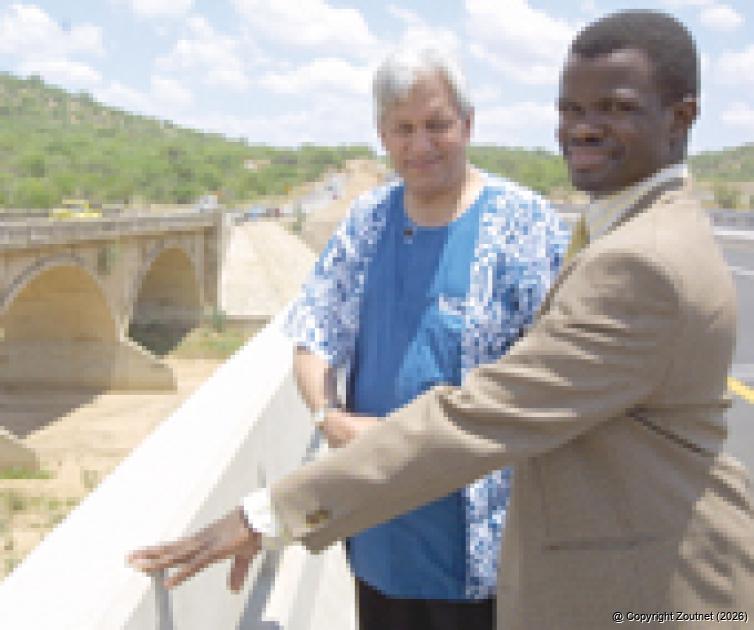
In absence of the Minister of Transport, Mr Jeff Radebe, due to sudden illness, the newly constructed Sand River Bridge just south of Musina was officially opened last Saturday by the mayor of Musina, Cllr David Phologa. Photographed on the new bridge, with the old bridge in the background, are Cllr Phologa (right) and the CEO of SANRAL, Mr Nazir Alli (left).
Bridge over Sand River opened
News Date: 03 December 2004
MUSINA – Traffic flow between South Africa and the rest of Africa was briefly disrupted on Saturday, November 27, with the opening of the newly constructed Sand River Bridge just south of Musina on the N1.
The bridge was supposed to be opened by the Minister of Transport, Mr Jeff Radebe, but due to a sudden illness on the part of the minister, this task had to be performed by the mayor of Musina, Cllr David Phologa.
Although the Sand River is dry for most of the year, occasional floods over the past years had damaged the existing structure. The most recent flood occurred in February 2000, when cyclone Eline caused major damage in the northern region of the country. The Sand River Bridge was extensively damaged during this flood which sparked fears that it might not be able to withstand another flood. Approximately 200m of the southern and 100m of the northern landfill were washed away.
The old Sand River Bridge was constructed between 1942 and 1944. The bridge consists of three arch spans and is 6m wide. The total bridge length is 70m. During the design stage of the upgrading project, several options were investigated to retain the character of the old bridge, such as widening and extending the bridge. However, the bridge was inadequate to handle a one-in-100 year flood (a flood that is statistically expected to take place once in a 100 years), which is required for an international route. It was therefore decided to construct the new bridge at a cost of R12 million.
The new bridge consists of seven 20m spans and has a total length of 140m. The bridge deck is 2,5m higher than the old bridge and is 12m wide. The Sand River Bridge is designed to withstand a one-in-100 year flood, and will ensure that neighbouring countries will be accessible, even if a cyclone such as Eline causes havoc.
SANRAL (South African National Road Agency Limited) will, after the completion of the portion of the N1 before Musina, continue within the next two years with the completion of the upgrading of the N1 towards the Zimbabwe border at Beit Bridge. They are busy with the design phase of the upgrading of the N1 through Musina, as well as the section between Musina and Beit Bridge.
During the opening function, a cycle race and parade of vintage cars was held to commemorate the event. Afterwards, guests were treated to lunch at the newly established Villa Italia Restaurant at the Sasol filling station. This came as welcome relief to all those who braved the heat to play witness to this historical event. Sadly, speculation is that the old bridge will have to be demolished as it poses a danger for the new bridge in the case of another flood.
Written by
Andries van Zyl
Andries joined the Zoutpansberger and Limpopo Mirror in April 1993 as a darkroom assistant. Within a couple of months he moved over to the production side of the newspaper and eventually doubled as a reporter. In 1995 he left the newspaper group and travelled overseas for a couple of months. In 1996, Andries rejoined the Zoutpansberger as a reporter. In August 2002, he was appointed as News Editor of the Zoutpansberger, a position he holds until today.

ADVERTISEMENT: