

ADVERTISEMENT:
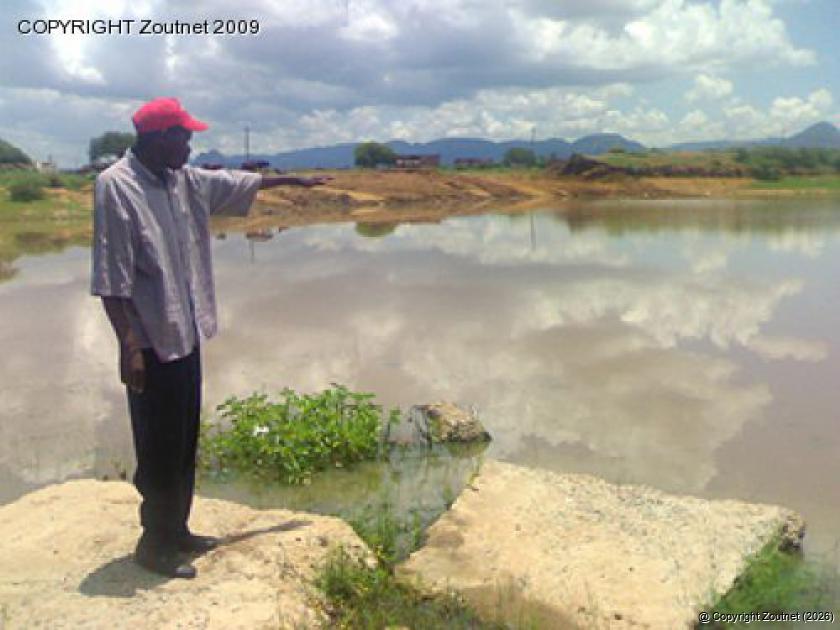
A community member of the Madodonga village points to a dam in the village which tested positive for cholera.
Dam at Kutama tests positive for cholera
News Date: 27 February 2009
Residents of Madodonga village in the Kutama area and the surrounding villages are still at risk of contracting cholera as the village dam recently tested positive for cholera.
Health practitioners at the local Louis Trichardt Memorial hospital realised that the number of cholera cases in the area were still at alarming levels and visited the area to try and establish the origin of the problem. During a visit to the area, they found that community members were dumping rubbish and objects such as disposable nappies in the dam. The very same dam is also used by other residents to collect water for household use.
“We then decided, together with the Department of Water Affairs officials, to have that particular dam’s water tested, only to find out that the samples tested positive for cholera,” said Mr Godfrey Tshimauswu, the chief executive officer of Louis Trichardt Memorial Hospital in an interview with Mirror on Friday.
Tshimauswu confirmed that the two patients who died of cholera at the hospital last week were coming from the Kutama area.
He added that they were shocked to see that community members were still ignorant in as far as hygiene is concerned. “From the hospital’s side, we are advising community members to refrain from using water from streams, dams and rivers,”’ Tshimauswu said.
Meanwhile, about 27 people have died of cholera contamination in the Kutama area since the outbreak of the disease in November last year. This figure is disputed by the Department of Health and Social Development in Limpopo, who claims that the death toll still stands at 23. Community members are now concerned that the department is downplaying the figures while people continue dying.
The cholera crisis continues to affect most parts of Limpopo. The spokesman for the Department of Health and Social Development, Mr Phuti Seloba, said there were 41 new cases that were recorded, which brings the number of cholera cases to 4 714 since the disease broke out in November last year. New cases are being recorded daily.
The Capricorn district still leads in terms of new cases, with 20 new cases recorded in the district. Vhembe has recorded six, Sekhukhune four, Mopani three and the Waterberg had eight new cases recorded. “There is a need to channel our resources towards Capricorn to assist them to deal with the disease as new cases continue to come from this district,” Seloba said.
He further said that they were very concerned about the behaviour of local communities. “This is a deadly disease and can leave people without relatives if left unchecked or proper care is not exercised,” he said. Seloba could not rule out the possibility that a higher death toll could emerge. Water drawn from some sources in the province was still being tested.
Seloba attributed the rise in cholera cases to failure by members of the public to observe basic hygiene to wash their hands, boil water before use and avoid drinking contaminated water from streams.
The headman of Madodonga village, Mr Progress Kutama, is advising all the villagers to refrain from playing in or collecting water from the rivers, dams and streams. “Cholera is a dangerous disease. I am appealing to the community members to stay away from these water sources,” he said.
Written by

ADVERTISEMENT: