

ADVERTISEMENT:
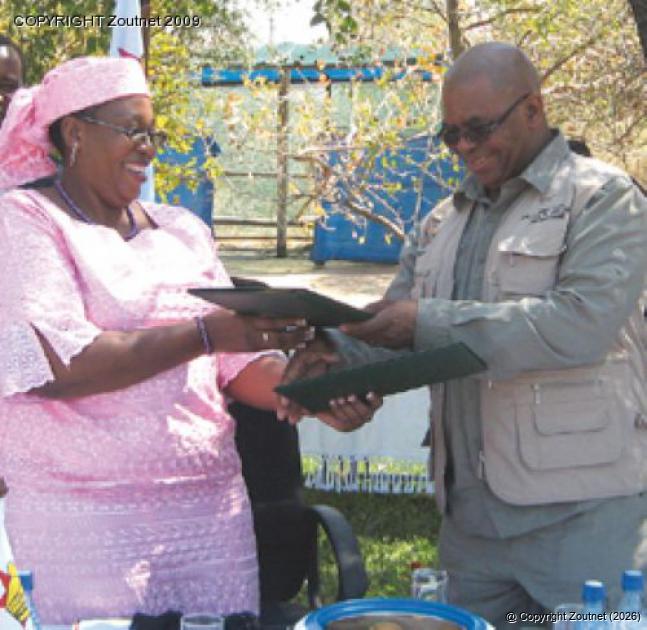
The two ministers, Mr Membathisi Mdladlana and Mrs Paurina Mpariwa, photographed during the signing of a Memorandum of Understanding to regularize safe labour migration of farm workers between the two the countries.
MOU to regularize migration of farm workers
News Date: 04 September 2009
The Minister of Labour, Mr Membathisi Mdladlana, and his Zimbabwean counterpart, Mrs Paurina Mpariwa, signed a Memorandum of Understanding (MOU) last Thursday to regularize safe labour migration of farm workers between the two countries.
The signing was a culmination of a joint ministerial mission involving Zimbabwe and South Africa, held in January 2006, which revealed a high prevalence of irregular migration by Zimbabwean farm workers, resulting in their exploitation, poor living and working standards and limited access to health care and other social amenities.
Mdladlana said the South African government was concerned with the exploitation of Zimbabweans working on farms in the country. “I am happy the two sides are working in collaboration with IOM to facilitate safe migration in a manner that will bring dignity to our people. I am particularly passionate about workers’ rights, to the extent that I have become very unpopular in South Africa, largely because I am dealing with labour brokers who are part of my biggest problem in eroding the rights of workers.”
Mdladlana said the government was now in the process of reviewing labour laws to curb the exploitation of workers from other countries. “The government of South Africa is against those employers who illegally recruit foreigners and then go on to exploit them. We have therefore called on Home Affairs officials from Zimbabwe and South Africa to look into that issue jointly and address those challenges,” he said.
“We are now making amendments to the Unemployment Insurance Fund Act, so that people from other countries working in South Africa with documents such as passports get official South African documents that will subsequently see them receive full labour benefits, just like South Africans. We want to make sure that we clear up this matter of documentation for our people as they will not be able to benefit from something that is otherwise their right. Every worker in South Africa contributes one percent of their wage to the Unemployment Insurance Fund, and if we find any employer who does not do adhere to this, then that is a crime. We know how to handle criminals and we don’t want to criminalize our employers as a result of this,” he said.
The minister added that the issue of documentation for workers was also very important for security reasons. “We also note that if this issue (of documentation) is not addressed as quickly as possible, it will create problems for our security forces in the long run. If people are not identified properly, they will do all sort of things, reasoning that, since they have not been fingerprinted, they cannot be traced in the event of committing a crime,” Mdladlana said.
Mdladlana also castigated employers who were ill-treating and exploiting foreign workers, saying South Africa’s labour laws protected every worker, regardless of their country of origin.
“Our labour laws protect all people working in South Africa, whether you are a Zimbabwean, Mozambican or any other nationality. Somehow, some of our employers seem to think that just because you are coming from outside South Africa you are not protected by our labour laws. They are wrong because we are signatories to a number of conventions in the International Labour Organization. I expect it is the same in Zimbabwe as well. In my view, if we get things right in the labour market, we will certainly save our two countries,” Mdladlana said
“The Memorandum of Understanding will certainly help in addressing the major challenge of illegal irregular labour migration where our people continue to cross into South Africa illegally to work without proper documents,” said Mpariwa. “We are jointly working with our South African counterparts to speed up the process of giving our nationals the necessary documents.”
She also noted that the new arrangement would see a reduction in the number of border jumpers, as Zimbabweans would be issued with proper documents, which would enable them to work in South Africa legally. “We hope that this signing of the MOU will promote safe migration as our people will now be able to cross the border legally.”
Mpariwa also criticised xenophobic attacks on foreigners by South Africa, saying it was against the spirit of regional development and unity of purpose. “We strongly condemn xenophobic attacks and we are saying we must promote the language of love and the unity of purpose among our people.”
The minister said the new development would also help in curbing crime, as Zimbabweans genuinely seeking employment in the neighbouring country would now be documented in ac-cordance with the South African labour laws.
The signing ceremony also marked the opening of a labour center at Beit Bridge IOM reception and support centre where locals intending to work on farms around Lim-popo province in South Africa will be recruited. The centre is a pilot project, which will be equipped with a computer-linked communication network system to facilitate the recruitment of locals in other outlying areas of Zimbabwe. The labour centre project will provide a safe labour migration mechanism for Zimbabweans to be employed in Limpopo province, to implement mechanisms to regularize the immigration status of irregular Zimbabwean migrants working on farms in the province and to ensure that migrants are fully informed of their employment conditions, rights and obligations before they leave for South Africa.
The development comes at a time when South Africa recently announced a special dispensation permit for Zimbabweans wishing to work and live in the country when the government scrapped visas for Zimbabweans.
Written by
Mashudu Netsianda
Mashudu Netsianda is our correspondent in Beit Bridge, Zimbabwe. He joined us in 2006, writing both local and international stories. He had worked for several Zimbabwean publications, as well as the Times of Swaziland. Mashudu received his training at the School of Mass Communication in Harare.

ADVERTISEMENT: