

ADVERTISEMENT:
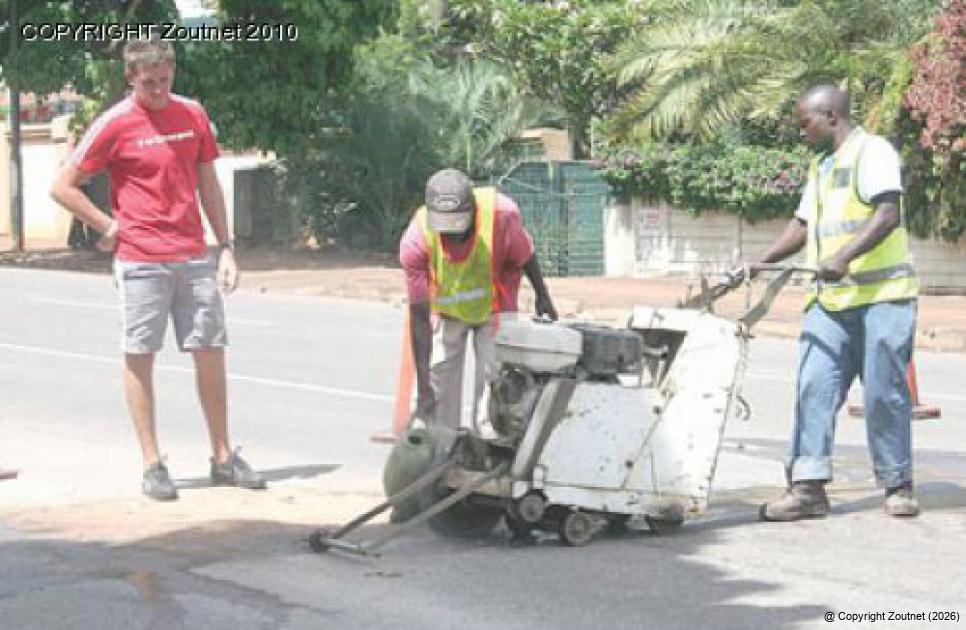
Currently a contractor is busy repairing potholes on the busier main streets. Here a water pipe problem caused damage in Krogh Street.
Streets fall apart, but Council is working on the problem
News Date: 22 January 2010
Potholes and the condition of Louis Trichardt’s roads … a regular topic of discussion in town - from the owner who has to repair his damaged vehicle to the municipal official who has to listen to all the complaints.
Can’t the residents see that something has been done, the municipal official may ask. Can’t the municipality see that if they do not maintain, repair and surface regularly, the cost of repairing just multiplies, the ratepayer may ask.
"The cause of the problems with the roads is that the municipality, now and even in the past, has not done regular maintenance on the roads,” says a local expert, who does not wish to be identified.
Regular maintenance implies that every tar road should have an enrichment layer at least once in every four years, where liquid tar or emulsion is sprayed on the existing tar.
Every eight years, that is not longer than four years after the enrichment layer, the tar road should be newly surfaced.
“The rest of the time, tar roads should be regularly checked for cracks and damage and be treated as soon as possible,” the expert said.
Filling a pothole is a routine maintenance activity.
“It cannot be scheduled before the pothole appears and it should not be left unattended once the pothole has developed,” states www.nra.co.za. Too many potholes indicate the need for a more comprehensive repair. In addition to pothole repair, routine maintenance repairs include edge patching, crack sealing and filling and shoulder repair.
Residents often first notice the grass growing in cracks in the tar road, the developing pothole and the water pipe burst that eventually causes great damage to the road. They get frustrated when they report the problems and reaction is either non-existent or very slow.
“The problem with leaking and bursting water pipes will have to be addressed because that is an underlying cause for much of the road damage in town,” the local expert said.
The huge pothole in Anderson Street near the local high school is an example of road damage caused by a water pipe. The school has been trying for a long time to get the municipality to do proper repair and not just temporary filling with gravel.
It also appears as if the municipality does not backfill and seal the road when they have broken the tar to repair a water pipe. An example can be seen in President Street near the back entrance of Superspar.
During December and January, a ratepayer of the Soutpansberg Ratepayers Association, Mr Herman Smith, drove around town and was appalled by the damage to the roads, curbing and sidewalks in town, new town and Eltivillas.
“The grass growing at the side of the roads is the first step to road damage. It should be sprayed to clear it out,” Mr Smith said. He was also very concerned about the many damaged sidewalks, probably broken by heavy vehicles. Municipal service delivery is one of the main issues in the dispute that the SPRA declared with the Makhado Municipality in August 2008.
The municipal spokesperson, Mr Louis Bobodi, said this week “as from February until August last year, Council set aside more than R16 million to upgrade and improve the roads in town. The project has been completed. More than 18 streets were uplifted and we still have to upgrade the remaining ones in the not-so-distant future. We are also currently establishing sidewalks.”
Contractors did major work on about nine streets or parts of streets, including Rissik, Songozwi, Grobler, President, Kruger, Erasmus, Burger, Kort and Baobab Streets. Currently, a contractor is busy repairing potholes on the busier main streets.
Residents hope that the town’s tar roads will be maintained regularly.
“A stitch in time saves nine,” says an old adage. Very true when the costs of road repairs and reconstruction is considered. To repair a pothole properly costs R500 per square metre. To resurface a road costs up to R1 million per kilometre, depending on the type of surfacing, with hot asphalt the best type of surfacing.
To reconstruct a road, that is to remove the existing surface and reconstruct the damaged base layer, costs between R1.2 million and R2 million per kilometre. And whether on local, provincial or national level, eventually the ratepayer foots the bill.
Written by
Linda van der Westhuizen
Linda van der Westhuizen has been with Zoutnet since 2001. She has a heart for God, people and their stories. Linda believes that every person is unique and has a special story to tell. It follows logically that human interest stories is her speciality. Linda finds working with people and their leaders in the economic, educational, spiritual and political arena very rewarding. “I have a special interest in what God is doing in our town, province and nation and what He wants us to become,” says Linda.

ADVERTISEMENT: