

ADVERTISEMENT:
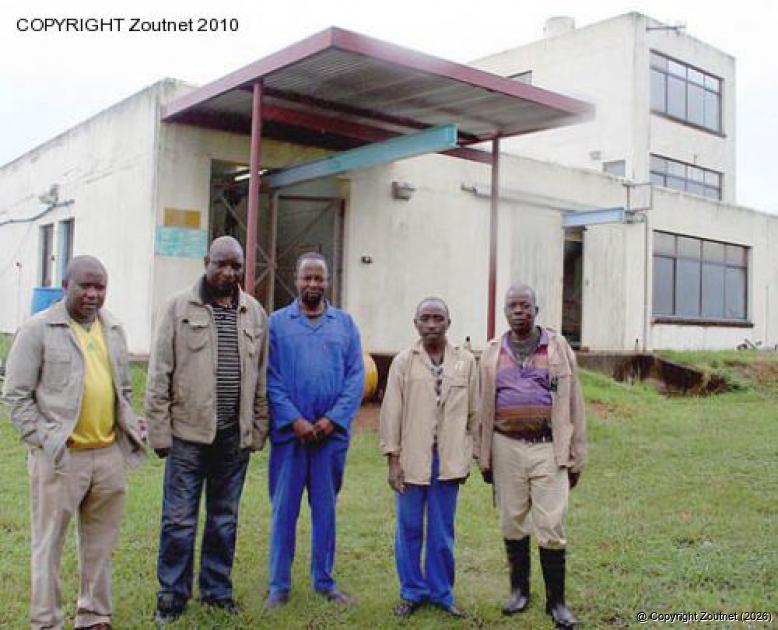
At the water purification plant at the Albasini dam are, from left, Director of Technical Services of Makhado Municipality Mr Thivhonali Ralulimi, Mr David Mukosi, and Messrs MS Netshituni, MW Nematswerani and assistant A Manganyi.
“Yes, you can still drink the water,” says municipality
News Date: 26 February 2010
The Makhado Municipality assured its citizens last week that there is no need to fear in terms of the quality of drinking water.
A visit to the water purification plant at the Albasini dam by the Zoutpansberger, accompanied by the Director of Technical Services, Mr Thivhonali Ralulimi, and Mr David Mukosi, responsible for the plant, took place on February 19.
The purpose of the visit was to gain first-hand knowledge of whether or not improvements had been made at the purification plant. On reaching the site, it was unexpectedly mentioned that taking photographs inside the building is not allowed.
The newer of the two buildings was opened for the tour. The tour started at the dosing room upstairs and both dosing machines were said to be in working order. “This is for lime dosing and the purpose is to raise the pH of the water. If the tests show that the pH is in the range of 7, we do not add chlorine. If it is below 7, it will harm the system. Most of the time, the pH is correct. Today the pH is 7.4,” said Mr Mukosi.
The next visiting point was where the dark green water entered from the source. Through a thin pipe, drops of the flocculent were released in the water at the entry point. “We add a little drop. If we have big volumes, we increase the dosage. The purpose of the flocculent is to separate particulates,” Mr Mukosi said.
From the flocculent room, the water flows through zigzag channels where the water mixes with the flocculent. At the last of the zigzag channels, the particles already adhere to each other. A brown ‘muddy’ substance forms on the surface of the water.
The water then flows into a sedimentation tank. “A rotating bridge depresses and opens a valve at a certain point and releases the sludge,” Mr Mukosi said. Clean water runs over into a channel.
The flocculent in the tanks outside is low. “We always keep minimum stock. The tanks are not full. We need it on demand. When we reach minimum supply level, we activate the suppliers to come and refill the tanks,” said Mr Ralulimi.
The next stop is the sand filter dam inside the building. “The purified water runs from there into the side channel. The water is very clean,” Mr Mukosi said. To the untrained eye it looks unattractive, perhaps because the walls of the channel appear slimy and greenish.
The next stop was the chlorine room, where the setting of the chlorine was done according to laboratory tests. Tests were said to be done hourly. On the question whether any pre-chlorination was done, Mr Ralulimi replied, “We do not do that (unless) the dam level is low and we draw from dead water. You use pre-chlorination if you don’t have an option.” Mr Mukhosi added that chlorine was very expensive.
All three pumps that pump the water to town were said to be in working order. The large pump was in use, with the other two on standby.
Upon request, the laboratory was shown. The log sheet was filled in once a day. Hourly tests were not shown. “We take the average for the day. We have all the instruments and the pH meter,” Mr Ralulimi said.
The water is tested according to SANS requirements. There was no copy of the requirements available in the laboratory. Mr Ralulimi promised to send a copy of SANS requirements, as well as a copy of test results. Apparently tests for pathogens that form a health risk were not done there. Vhembe District comes bi-weekly and tests the source, in the case of an indication of E.Coli.
“We have three skilled operators for the plant. The allocation of operators for water treatment process is determined by DWAE,” said Mr Ralulimi.
Besides the water purified at the Albasini dam, borehole water is the other source of water for the town. “The borehole water is perceived as being contaminated. We do tests. A company has been appointed that tests our water and it has been found to be within the standard. We are adding chlorine. There need not be any fears in terms of the quality of the water,” Mr Ralulimi said.
A request for a member of the Soutpansberg Ratepayers Association to be part of the tour to the Albasini plant was flatly refused.
Written by
Linda van der Westhuizen
Linda van der Westhuizen has been with Zoutnet since 2001. She has a heart for God, people and their stories. Linda believes that every person is unique and has a special story to tell. It follows logically that human interest stories is her speciality. Linda finds working with people and their leaders in the economic, educational, spiritual and political arena very rewarding. “I have a special interest in what God is doing in our town, province and nation and what He wants us to become,” says Linda.

ADVERTISEMENT: