

ADVERTISEMENT:
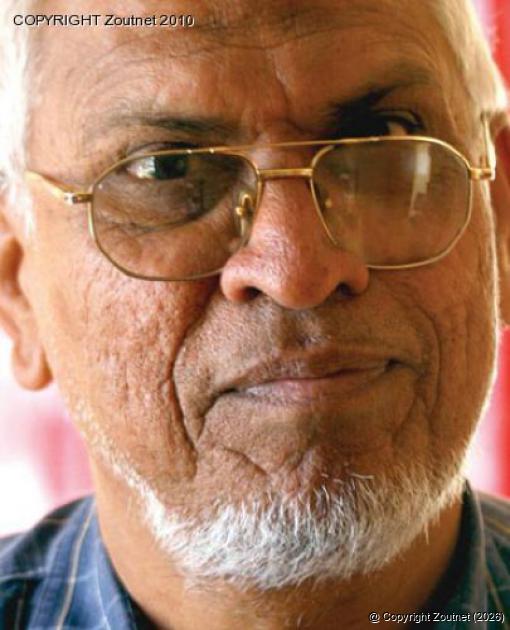
Idris, a resident of Eltivillas in Louis Trichardt. He says he merely possesses a unique ability to sum up a person´s life through intuition and observation, based on the person´s signature.
Your signature is a blueprint of your life
News Date: 02 April 2010
There is an old saying that one can tell a lot about a person by looking at the shoes the person is wearing, but in Mr Idris Sheikh’s case, he can tell a lot about a person by merely looking at their signature.
Idris, a resident of Eltivillas in Louis Trichardt, is quick to point out that he merely possesses a unique ability to sum up a person’s life through intuition and observation, based on the person’s signature.
“A signature is a graphic imprint of a person’s subconscious personality,” says Idris. Over the last 43 years, he has analysed more than a million signatures in the 35 countries he has visited, lived and worked in. These included signatures from sheikhs, politicians, and government officials to just plain, everyday folk.
“I do it for people who want to learn something about themselves,” says Idris.
Idris first recognised his gift back in 1967 in India when he told someone something about himself and it turned out to be true.
“That was the beginning,” says Idris. Later he started using people’s signatures to analyse them. He fine-tuned his ability through keen observation and studying people.
“My journey has taken me to study the culture and habits of people, where they live, what they eat, their temperament – even the political dimensions of the country they life in and their religious beliefs,” says Idris. “Observation is the biggest key in knowledge. In the same way, you can tell someone something from the past, or you can tell the person something about his present life, because the information is already there. You can also see if that person has learned from their mistakes and, based on the past, you can determine what is ahead with regard to that person’s temperament,” he adds.
Idris explains that it is like driving a car at 180km/h on the highway. Something will go wrong eventually.
So how does he do it?
“When analysing a signature, you don’t go for the shape of the signature, you look at the curves. Curves indicate the temperament of a person and the manner in which they make the curves indicates how they run their life in daily events,” he explains.
This is an indication of that person’s temperament, whether it be mild, aggressive or moderate. He also gives these curves numeric value, indicating time in years. It is therefore possible for him to highlight certain events in a person’s past, subconsciously imprinted in their signature.
The angle at which a signature is written, is an indication of ambition. Idris looks at the signature and then draws a horizontal line at its base. The steeper the angle, the more ambition the person demonstrates.
As for breaks in a signature, this indicates a person’s sense of adventure, while persons using full stops in their signature are normally very precise people.
“Hollowness of letters in a signature indicate issues of health,” says Idris.
These are just some of the characteristics Idris looks at when analysing a signature. There are, however, many other characteristics he takes into consideration when looking at a signature and he has almost perfected his ability to an exact science.
Idris has many an interesting tale to tell with regard to some of the people whose signatures he has analysed over the past four decades.
“One young man in America just wanted to know what his most favourite thing was in life, just to test me. I analysed his signature and told him that he liked horses,” says Idris.
The young man was so surprised that he took out his cheque book and told Idris to write in an amount as payment.
“I said no, I didn’t want anything in return,” says Idris. To this day, Idris refuses to accept any money for analysing people’s signatures.
“I have never made it a business,” says Idris.
While in Sweden in 1985, Idris was also asked to make a prediction regarding the outcome of an election, based on the strengths of a test group of five politicians.
“All five analyses came true,” says Idris.
This immediately caught the media’s attention, with the Swedish newspaper, Västerbottens Folkblad, doing two stories on his remarkable ability.
Idris and his wife, Kamar, moved to South Africa in 1993. They have two sons, Faisel and Aqsam, and a daughter, Isra. Faisel was born in England and the other two in South Africa.
Up till the end of March, Idris worked as an Islamic consultant at ABSA Bank in Louis Trichardt. He is now embarking on a new journey in life.
“I am looking to become a legal consultant for immigration or possibly an interpreter,” says Idris. He is a man of many talents. He holds an LLB-degree in international law, a BA-degree in English and a BA honours degree in Islamic studies. He is also very capable in several languages, including Swedish, French, Arabic, Hindi (Indian main language), Urdu (spoken in Pakistan), Gujarati and even ancient languages such as Sanskrit.
Written by
Andries van Zyl
Andries joined the Zoutpansberger and Limpopo Mirror in April 1993 as a darkroom assistant. Within a couple of months he moved over to the production side of the newspaper and eventually doubled as a reporter. In 1995 he left the newspaper group and travelled overseas for a couple of months. In 1996, Andries rejoined the Zoutpansberger as a reporter. In August 2002, he was appointed as News Editor of the Zoutpansberger, a position he holds until today.

ADVERTISEMENT: