
ADVERTISEMENT:
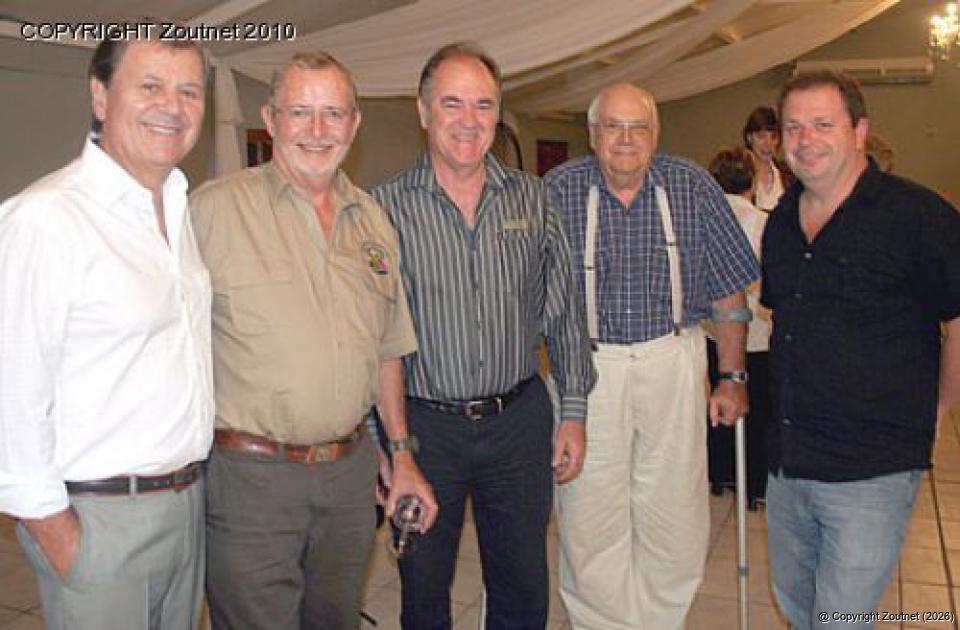
Australia made headlines by petitioning Britain to pardon Breaker Morant, whose victim’s graves are in the Soutpansberg area. Louis Trichardt was honoured to receive a visit from big Australian names. From left are Australian television journalist Ray Martin, local heritage expert Charles Leach, military lawyer Jim Unkles (who wrote the petition), Poog Henning, local landowner on whose farm some of the graves are, and Australian author Nic Bleszinski.
International spotlight falls on Boer-killings
News Date: 09 April 2010
“Was he a cold-blooded murderer or a scapegoat of the British Empire? Maybe both,” said Australian television journalist Ray Martin during a recent visit to the Soutpansberg area.
Martin was referring to ‘Breaker’ Morant, for whom a posthumous pardon is now sought by Australia. The petition that Australia sent to Britain in February, seeking pardon for two Bushveldt Carbineers, was written by military lawyer James Unkles.
Commander Unkles, with 28 years of military law and 250 courts martial behind him, arrived in the Soutpansberg on March 31. This is the area where some of the murders took place that led to the court martial and execution of Morant and his sidekick, Peter Handcock, on February 27, 1902. The death sentence of a third Australian, George Witton, was commuted to a life sentence and he was later released. Witton published a book, Scapegoats of the Empire.
Australian author Nick Bleszinski, who wrote a book titled Shoot straight you bastards!, after the last words of Morant, accompanied Unkles. Unkles said at a function at Lalapanzi Hotel on April 1 that he had petitioned the British Crown to pardon lieutenants Morant, Handcock and Witton for their role in the murders of Boer soldiers. He said that in the midst of the brutalities of a war where the British laws of war were thrown out the window, these three Australians believed that they had followed the orders of Lord Kitchener.
“Today, the South Africans and Australians stand together in a mission to ensure that the British take responsibility for the terrible deeds committed against the Boers and against Morant and his friends. The British army and Empire are responsible for the unfair procedure in the prosecution of the three men … I don’t think Morant was a cold-blooded murderer. I believe they deserve a pardon. It is probably your view that they don’t. I respect your view,” Unkles said.
Unkles told the Zoutpansberger that he would be surprised if he received a decision on the petition this year, since the British were having an election and might regard it as politically lethal to give a decision at this stage.
Award-winning Martin, a household name in Australia and best known for various on-air roles at Channel Nine, said that he was almost embarrassed by the generosity of spirit and kindness of local heritage expert Charles Leach and his wife Bev. Leach took Martin, producer Danny Keens and the whole crew of the popular current affairs programme Sixty Minutes to various historical sites, including the site of the concentration camps for women and children in Polokwane, war monuments and heritage sites in the area and the graves of the Van Staden children on Poog Henning’s farm.
“It was very emotional and moving. I had no idea how powerful the memories are in this part of South Africa. We think of the Anglo Boer War as a skirmish, but it was so much more. I learnt about the concentration camps and the ´Scorched Earth policy´ - it is appalling! We talked to relatives of the victims of the Morant crimes and saw how, 108 years later, they cry when they tell the story,” Martin said. He said that in Australia, the families of Morant and Hancock had had their lives shattered as well.
When Martin saw the actual scenes where the BVC operated, he realised how “different it was from the movie.” The film Breaker Morant was released in 1980. Martin emphasised that the Nine Network team came without any agenda. “We did not come to try and prove that they are innocent. We try to tell a story,” Martin said.
Cameraman Drew Benjamin moved the audience at the function when he apologised to the South Africans. Keens said that he did not think that Morant should be pardoned. This sentiment is echoed by Australian author Craig Wilcox. Author Nic Bleszinsky, who had done extensive research on Breaker Morant, believes that a pardon is long overdue. At the heritage sites he saw “the bare bones of a fantastic heritage trail. Why aren’t you doing something about it ? It is sad to see that some of the homesteads are falling apart … The people will come here, if we can help you to make it into something permanent,” Bleszinski said. He announced that he was hoping for a remake of the movie in the actual area.
Leach regarded that as good news. “Whether or not a pardon is given, it is not going to change a single grave, it will not cancel a single fact that I have researched and it will not cancel the deep-seated pain. But if it will bring a lot of attention to our area, resulting in nurturing our heritage, then we have succeeded… I am happy that, for the first time in a hundred years, we have put the South African story across,” Leach said. Producer Keens said that Leach had researched the story, but now “Leach has become the story.”
Written by
Linda van der Westhuizen
Linda van der Westhuizen has been with Zoutnet since 2001. She has a heart for God, people and their stories. Linda believes that every person is unique and has a special story to tell. It follows logically that human interest stories is her speciality. Linda finds working with people and their leaders in the economic, educational, spiritual and political arena very rewarding. “I have a special interest in what God is doing in our town, province and nation and what He wants us to become,” says Linda.

ADVERTISEMENT: