

ADVERTISEMENT:
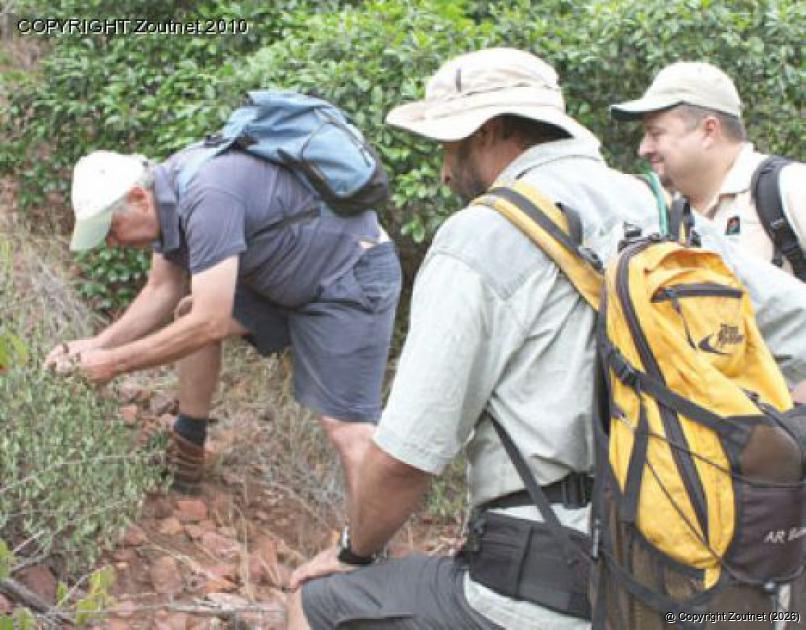
Seeds of flora at Wylies Poort in the Soutpansberg were collected in March this year. This is part of a national and international project to collect and conserve seeds of plant species. The seeds of some plant species are eventually preserved in the Millennium Seed Bank in London. From left are Willem Froneman, Norbert Hahn and Erich van Wyk (SANBI). Photo supplied.
Conservationists to help save local flora
News Date: 09 April 2010
The flora of the Soutpansberg area, famous for its diversity, is under threat, as is flora worldwide.
Local conservationists, however, are not sitting still and have teamed up with a national and international project to collect and conserve seeds of plant species. Seed are collected and eventually preserved in the Millennium Seed Bank. It is placed in cold storage at -20°C, where the seed can remain available for use over hundreds of years.
The Millennium Seed Bank is managed by the Royal Botanical Gardens, also referred to as Kew Gardens, situated between Richmond and Kew in south-west London, England. To counter the loss of biodiversity through plant-species extinction, the Millennium Seed Bank Project (MSBP) International Programme was established to collect and preserve seed. The MSBP is the largest ever global ex situ (outside of natural habitat) conservation programme. Ten years ago, the South Africa National Biodiversity Institute (SANBI) signed an agreement with Royal Botanical Gardens, Kew. Their objectives are to develop capacity in support of seed collection and to collect and conserve 2500 of South Africa’s flora by 2010, at least 80 % of those being endemic, economic or endangered species. At the end of 2008, over 3000 seed collections of South Africa had already been conserved, representing an estimated 2100 species in the Millennium Seed Bank (www.sanbi.org ).
On March 17, local experts and conservationists met with SANBI for a workshop at the University of Venda. The workshop was initiated by Mr Alistair Stewart of Molozi Trust. SANBI project manager Mr Erich van Wyk said it was an important opportunity to establish more cooperation with “experts who have their eye on the ground”. Unfortunately, any rumour that Limpopo would establish its own seed bank was untrue. Van Wyk was satisfied with the conservation contacts that they had made.
“Lecturers of the University of Venda who were there would like to involve their students in the activities. Upcoming farmers were eager that we should work together with them. Forestry wants to connect with us. I am pleased that Coal of Africa sent a representative. I look forward to working even more closely with Norbert Hahn, expert on flora and fauna,” Van Wyk said.
SANBI need local experts to advise them where seed is ready for collection and help with seed collection.
“We are in Pretoria and are dependent on local expertise,” Van Wyk said. SANBI in Pretoria collects the seed of the whole of South Africa outside the Cape, with Mr Livhuwani Nkuna, originally from the Soutpansberg area, heading this collection project. SANBI in Kirstenbosch collects seeds in the Cape and all seeds are channelled to them to be cleaned and processed.
Local biologist and conservation fundi Dr Norbert Hahn attended the meeting, along with other interested conservationists. He felt the need for more discussion at the meeting, since time has run out.
“It is important to collect the endangered and endemic species. But how many experts are there to identify the species selectively? The Soutpansberg is a biological hotspot!” says Hahn. According to his research, the Soutpansberg contains 41 % of all plant genera and 68% of all plant families of the Southern African region. Among the 18 recognised centres of endemism for Southern Africa, the Soutpansberg has the highest generic and family diversity. Hahn sees habitat loss as the greatest threat leading to a diminishing of biotic diversity. Habitat degradation has been extensive. Hahn has been actively involved with the seed collection in the Soutpansberg for years. During the recent visit of SANBI, he once again made his expertise available and helped to collect seed at Wylies Poort.
Written by
Linda van der Westhuizen
Linda van der Westhuizen has been with Zoutnet since 2001. She has a heart for God, people and their stories. Linda believes that every person is unique and has a special story to tell. It follows logically that human interest stories is her speciality. Linda finds working with people and their leaders in the economic, educational, spiritual and political arena very rewarding. “I have a special interest in what God is doing in our town, province and nation and what He wants us to become,” says Linda.

ADVERTISEMENT: