

ADVERTISEMENT:
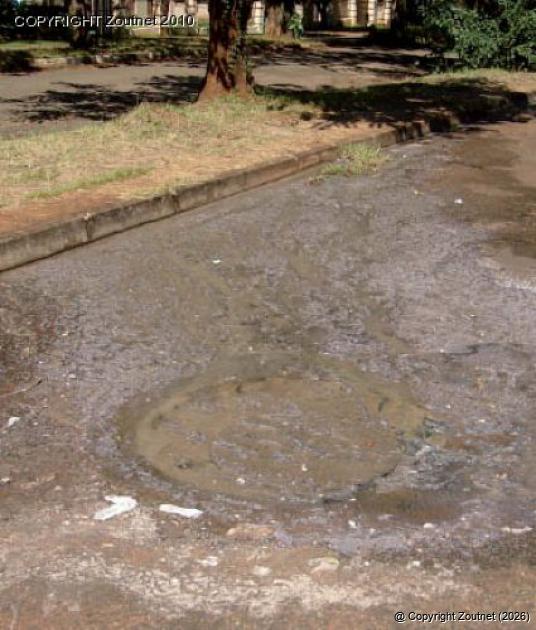
Just one of the numerous sewerage spills in town, right through the year.
Report paints bleak municipal sewerage picture
News Date: 28 May 2010
A lot has been said the last couple of weeks about the Makhado Municipality’s poor rating with regard to waste water treatment (sewerage), following the release of the Department of Water Affairs´ annual Green Drop Report. The municipality has scored a measly 8%. At the beginning of May, the Makhado Municipality’s director of technical services, Mr Thivho Ralulimi, went on national radio during an interview on RSG’s Sakpas, stating that there was no crisis with regard to sewerage in Louis Trichardt. A week later, the municipality’s new municipal manager, Mr Shadrack Tshikalange, however, described the town’s sewerage situation as a disaster. The two completely contradictory statements by two of the municipality’s most senior officials left residents dumfounded and begged the question: How bad is the situation really? As “opinions” may differ on how bad a situation is, as Ralulimi stated in his radio interview, government decided to set standard criteria by which municipalities are evaluated with regard to waste water treatment. This gave rise to the Department of Water Affairs´ Green Drop Report, a risk-based regulatory system which provides early warning signs of plants that contain a certain measure of risk. The report was compiled for the period August 2008 to July 2009, during which only 449 out of the approximately 852 municipal waste water systems (53%) were assessed. This, according to the report, was mainly due to municipalities´ not adhering to the call to be assessed, municipal officials´ not being sufficiently confident in their levels of competence to be subjected to assessments, and municipalities´ not managing waste water services according to expected requirements and therefore not being in possession of management information required for Green Drop assessments. Out of these 449 municipalities, only 203 (45%) of the waste water services systems assessed scored better than 50% in terms of the stringent criteria set. “This implies that, in spite of all the evident shortcomings, the sector is not in complete disrepair,” the report states. This is, however, only with regard to those municipalities who scored above 50%. “However, there remains concern over the 55% (of systems) that scored between 0% and 49%, meaning that drastic improvement is required before the department’s confidence levels in the management practices and abilities of the responsible authorities are fulfilled,” the report continues. The Makhado Municipality falls within this 0% to 49%. Their low score of 8% was due to the fact that they failed to score any points in five of the seven criteria set for assessment. In the criteria for monitoring programme efficiency; regular submission of waste water quality results to the Department of Water Affairs; waste water quality compliance; waste water failures response management; and waste water treatment works capacity, the Makhado Municipality scored 0%. The reason given by the report for giving the municipality 0% was “Not complying with any of the requirements or the complete lack of information”. As for the remaining two criteria, the municipality scored 50% for “process control, maintenance and management skill” and 30% in the criterion “credibility of waste water sample analysis”. Overall, most of the municipalities in Limpopo had low scores. The provincial average for Limpopo was a mere 18%. “The low-scoring authorities will be placed under close surveillance, with the objective of ensuring improvement,” states the report. It mentions that “It was found that most facilities in the rural areas and smaller towns are not adequately equipped with staff of appropriate skills, and this constrained the performance of these systems in their overall Green Drop performance.” For members of the Soutpansberg Ratepayers Association, the report confirmed what they have been stating all along, namely that the Makhado Municipality’s waste water treatment capabilities border on disaster. As for low-scoring municipalities, the report concludes by stating that: “The Department will expect acceptable plans for sustainable rectification from all water services authorities to ensure a definitive turn-around of the South African waste water business. The implementation of these plans will be monitored and failure to comply will necessitate firm action.”
Written by
Andries van Zyl
Andries joined the Zoutpansberger and Limpopo Mirror in April 1993 as a darkroom assistant. Within a couple of months he moved over to the production side of the newspaper and eventually doubled as a reporter. In 1995 he left the newspaper group and travelled overseas for a couple of months. In 1996, Andries rejoined the Zoutpansberger as a reporter. In August 2002, he was appointed as News Editor of the Zoutpansberger, a position he holds until today.

ADVERTISEMENT: