
ADVERTISEMENT:
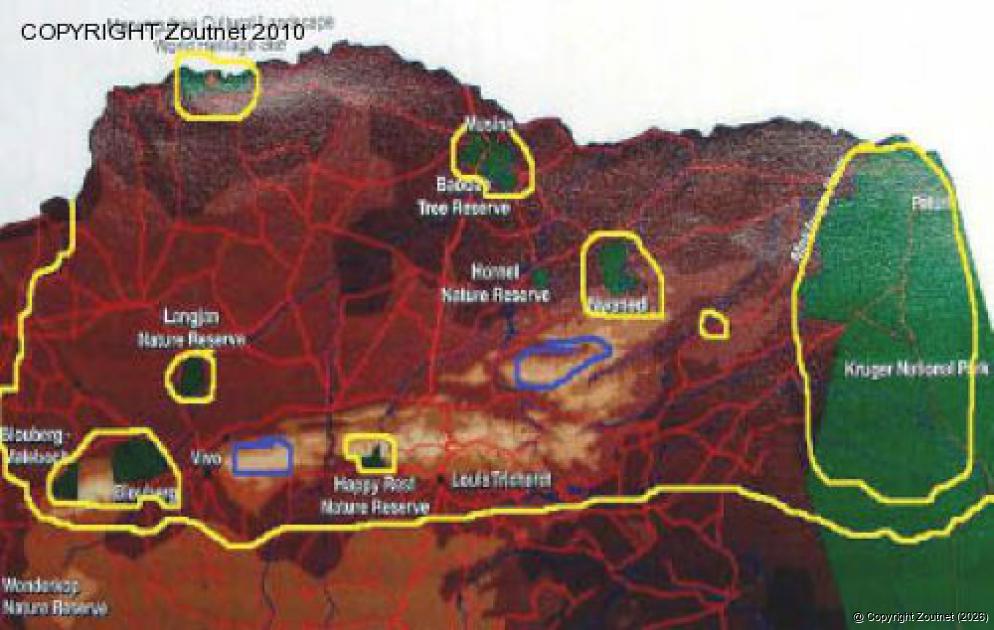
The Vhembe Biosphere Reserve has been internationally recognised by UNESCO. The reserve includes two recognized centres of biodiversity and endemism, the Soutpansberg and Blouberg. It includes the biodiverse northern part of the Kruger National Park, the Mapungubwe National Park and World heritage site, several provincial nature reserves, and the Makgabeng Plateau with more than 1000 rock art sites. Map supplied.
Vhembe Biosphere Reserve internationally recognised
News Date: 04 June 2010
For almost a year now, the Vhembe Biosphere Reserve has been enjoying international recognition by UNESCO. There are just over 500 biospheres worldwide. In South Africa, there are six, three in the Cape and three in Limpopo, with the Vhembe Biosphere Reserve (VBR) the latest addition. The other two biospheres in Limpopo are the Waterberg Biosphere Reserve (WBR) and the Kruger-to-Canyon. Local environmentalists from the Soutpansberg initiated the process, whereafter the MEC of Environmental Affairs endorsed the nomination and sent it to UNESCO in Paris, France. Stringent criteria applied and UNESCO declared the area as a Biosphere Reserve in June 2009. The VBR covers five local municipal areas of the Limpopo Province. They are Blouberg, Musina, Makhado, Thulamela and Mutale. A portion of the Kruger National Park, north of the Shingwedzi River, is also included. “The eastern border is formed by the Mogalakwena River and the southern border extends roughly from just south of the Blouberg - Makgabeng and Soutpansberg Mountain Ranges, across the Luvuvhu River catchment, to the east. The northern and eastern boundaries are formed by the international boundaries with Botswana, Zimbabwe and Mozambique. The size of the VBR is approximately 30 701 km2," states the documents supplied by Drs Karen Steenkamp, Manager of Environment Special Projects, and John Rosmarin. The Vhembe Biosphere Reserve area is recognized internationally for its wildlife and its unique biological and cultural diversity. According to the official documentation, the reserve includes two recognized centres of biodiversity and endemism, the Soutpansberg and Blouberg. It includes the biodiverse northern part of the Kruger National Park, the Mapungubwe National Park and World heritage site, several provincial nature reserves, and the Makgabeng Plateau with more than 1000 rock art sites. Rosmarin explains why the Soutpansberg is one of Southern Africa’s “most bio-diverse areas and has one of the country’s richest natural assets.” The mountain covers less than 0.5% of the surface area of South Africa, but it contains 30% of the tree species, 48% of the genera of flowering plants, 60% of the bird species, 40% of the mammals, 30% of the amphibians and reptiles and 70% of the 66 families of spiders. “By comparison, the whole of Canada (9 220 970 km2) has 3160 plant species as against the Soutpansberg’s about 3000 species in a tiny area of some 6800 km2! In fact, the Soutpansberg Mountain has been equated to an island such as Madagascar, where one finds a specific micro-climate which has resulted in an extremely bio-diverse environment having many endemic species of plants and insects,” Rosmarin said. “Altogether, 594 tree taxa are known in the Soutpansberg, one of the highest counts for southern Africa, and approximately one third of all known trees of southern Africa,” writes Dr Norbert Hahn in Tree list of the Soutpansberg. Hahn and other local experts formed the Soutpansberg-Limpopo Biosphere initiative and published A first synthesis of the environmental, biological and cultural assets of the Soutpansberg in 2003. They played an important role and laid a foundation for the eventual recognition of the VBR. What are the advantages of a biosphere reserve? Rosmarin summarized some of the important advantages that arise out of the declaration of an area as a Biosphere Reserve. * It integrates the current wild life and tourism industry with the cultural assets of its people, to jointly promote the sustainable utilization of the area for the benefit of all its stakeholders. * It empowers local communities to take responsibility for the development and conservation functions of the areas in which they live and to contribute towards their economic upliftment. * It provides a framework within which current legislation through, for example, Integrated Development Plans (IDPs) can be used to improve planning, development and conservation in a region. * It helps to create partnerships between private sector, community structures and Government in order to share knowledge and co-operate in solving natural resource problems. Steenkamp adds that the concept of a biosphere is well known in Europe and tourists are attracted to the idea of visiting a biosphere reserve.
Written by
Linda van der Westhuizen
Linda van der Westhuizen has been with Zoutnet since 2001. She has a heart for God, people and their stories. Linda believes that every person is unique and has a special story to tell. It follows logically that human interest stories is her speciality. Linda finds working with people and their leaders in the economic, educational, spiritual and political arena very rewarding. “I have a special interest in what God is doing in our town, province and nation and what He wants us to become,” says Linda.

ADVERTISEMENT: