

ADVERTISEMENT:
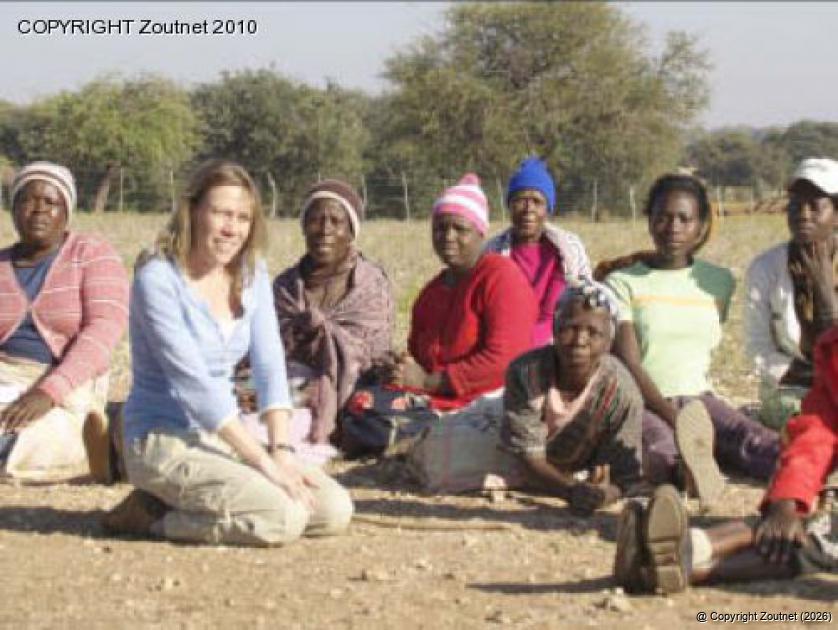
Sarah Venter alongside the women she has hired in Northern Limpopo´s Venda region to gather baobab seeds for the production of baobab oil.
Baobab trees now a source of income for many
News Date: 18 June 2010
In the dusty soil of the Venda region grows a familiar tree that bears the fruit for an unfamiliar product.
The baobab tree, now protected by South African legislation, is being harvested by locals in the Venda region for the manufacturing of cosmetic oil under the direction of a local entrepreneur, Sarah Venter from Louis Trichardt.
Venter is employing members of South Africa’s impoverished northern community to collect baobab seeds for the production of baobab oil, a vitamin-rich skin moisturizer.
“The number of workers basically went from 20 to about 1,500 in six years´ time,” Venter said.
She trades seeds for cash at 23 villages in the region, visiting each of them twice every month, once to collect seeds and once to pay the workers.
To start her business, Venter approached the chief of a local village to ask if she could buy baobab seeds from the region’s densely populated baobab area. The chief consented, and after investing what Venter called “a fair amount of personal capital,” she had herself a business.
The resource, baobab fruit, matures in early winter and then drops from the tree. Workers pick up the fruit, crack open its outer shell, remove the seeds and sell them to Venter. The workers have no set schedule, allowing them to work in whatever available time they have throughout the month.
Venter employs workers who practice, for the most part, a livelihood strategy - they work wherever they can. This may include collecting marula fruit when they are in season, thatching roofs for villagers or providing other labour services for whoever can pay.
Due in part to the urban migration trend amongst men in Venda, Venter’s workers are around 95% women. Each worker earns on average around R500 per month from the Baobab seed sales, but there is no limit to how much they can pick and earn.
After Venter has purchased seeds from the villages, she takes them to a screw press where the oil is extracted and then filtered to remove impurities. Unlike many cosmetic body oils, Venter’s oil remains unrefined. She prefers to keep the oil pure by allowing many naturally occurring elements to remain in the product.
The oil contains Omega 3, 6 and 9 fatty acids, making it desirable for moisturizing skin and aiding in the healing of dry problem skin. It can aid in the healing of many skin problems like dry psoriasis, eczema, sun spots and stretch marks.
She distributes her line of cosmetics all over the country, mostly in health shops.
“They are most popular in Durban and Cape Town right now, but the market is continuing to grow,” Venter said.
Because the trees enjoy a dry season, the Venda region is ideal for the Baobab. The trees mainly grow north of the Soutpansberg in South Africa, stretching up as far north as Kenya and Senegal.
Among the Venda people, Venter said, eating the Baobab fruit used to be commonplace. But people on the reserve have moved away from utilizing land resources for food and income in recent years, so protecting the tree has lost importance in the community.
As a result of Venter’s project, now that the tree can be seen as a source of income, many of the people in the region make certain to protect it.
For Venter, protecting and studying the tree is a major part of her life. She is currently working on her Ph.D. from Wits University in Johannesburg, studying the ecology and sustainable utilization of the baobab fruit.
As a Venda-speaker herself, Venter enjoys the unconventional relationship she holds with the Venda workers. Through her project, she has been able to create a network of economic support for the struggling community, connecting the Venda to local jobs.
Written by
Scott Schmidley

ADVERTISEMENT: