

ADVERTISEMENT:
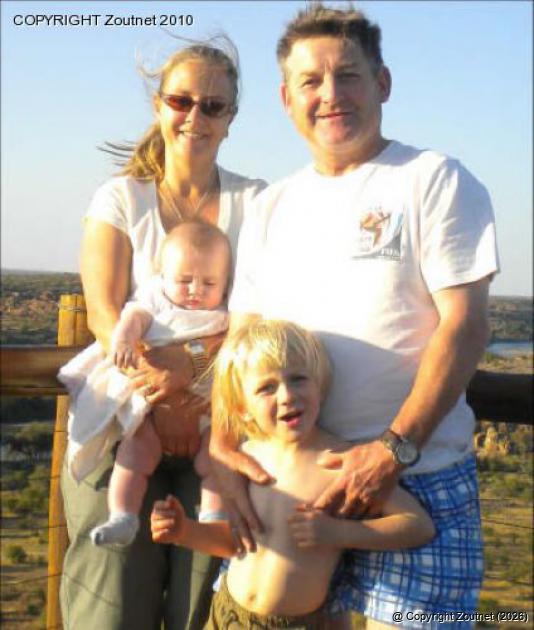
Nigel and Dina Rushton with their two sons, pictured at Mapungubwe during their recent visit to the Soutpansberg. Photo supplied.
British family finally home, no thanks to Home Affairs
News Date: 20 August 2010
The ignorance and arrogance of Home Affairs officials in Louis Trichardt brought an abrupt end to the excitement and positive experience they had had of South Africa, following the recent Soccer World Cup.
This is according to Mr Nigel Rushton of London, England. The Rushton family was one of the thousands of overseas visitors who flocked to South Africa to join in the euphoria of the international soccer spectacle.
Their dream vacation, however, turned into a nightmare when Nigel and his wife, Dina, tried to extend their baby son’s visa. On entry at OR Tambo airport, the Rushton’s were given normal visas, but five-month-old Benjamin’s visa was for two weeks less than required for the duration of their stay. Their stay included a visit to Dina’s parents, Koos and Nellie Wolmarans of Louis Trichardt. Benjamin travelled on his British Passport, due to the 16-week processing time for his South African Passport being greater than the period between his birth and the time of the Rushtons´ World Cup holiday departure.
“Immigration at the airport explained that we had to apply for an extension on his behalf through the Home Affairs or we would be fined [R1 000) and not be allowed to return to South Africa. This we did six weeks before our return at the Home Affairs office in Louis Trichardt,” Nigel said. He said initially they were impressed with the service they received from an officer called Richard.
Things soon went from good to bad, however, when the application the local Home Affairs office had sent to the Pretoria office went missing.
“We requested a letter to present to immigration at the airport to confirm that we had made the application, but it was refused. Richard had agreed that it was a reasonable request at first and began to write such a letter, but was instructed not to continue by his deputy manager”.
From this point forward, the Rushtons received no joy from the local Home Affairs office.
Three days before their departure, the Rushtons´ situation became desperate. At that stage they were instructed to make another application, which was to be faxed to Pretoria. This was done, but again to no avail. A strike by Home Affairs officials in Pretoria on July 30 also did not help.
Nigel again asked for proof that they had made an application. Again the local Home Affairs office refused. This was despite a call by Nigel to the British Consulate, who informed him that Home Affairs could not refuse such a request.
By the evening of July 30, the Rushtons had spent 67 hours during seven visits and phone calls, trying to sort out their son’s visa.
“I tried to extract an explanation for the decision not to give us confirmation, but received obtuse answers or none at all,” Nigel said.
“Most infuriating was the blatant manner in which the managers ignored direct questions. One female staff member, chewing gum and leaning on the dividing counter, summoned us by banging her knuckles on the counter top and rolling her eyes in an appointed direction. When we asked her questions, she would look disapprovingly at us and wryly smile at her colleague as though the whole thing was a cruel game,” said Nigel.
In desperation, Nigel called the Director of Investigation at the OR Tambo immigration office.
“I spoke to a lady called Pinky, who called back six hours before our flight, assuring us that she understood the situation and we would be allowed through if all else was in order”.
The Rushtons eventually got home, but, as Nigel stated, “no thanks to the managers in charge at the Home Affairs office in Louis Trichardt. The events that have unfolded during the past weeks are a remarkable example of South African administration at its very worst.”
Nigel said that, if represented by the staff at Home Affairs currently employed in Louis Trichardt, he would be rightly ashamed.
“Ironically, the Home Affairs employees were on strike for increased salaries. May I suggest that the money be spent on improved customer service training,” Nigel said. On the positive side, Nigel said his general experience of the World Cup organisation was very good.
“I propose Louis Trichardt Home Affairs ask FIFA to lend a hand,” Nigel said.
Over the past two weeks, the Zoutpansberger made several attempts to elicit a response regarding the Rushtons´ treatment at the hands of local Home Affairs officials. On August 5, a call was made to Ms Siobhan McCarthy. Her voicemail directed all media enquiries to a “Ronnie”. Ronnie was phoned, and he instructed the newspaper to send through Mr Rushton’s statement via e-mail to him for comment. This was done the same day. By August 12, no response was received and another e-mail was sent to Ronnie, asking him for comment. By August 16, an SMS, as per her voice mail request, was sent to Ms McCarthy, asking her to comment. On August 17, all media enquiries and Mr Rushton’s statement were sent through to the Home Affairs offices in Pretoria. On the same day, Ms McCarthy replied by SMS, stating that she no longer worked for Home Affairs, although their website still lists her as chief director of communications. When asked if Ronnie was the new spokesperson, Ms McCarthy replied by SMS: “Yes, Ronnie is the person to speak to”.
At the time of going to press, the Zoutpansberger had still not received any response from Home Affairs.
Written by
Andries van Zyl
Andries joined the Zoutpansberger and Limpopo Mirror in April 1993 as a darkroom assistant. Within a couple of months he moved over to the production side of the newspaper and eventually doubled as a reporter. In 1995 he left the newspaper group and travelled overseas for a couple of months. In 1996, Andries rejoined the Zoutpansberger as a reporter. In August 2002, he was appointed as News Editor of the Zoutpansberger, a position he holds until today.

ADVERTISEMENT: